

Health plan tackles lamb losses
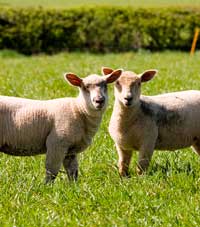
Advanced grassland management, good record-keeping and a willingness to take independent advice on health planning have helped dedicated shepherds John and Edward Higgins consistently improve flock productivity at Frodesley Park Farm, Longnor, Shropshire.
Always keen to learn, the father and son partnership participated in a West Midlands flock health planning project co-ordinated by ADAS in 2007. They found the experience highly beneficial, and it has been the springboard for a number of improvements implemented over the past two years that have boosted profitability.
The Higgins run 1000 Suffolk x Mule ewes put to Texel rams on 81ha (200 acres) of grassland, plus rented land for growing and grazing stubble turnips in winter. In addition, about 200 Suffolk x Mule ewe lambs are put to Charollais rams each year. Lambing starts in February for the older ewes and continues in batches through to April with the ewe lambs. The bulk of the flock, about 850 ewes, lamb over a concentrated 10-day period in March.
All lambs are creep fed from an early age and finished on the farm from May onwards. Lambs are sold through Shrewsbury livestock market and May Hill lamb group. The farm buildings are also used for finishing 1600 pigs on contract through the summer and autumn.
Son Edward takes a keen interest in grassland management and has progressively reduced concentrate input by experimenting with Aber high sugar grasses and chicory. The focus has paid off and improvements in both summer and winter forage (hay) quality have helped cut input costs.
“By investing in high quality grass reseeds and productive alternative forages we’ve definitely cut our concentrate bill,” Edward says. “But we’ve found the focus on health planning in recent years has also improved returns.”
John points out they were keen to participate in the health planning project because they felt a number of issues were holding them back. “We were particularly concerned about lamb losses, having lost a lot in 2006, mostly from unknown causes. Edward has always been pretty good about keeping records, but we’re weaker at reviewing performance and identifying problems. This is where involvement in the project was so useful. Help with analysis of our own records has been enlightening, providing accurate information on which to base decisions.”
With support and advice from ADAS sheep consultant Kate Philips and vet Benno Veenstra from Stapeley Vet Practice in Minsterley, the in-field lamb losses were targeted as a major area for improvement. Other objectives included improving the lambing performance of the ewe lambs, reducing anthelmintic usage and cutting lameness.
 |
|---|
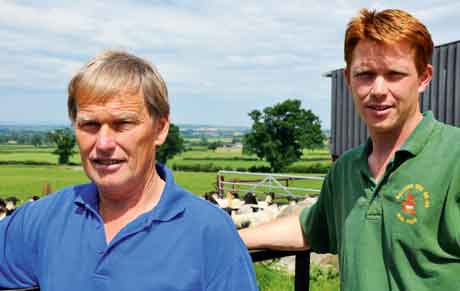
| Tackling mid-season lamb losses and higher than average barren rates has proved worthwhile, helping lift profitability for John(l) and Edward Higgins. |
“In 2006, 82 lambs were lost post turnout and half of these losses were from unknown causes. We suspected clostridial diseases and/or pasteurella, pointing out that although the ewes had been vaccinated with Heptavac-P Plus any passive immunity from colostrum would have long since waned. Immunity against pasteurella only lasts for up to three or four weeks and only up to 12 weeks for clostridia.”
As a result, in the spring of 2007 all lambs were vaccinated with Ovivac-P Plus twice – four to six weeks apart – as recommended by the manufacturer. The preventative approach halved the lamb losses and produced a net gain of £1033 that year after the cost of the vaccine and labour were taken into account.
Vaccination has continued for the finishing lambs against clostridial diseases and pasteurella because it more than pays for itself, says Edward. “It’s hard to take when you are picking up dead lambs in August when they are so close to finishing – and at recent prices it’s even more painful. Add in the costs of disposal too and vaccination becomes even more cost-effective.”
Lambing performance of the ewe lambs was also identified as an area for improvement. Three years ago the barren rate and lamb losses from ewe lambs were high as a consequence of abortion problems. Blood samples of barren ewes and any animals aborting indicated toxoplasma and campylobacter were both implicated. As a result of ewe vaccination pre-tupping, scanning results have improved each year since and fewer ewe lambs have aborted.
Significant progress has also been made on the lameness front, thanks to a zero tolerance policy. All ewe lambs and tups are vaccinated against footrot and any persistently lame ewes are culled, explains John Higgins.
“We’ve enjoyed learning from the experts and the other farmers who participated in the ADAS project. As a result we’ve also developed a much closer association with our vet Benno Veenstra and it has definitely reaped dividends.”