Farmers frustrated as trailer weight increase abandoned
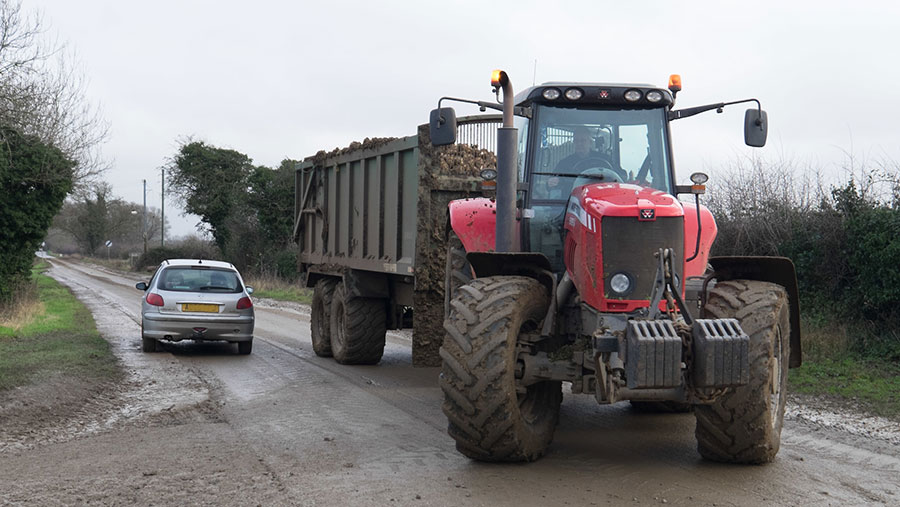 © Tim Scrivener
 The government has infuriated farmers and contractors by ditching plans to increase the on-the-road weight limit for agricultural trailers.
Farmers and contractors voiced their frustration after the Department for Transport (DfT) said it would not proceed with increases to the combination weight limits of tractors and trailers.
The maximum combination weight of a tractor and single trailer was increased from 24.39t to 31t in March 2015.
But the maximum laden weight of a trailer alone remained unchanged at 18.29t.
See also: Trailer weight increase moves a step closer
An increase in the trailer weight limit was expected in second phase of changes. But the government said it will not proceed any further with regulatory change.
Frustration
Norfolk farmer and contractor Rob Alexander, who grows sugar beet and vining peas as well as combinable crops, described the decision as frustrating.
Mr Alexander, who farms at Pulham Market, said: “The fact that legislation isn’t able to keep up with the size of farm equipment is very disappointing.”
He added: “I would like to see some sort of MoT or regular official check if it meant I could send my guys out legally and with a clear conscience that everything is being done properly.”
Mr Alexander said his arable farming and contracting business already operated its own self-check system and all his kit was on commercial running gear.
“It would be nice if it was officially recognised, rather than just being our way of doing it.”
Martin Hays, chairman of the National Association of Agricultural Contractors (NAAC) said: “We feel very let down that the government has chosen to hold back our sector.”
Current legislation on trailer weights is 30 years old, said Mr Hays.
The law has failed to kept up with advances in farm machinery and agricultural engineering – and the pressures faced by the farming industry, he added.
“Brexit will add further challenges to compete on a world market and it is essential that contractors and farmers have the tools available to work efficiently and safely.
Brexit will add further challenges to compete on a world market and it is essential that contractors and farmers have the tools available to work efficiently and safely Martin Hays, National Association of Agricultural Contractors
“This means higher trailer capacities to keep vehicle movements on the road to a minimum, while keeping up with larger harvesting machinery in field.”
Adequate increase
Mr Hays said the NAAC had spent the past eight years working with the government to secure an adequate increase in the trailer weight limit.
“To be told that further trailer weight increases will now not take place is a severe blow,” he said.
The NAAC had accepted the industry would need roadworthiness testing and possibly changes to driver testing before moving to higher weights, said Mr Hays.
The NAAC would be seeking formal clarification from the government for the reasons behind the DfT’s decision, he added.
A spokesmen for the DfT said: “Further analysis has show that the limits set in 2015 struck the right balance between the costs and benefits of higher weights.
“To further increase the permitted trailer weights would be expected to lead to significant additional wear on road surfaces, costing about £25m/year.
“The government is conscious of the effect that such an outcome would have on rural road users and the burden it would place on authorities responsible for road maintenance.”
As such, the government had decided not to proceed further with regulatory change.
The department said the government is not considering the introduction of mandatory roadworthiness testing for tractors and trailers used for agricultural purposes.
But it said it reminded operators that it was a legal obligation to keep vehicles in a roadworthy condition.
“We welcome industry initiatives around voluntary vehicle testing and the DfT will engage with stakeholders to help facilitate this where possible.”