Versatile boom spreader does four jobs for Norfolk farm
 © James Andrews
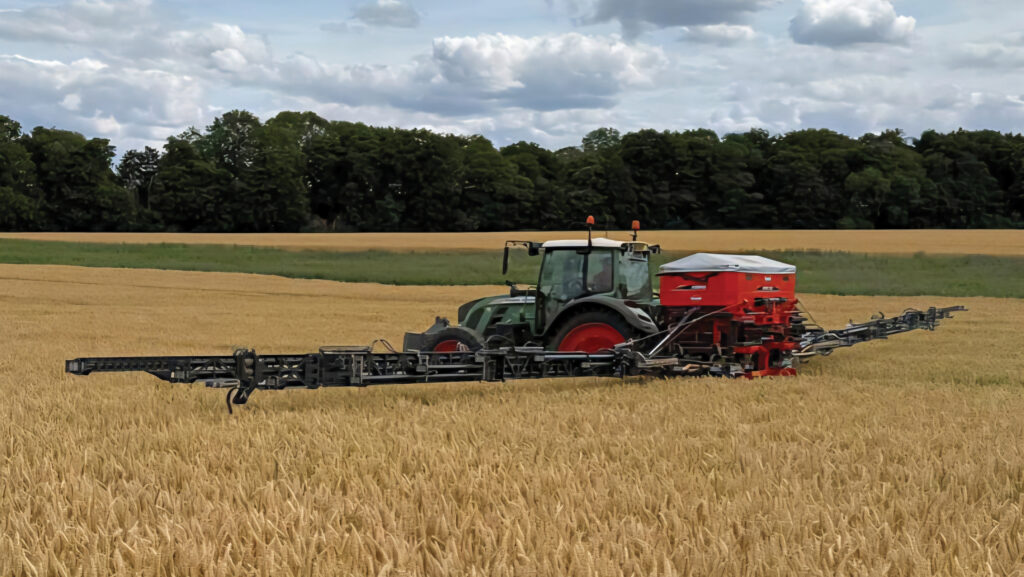
 Finding himself perilously short of sprayer capacity in the spring, Lee Oakes took the decision to bolster his machinery arsenal with a granular boom spreader.
Up to this point, liquid fertiliser was the primary method of crop nutrition at Foxburrow Farm, near Dereham, which Lee manages for the Goff family.
See also: Forward-control Fastrac ups spreading output by 30%
But with their self-propelled Horsch PT280 and trailed Leeb 6LT struggling to stay on top of the 2,500ha estate’s workload, some granular support was required.
The only problem was that, having got used to the pinpoint precision of applying nutrients via a nozzle, Lee was loath to go back to spinning discs.
And though a pneumatic machine would provide the obvious solution, it would be a big outlay to justify if it was only going to be applying fertiliser.
Lee Oakes © James Andrews
As luck would have it, he was also on the hunt for an Avadex applicator and extra slug pelleter, as well as a method of broadcasting stubble turnips and crimson clover into a standing crop.
If he could find a tool to do all four, the investment would stack up nicely.
That’s when he came across Kuhn’s Aero 32.1. “It was the only serious contender and once I’d had a chat with Oli Bensted at Farol and Edd Fanshawe at Kuhn, I was convinced it could do everything we needed,” says Lee.
How it works
In its standard setup, the Aero has four hydraulically driven metering units that deliver prilled and granular fertilisers to 24 spreader plates dotted across the boom.
Working widths are more limited than conventional spreaders, with just 27m, 28m or 30m options available. However, the latter fitted perfectly with the farm’s existing tramlines and controlled traffic system.
These separate units give the machine four automatically adjustable sections, allowing application rates to be varied across the working width, as well as offering staged switching at headlands to minimise overwraps.
In addition, the spreader has two weigh cells that constantly monitor how much product is left in the hopper.
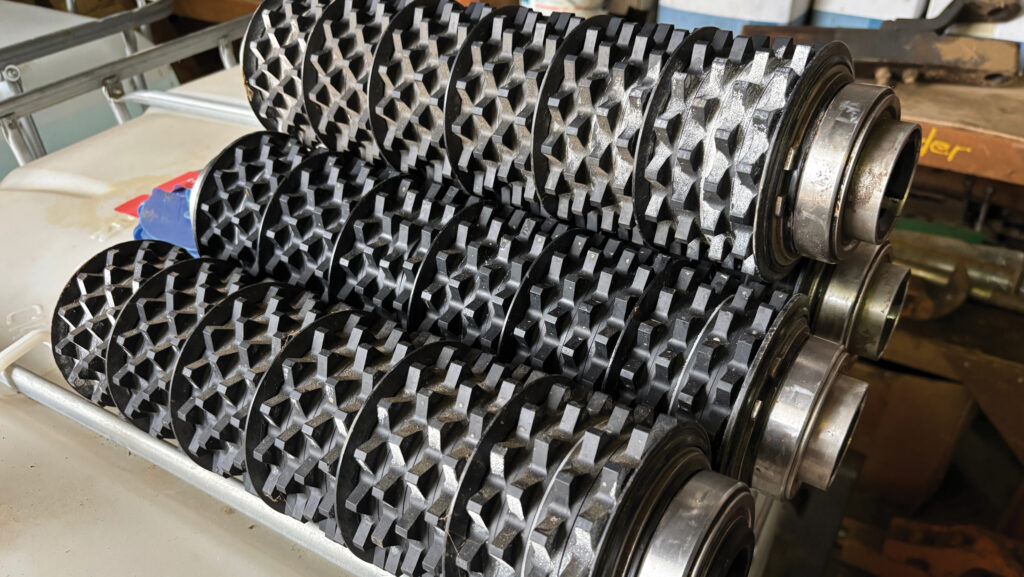
Regular spiked rollers © James Andrews
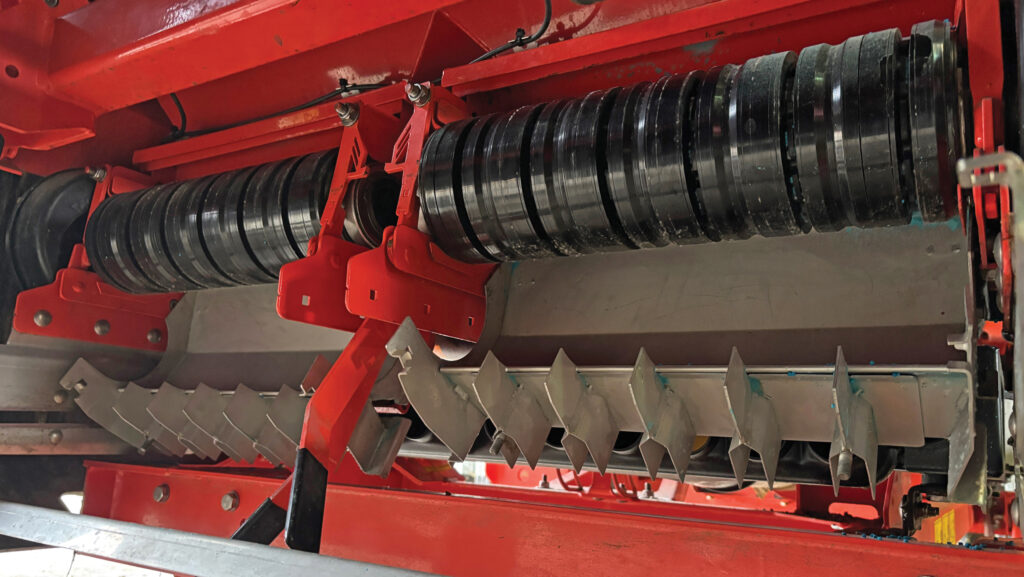
Grooved rollers © James Andrews
Swapping to Avadex, slug pellets or small seeding mode is a straightforward process that involves changing the spiked roller in each metering unit for a grooved alternative.
These are an option, which Lee ensured were included in the deal.
Other extras included a hopper extension that bumps the capacity from 1,900 to 3,200 litres, and automatic boom levelling with two ultrasonic sensors.
All this gear took the total outlay to about £66,500.
Spreading accuracy
Shortly after the spreader arrived in January 2024, it was put to work applying bagged fertilisers in the spring, allowing the sprayers to focus on herbicide and fungicide applications.
Accuracy has been spot-on, with it delivering the product evenly and using precisely the right amount.
“There’s barely a gram of difference between what you set it to and what’s left in the hopper at the end of the job,” Lee says.
Another bonus of the granular spreader is that it avoids scorching crops, which can occur with liquid applications in particularly hot summers.
The only penalty is weight, with the machine tipping the scales at about 2.2t empty and 5.5t when fully loaded.
As a result, the Fendt 724 up front needs to be teamed with a 1,200kg front weight to keep the outfit balanced.
The complex boom also means the Aero is more easily damaged than a conventional spinner, so care needs to be taken when threading it down tree-lined lanes.
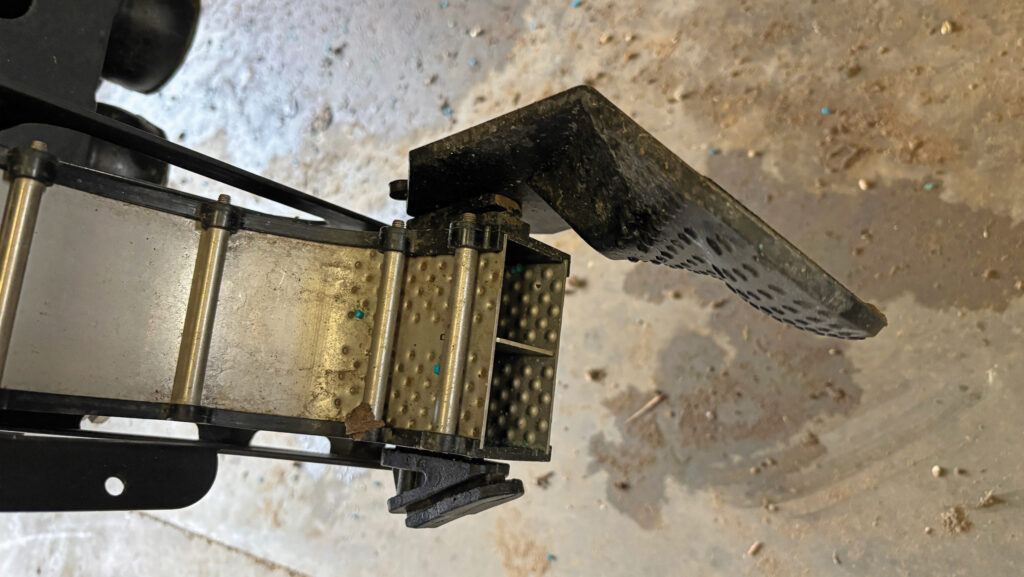
One of the 24 boom outlets © James Andrews
Stubble turnips
Though the extra fert capacity has been a boon, a bigger bonus has been the way in which the Aero has transformed stubble turnip establishment.
Previous attempts at planting the crop with a Horsch Avatar – alongside a crimson clover companion – had delivered disappointing results, largely due to the compressed growing season.
As the drill could roll only once the harvest was complete, establishment would often take place in mid-August.
The beauty of getting a strong stubble turnip and crimson clover crop is that it brings a chunk of extra revenue from ground that would otherwise be lying dormant over winter.
“We grow spring malting barley, grain maize, combining peas and vining peas, so there’s usually about 300ha we can make use of,” says Lee.
“But because the turnips never came to much, it limited the number of livestock we could support over the winter months.”
At present, the farm runs a 110-cow pedigree Red Poll herd and 1,600 ewes, with store lambs bought in depending on how much fodder is available. This year numbers are up to 3,000.
Some stock is sold commercially, but an increasing number are being butchered locally and retailed through the farm’s online shop – see “Foxburrow Farm online shop”.
Improved yields
The Aero’s stubble turnip seeding abilities were first tested in 2024, with a small area broadcast into a crop of wheat in mid-June.
It established well, and with roughly a two-month head start over conventionally drilled crops, it outperformed them massively.
“With later sown crops we might only get about 10 days’ worth of grazing out of them, but now we can get six weeks or more – we started in mid-September this time and have been able to strip graze to get the most out of it.”
It should be a good earner, too. “If you do some fag packet sums, working on 15 lambs/ha at a £140 margin, that’s a potential £2,100/ha profit,” says Lee.
Then there’s the fertility and soil conditioning bonus of having stock on the land which, though harder to quantify, has long-term benefits.
The only challenge of using the Aero for this task was selecting a suitable seed-rate, as Kuhn doesn’t provide one.
After a bit of guesswork, he opted for 2kg/ha of clover and 7kg/ha of stubble turnips, assuming that a good portion of the seeds wouldn’t grow.
“As it happens, most of them did, so we’ve got a lot of plants per square metre,” he says.
“I’ve considered dropping back to 4kg or 5kg/ha, but the sheep seem to like the small turnips, so I might stick as I am next year and just do a trial plot at the lower rate.”
Speedy and cheap establishment
Another perk is the speed at which the Aero can cover the ground, with 200-250ha easily achievable in a day, compared with 70-90ha using the Avatar.
It’s cheap, too, with establishment costs sitting at £15-£16/ha, plus £3/ha for seed.
And because the payload is considerably lighter than fertiliser, the farm’s smaller Fendt 516 is enough to handle the task.
This frees up the 724 to do other work and helps Lee balance the number of hours he puts on each tractor.
The only challenge is loading small bags into the hopper, as the machine has no steps or access platform.
Thankfully, only one fill a day is required when sowing stubble turnips, so it’s not too much of a hardship to use a stepladder.
Fertiliser loading is simpler, as the cover can be opened using a lever that’s operated from the ground.
Generally, he buys in bulk, so the product is tipped in using an adapted bucket. And for bags, the team has fashioned a long-handled knife to slice them open.
More crops planned
The spreader is being used to establish an increasing portion of the farm’s Countryside Stewardship and Sustainable Farming Incentive mixes, most of which are put together on farm from straights blended in a concrete mixer.
Next, Lee plans to experiment with broadcasting oilseed rape into standing crops.
The hope is that it will establish as well as the turnips and benefit from the sheltered microclimate under the canopy.
“Timing will be the key thing, particularly when it comes to flea beetle migration,” he says.
Foxburrow Farm online shop
A growing portion of meat produced by the farm’s pedigree grass-fed Red Poll cattle and sheep herd is being sold through the Foxburrow Farm online shop.
It’s butchered locally before being frozen on site, packaged and delivered throughout the UK.
Buyers can opt for mixed beef or lamb boxes containing a selection of prime cuts, mince and burgers, or put their own custom shopping list together.
Kuhn Aero 32.1
Hopper 3,200 litres (1,900 litres without extension)
Boom width 30m
Metering Four hydraulically driven units
Outlets 24
Price paid £66,500 (in 2024)