How to get ultra-accurate RTK guidance for £1,100
 © MAG/Oliver Mark
 Once the preserve of the generously acred, ultra-accurate RTK guidance is now a financially viable option for farms of a princelier scale thanks to fit-it-yourself kits powered by open-source software.
For little more than £1,000, buyers can assemble everything required to have their combine running arrow-straight, sprayer nozzles opening automatically, or the tractor completing a hands-free headland turn.
And they needn’t be particularly tech savvy to get an autosteer system plumbed in and tuned up, no matter the age or type of host machine.
Thanks to a benevolent online community of farmers – led by the godfather of open-source coding, Canadian grower Brian Tischler – most of the legwork has already been done.
See also: UK made kit converts any tractor to RTK autosteer for £3k
The software is shared on his AgOpenGPS repository, free to download, and regularly added to by computer-literate operators across the world.
It now includes all the essentials – guidance, headland turn, section control and variable rate – and an increasing number of isobus implement control functions.
Accompanying hardware costs £1,000-£3,000, depending on whether components are sourced individually or bought as a largely plug-and-play package.
The first apostles of this approach didn’t have it quite so easy, with many devoting hundreds of hours to writing code and soldering finicky circuit boards.
Several of them have now established businesses off the back of their experience, including West Country farmer Charles Quick.
His CSEQ online shop sells both complete retrofit kits and specific parts, including steering valves for tractors that aren’t autosteer-ready and, for those that are, a wiring harness that connects to the canbus system through the diagnostics port.
One of the latest inductees to the Jolly Cheap Guidance Club is Rutland-farmer-turned-YouTuber Tom Lamb. He recently rigged up straight line assistance for his Massey Ferguson Cerea combine and mid-1980s forward-control MF 698 sprayer tractor, with support from another farm-based guidance guru – Andy Ireland of RTK Precision.
Tom Lamb © MAG/Oliver Mark
Assembling a base station
Rather than settle for the drift-prone lines from an Egnos signal or rely on cellular or internet connection for an Ntrip mobile RTK system, Tom opted to put up his own base station.
Though the parts required sound disconcertingly high-tech, they’re widely available online, joining them together is relatively straightforward and the internet is awash with tutorials.
Among the ingredients for this technological stew is a GNSS dome (£50), which Tom mounted on a pole atop the workshop roof.
This is wired into a U-blox F9P RTK receiver (£150) that supports all the major satellites: GPS, Glonass, Galileo and Beidou. Provided it is positioned loftily, it should never struggle for signal.
The receiver is married to a Raspberry Pi 4 minicomputer (£30), to which he soldered a HAT hardware board (£25) and added a cooling fan.
This unit gets both power and internet from a power-over-ethernet (PoE) injector. Aside from the fact that these components will sound alien to the average spanner-wielder, the process is fairly simple.
To get them all working, Tom is using free, open-source software from the Centipede Project. This was uploaded onto the Raspberry Pi from his laptop and left plugged in for 24 hours to establish the antenna’s pinpoint coordinates.
The resulting GNSS RTK correction signal is accurate to 15mm in the locality of the base station, dropping by a paltry 1mm for every kilometre travelled.
There’s a growing network of these free-to-access base stations in England and the east coast of Scotland, and many hundreds of them dotted across France and Hungary.
Die-straight swaths
One member of the Lamb fleet to benefit from this new-found accuracy is the Massey Ferguson Cerea combine, bought over winter to replace an MF 30.
As this has the firm’s Auto Level slope compensation system, Tom fitted dual GNSS antennas on the roof that account not only for its geographical position but also body roll – based on the height difference between the two.
Crunching this data is RTK Precision’s controller (£400), painstakingly assembled by Andy. This also takes a feed from a 5V linear actuator (£30) attached to the combine’s steering ram by two car exhaust clamps.
Steering valve © MAG/Oliver Mark
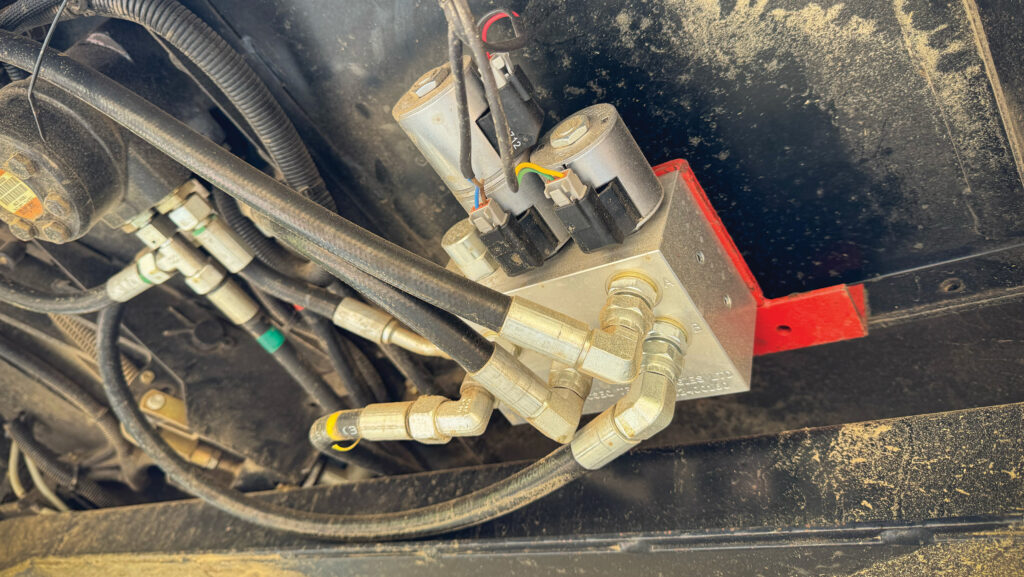
Rather than fit an ungainly – albeit cheaper – electric steering wheel motor, Tom plumbed in one of CSEQ’s hydraulic steering valve blocks (£485).
This is fixed to a bracket under the cab, with pipes teed into the existing hydraulic lines that run to the rear axle.
The block incorporates a Hydraforce proportional valve with a solenoid each for left and right turns, and a safety cut-out that opens a plunger when it receives a 12V feed from a separate on/off box in the cab. This prevents autosteer from kicking in unexpectedly.
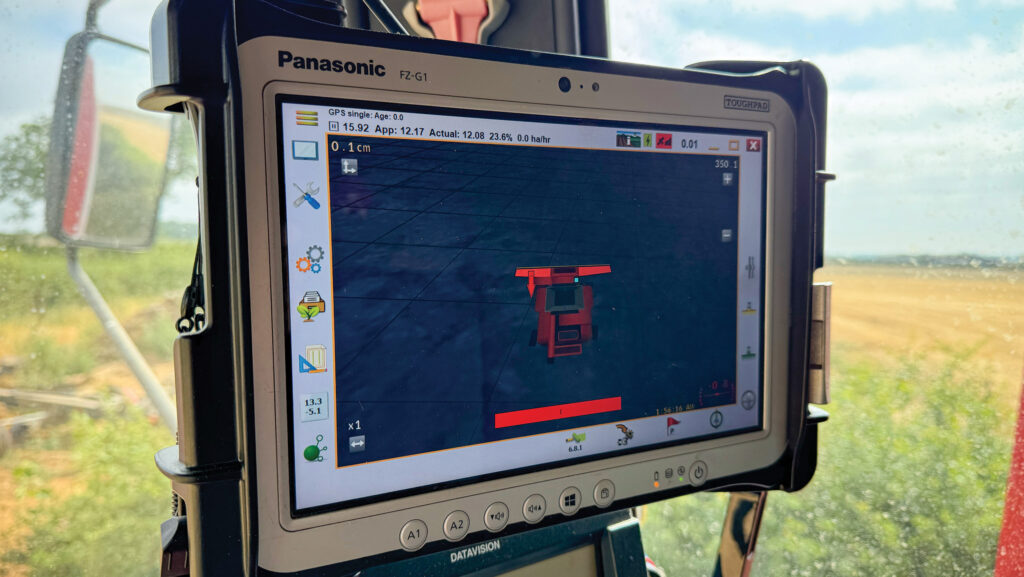
Continuing the budget theme, Tom sourced a second-hand, Windows-based Panasonic ToughPad (£100) – an industrial-spec tablet used by gas meter readers and the like – onto which he loaded the AgOpenGPS user interface.
Panasonic ToughPad © MAG/Oliver Mark
Though it comes with a built-in SIM modem, he has dodged the monthly data subscription by tethering it to his phone. One connected to the cloud, he can load his stored field maps and AB lines, and save revised versions for future use.
As well as straight-line guidance, the system can follow a meandering route along a headland once the field has been mapped, complete an end-of-bout turn automatically at a set distance from the boundary and miss a selectable number of passes.
The next steps are to devise a section control system that will lift one side of the header where the end of a run ends on a sharp angle, and integrate it with the yield monitor to give a more accurate picture of crop performance.
Tom estimates that his current setup would take about three hours to fit and cost about £1,100 by sourcing the components individually.
Alternatively, RTK Precision offers complete twin-antenna kits for £2,750, which Andy is happy to help set up.
Ageing sprayer thrust into the 21st century
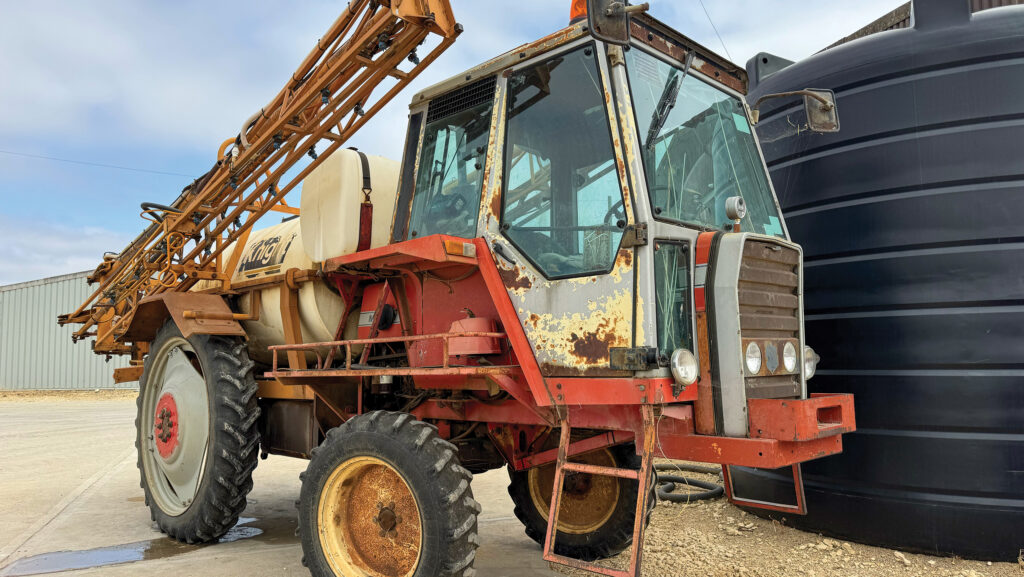
The farm’s forward-control Massey 698 with 20m Knight demount spray pack has been given the same treatment. Doing so means it no longer relies on drill-established tramlines, which will allow Tom to upgrade the current 4m Vaderstad Rapid to 6m.
The fitting process was much the same as the combine. It uses an identical steering valve – this time fitted in the tractor’s nose cone – but with a single roof-mounted antenna and a gyroscope incorporated in the controller box.
This allows for roll compensation, though not as accurately as a twin setup.
The system currently includes guidance and auto turn. Section control – and therefore end-of-bout on/off – is pending.
Budget 8S guidance
Centipede Project software is also guiding the frontline Massey Ferguson 8S.305, which had previously been running on the 15-30cm accuracy of an Egnos signal.
After snorting at the £3,800 quote to unlock its existing cab-mounted dome to access his base station-derived RTK correction signal, Tom devised a workaround. And, with the tractor autosteer-ready, the process was far easier than with the combine and sprayer.
As he was well chuffed with the dual antenna system, he set about replicating it – only this time with next-gen U-blox units on the roof that feed into a Septentrio Mosiac-G5 receiver chip soldered to the motherboard.
This is reckoned to be one of the most accurate GNSS receivers available, offering 6mm accuracy and, thanks to multi-band satellite tracking, better reliability under trees.
Like Tom’s other machines, the system runs on AgOpenGPS software. A wiring harness plugs straight into the canbus system via the diagnostics port, allowing guidance to be engaged and disengaged through the existing joystick button.
He also treated himself to a fancier tablet – a £279 Microsoft Surface Pro 700 – that he can use for general internet browsing.
Despite the minor indulgence, he’s managed to get ultra-accurate guidance on his three main machines for about £3,700 – an outlay soon paid for with a decent wheat yield.