Retrofit PTx OutRun system makes tillage tractors driverless
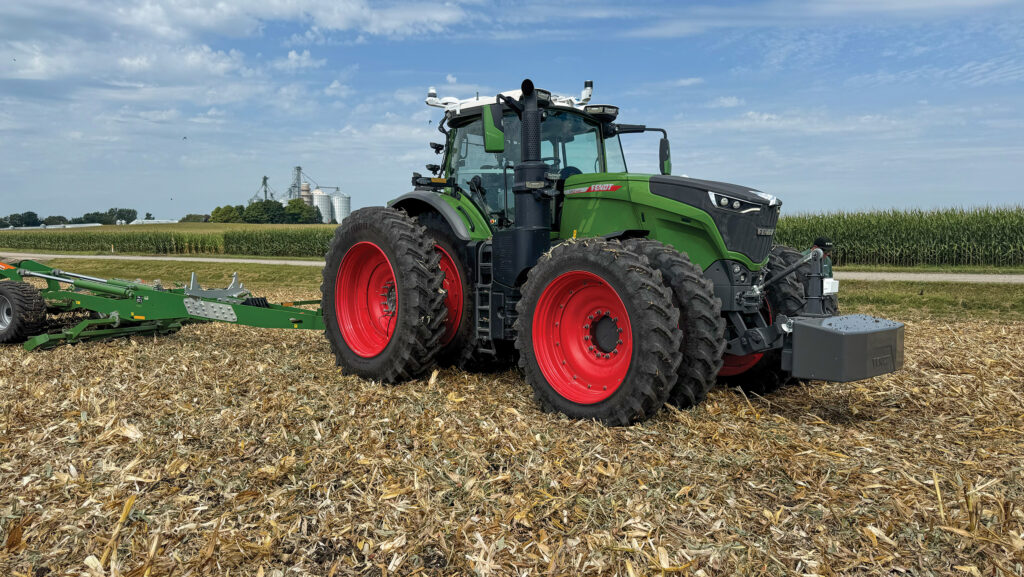 An unpiloted Fendt 1052 pulls Amazone’s TopCut 12000 © MAG/Mark Oliver
Agco has developed a digital driver that can plan and execute a simple field task with little human input.
Simply give it a map and a licence to roam and, like a good rambler, it will find the most suitable route – all while the seat remains vacant.
This virtual farmhand is called OutRun and is sold through PTx, the artist formerly known as Trimble. Much of the hardware and task-planning software emanates from Agco’s acquisition of Canadian ag electronics and software specialist JCA Industries for a reported C$63m (£36m) in 2022.
See also: £50k Sabanto Steward kit gets Fendt 700s working autonomously
The firm has recently been demoing this driver-sometimes-optional system in the US, where vast, footpath-free fields lend themselves to such experiments without risk of flattening a person/dog/pylon.
For now, it can only be used to cart grain or pull a cultivator. But every day’s a school day in the fast-paced world of artificial intelligence, and, in time, the software will be taught how to run a drill, rake and baler.
It must be said that the current system is not ground-breaking. Old foe John Deere already has something similar, which, in true Deere style, is offered exclusively on its own tractors from factory.
Agco, on the other hand, is going down the aftermarket route. From the manufacturer’s perspective, this “retrofit-first” strategy reduces its reliance on new tractor sales, thus opening the door to a far larger market.
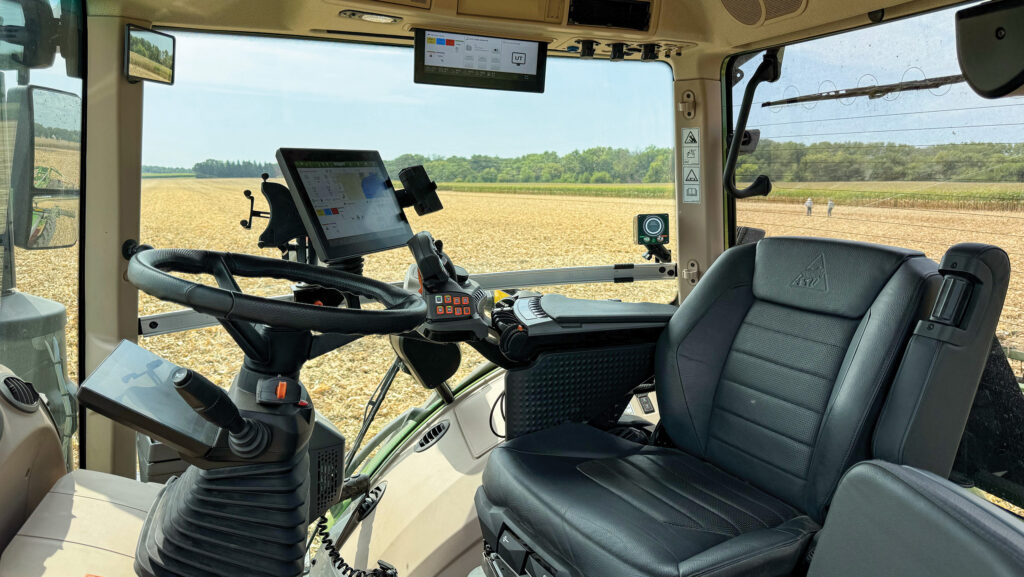
There are no changes in the cab – operators can still hop on and drive © MAG/Oliver Mark
What can it do?
OutRun was initially introduced two years ago as a means of controlling a grain-carting tractor from the combine, a bit like Deere’s 2012-launched Machine Sync.
In this guise, Joe Bloggs in the combine can beckon the unoccupied tractor, control its speed and position as it draws alongside, then dismiss it to the edge of the field once unloading is complete.
This most obviously suits big American and Australian operations where auger-armed chasers run sorties between the harvester and a motherbin or road-going bulker. One-man bands could also benefit from the time saved by unloading on the hoof.
Development of the software has since gathered pace, with a tillage-specific version introduced in July. This will plan a field route and then complete the work, in theory saving hundreds or even thousands of man-hours a year.
In the meantime, operators can get on with other pressing jobs before returning to babysit when necessary. Think of it as an apprentice that’s available at a drop of a hat, without the tea breaks or sick days.
Clearly, cultivating is one of the simplest fieldwork tasks to automate, with relatively few moving parts and, generally, less human input required. Slow, brainless operations such as deep ripping or discing are particularly well suited to driverless operation.
For now, the system can be rigged up on Fendt’s 700-, 900- and 1000-series tractors, and soon the 500s. Compatibility with models from fellow Agco brands Massey Ferguson and Valtra is sure to follow.
It can also be used on Case IH’s Magnum and John Deere 9R and 8R AutoPowrs from model year 2014 onwards. For reasons mentioned earlier, PTx is unlikely to infiltrate many newer Deeres given that they are already available with something similar.
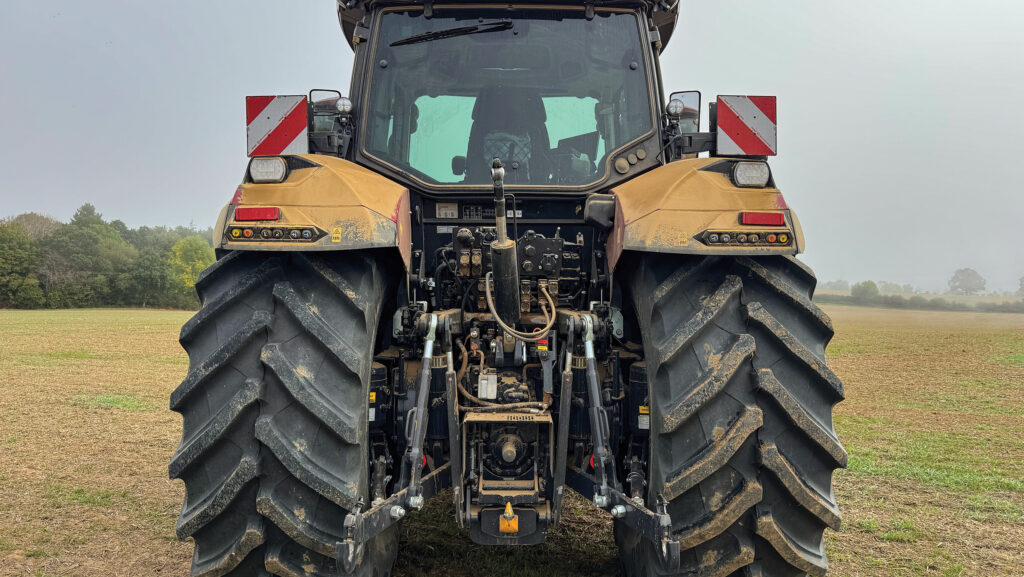
Installation takes about five hours and mainly involves running cables down from the box of tricks on the roof. Once wired up, the kit can be moved between tractors fairly easily.
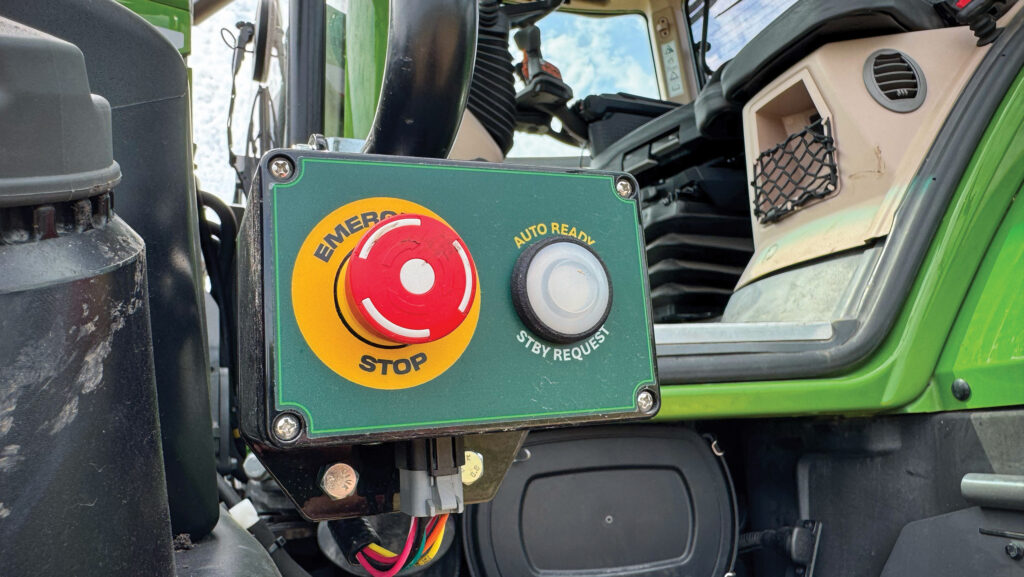
‘Auto ready’ and emergency stop buttons © MAG/Oliver Mark
How does it work?
Despite using similar technology to driverless cars, the highway is out of bounds. Owners must take the wheel between yard and field.
PTx also recommends that they pilot the first lap of the boundary. This makes it accurate, gives them a chance to check that the implement is set up for the prevailing ground conditions and provides an opportunity to spot fallen trees or other obstacles.
Alternatively, maps can be imported from farm management platforms such as FieldsOps, Operations Center or Agco’s Farm Engage. The system will accept the same boundary for three years, after which it must be redrawn to eliminate any risk of line drift.
Either way, this creates a geofence that the tractor will not pass – nefarious Russian interference notwithstanding…
Once established, the mission can be prepared. This step-by-step process requires implement dimensions, a working angle, and in-work and turning speeds. “Go-slow” or “no-till” zones can be drawn freehand on the map, and an end point added for the tractor to be collected or refuelled.
Babysitters can then select one of several work-pattern options, before hitting buttons inside and outside the cab and pressing play on the smartphone app.
Through the app, they can view progress, tractor read-outs such as fuel level and speed, and feeds from the 360deg camera system.
As well as relaying live footage, these four eyes look for obstructions – a responsibility shared with a front-mounted radar (good for seeing through fog or dust) and a lidar sensor.
They are wired into the roof-mounted box, where they meet a high-capacity computer, two receivers – to determine both location and orientation – and a Starlink satellite connection that provides a line of communication to the app.
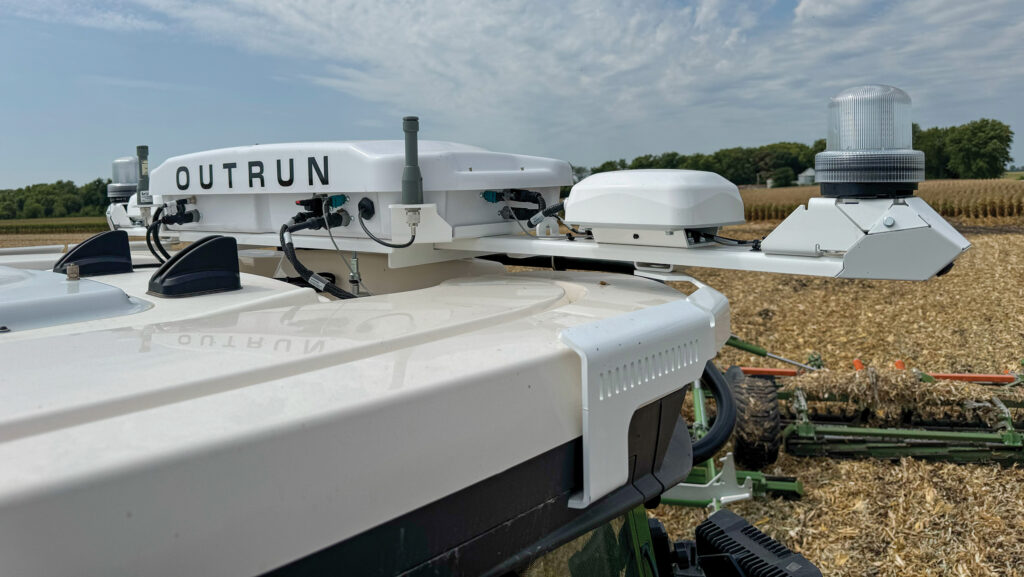
The roof-mounted ensemble includes a lidar sensor (below) © MAG_Oliver Mark
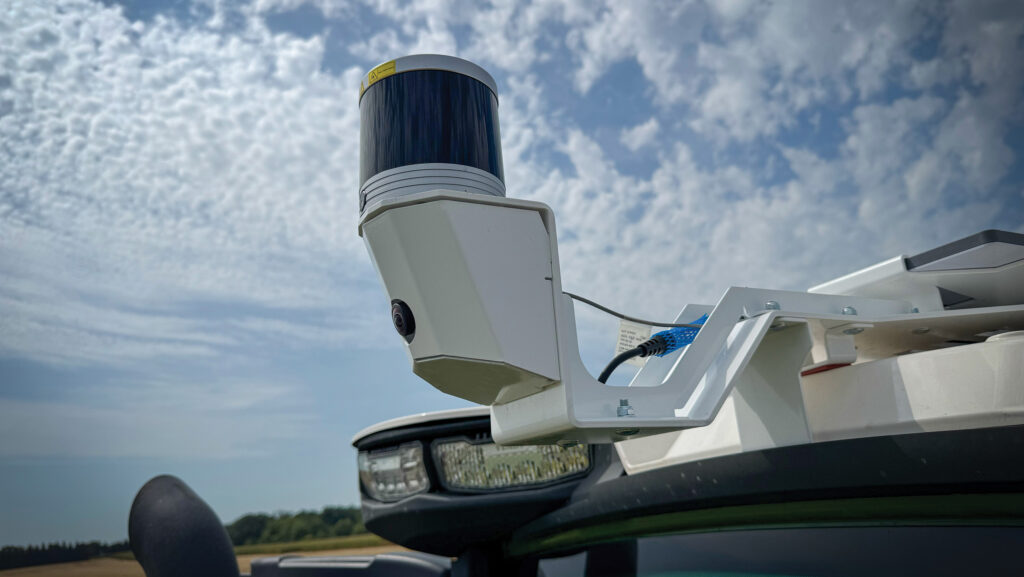
© MAG/Oliver Mark
Benefits and limitations
Farmers in remote areas of the US and Canada are desperate for this type of autonomy. There is a chronic labour shortage and the short growing seasons make work intense, so the extra pair of virtual hands will free up time to manage other duties, oversee operations and, frankly, get a little more sleep.
Clearly, it lends itself to sprawling arable concerns with fields of many hundred acres, where there are no footpaths, few poles and pylons, and roads are ghostly quiet – making the chance of a calamity negligible.
Without the challenge of manning seats, it also gives growers the option of running several small tractors rather than a single big ‘un to reduce compaction and minimise hold-ups should one break down mid-season.
This concept has been pushed by Illinois-based start-up Sabanto, which has been offering an OutRun-like system for the past five years.
Despite not having Agco’s resources, reach and clout, it has successfully switched dozens of farms from a single 400hp tractor and 24-row planter to several smaller outfits – typically cheap Kubotas – that cumulatively match its output.
So, plenty of upsides. But challenges with driverless machinery abound.
The most obvious is legislation, or lack of it. Technology has moved faster than law-making and, though discussions with government are ongoing, they are fraught with complexity. Who is at fault if an accident occurs as the machine passes over a footpath, for instance?
Then there are more practical issues. Though the system can control the basics – steering, speed and rear linkage position – it still has very little intelligence.
What happens if the cultivator bungs up, a shear-bolt snaps or metal wears quicker than expected? There is currently no way of monitoring the implement aside from guessing at a blockage based on engine load.
PTx says it is developing a camera-based system that will incorporate artificial intelligence to detect issues. It is also working on isobus compatibility for implement control and to show drill hopper fill level, bale counts and the like.
Operators can view live feeds from the cameras via their smartphone © MAG/Oliver Mark
When will it be available?
Agco is aiming to have autonomous systems for cultivating, drilling, spreading, spraying and harvesting in place by 2030. These will be focused on corn and soya bean production in the Americas.
There are currently 35 driverless units running in the US and Canada, though numbers are expected to grow rapidly. In theory, this will allow PTx to assess OutRun’s performance on a huge scale, improve the system quickly and add new features.
Any UK roll-out will only start once the necessary legislation is in place. How long this will take is anyone’s guess.
As for cost, US farmers are paying $56,000 (£42,000) for the hardware and a $9,000 (£6,700) annual subscription for the tillage system. Both figures rise slightly for grain carting, as it requires a miniature version of the tractor kit for the combine roof.