11 new Valtra S376 tractors – JSE’s buying decision revealed
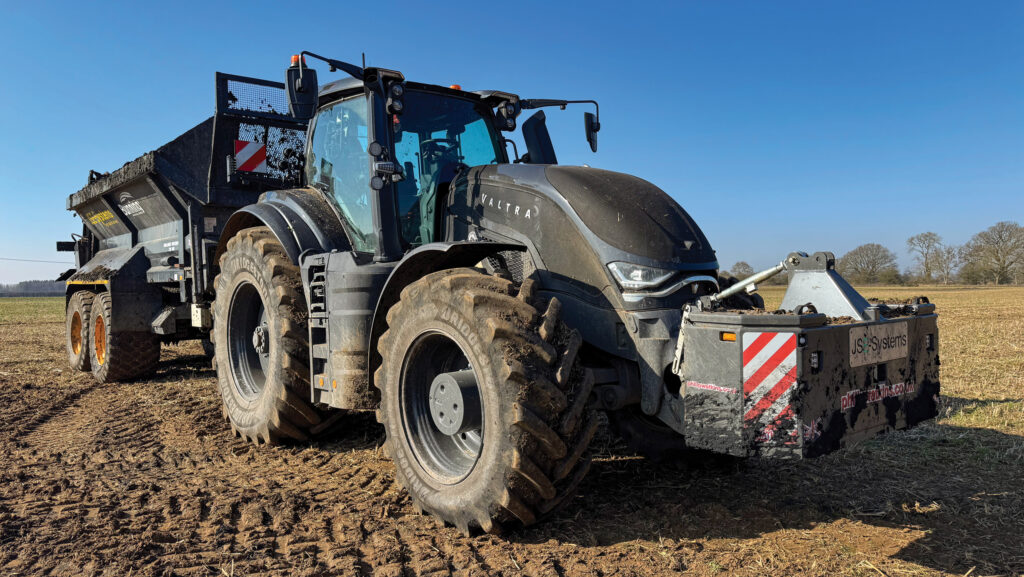 Valtra S376 © MAG/Oliver Mark
 For some businesses, buying a new tractor is a blue-moon event, others might stretch to one or two a year, but precious few will have landed 11 in a single haul.
Lincolnshire spreading contractor JSE-Systems did just that 10 months ago, with its motherlode of Valtra S376s making for one of the biggest single machinery deals in the UK last year.
The posse of inky-liveried prime movers arrived on 1 July, just in time for the firm’s main muckspreading window.
See also: Why FW’s Contractor of the Year opted for £25k Siwi quick hitch
About the contractor
JSE-Systems spreads 400,000t of biosolids annually, plus another 100,000t of compost, chicken muck and farmyard manure.
It also applies 30,000t/year of lime, gypsum, Fibrophos, phosphate and potash fertilisers over 50,000ha using a fleet of JCB Fastracs and AgriSpread spreaders.
Unsurprisingly, this multimillion-pound transaction was preceded by extensive homework.
A dozen of JSE’s seasonal staff were tasked with assessing the pros and cons of demonstrators from most major brands, while proprietor Nik Johnson and operations manager Bertie Harper pored over the facts and figures.
And it was the Finnish firm that got the nod, giving the manufacturer – and dealer Chandlers – a serious shot in the arm during a desperately poor year for tractor sales.
Self-propelled replacement
Motivation for this epic outlay came from the renewal of an eight-year biosolids application contract with Anglian Water, covering a vast area bookended by the Thames in the south and the Humber northwards.
While the previous agreement saw JSE operate Anglian’s own Vredo VT4226s 22t bodies, this time around the firm was free to procure its own power units.
“We knew we were going to move away from self-propelleds simply because of cost and reliability – it was just a question of what to,” says Nik.
“Buying the tractor units ourselves gives us more control over what we run, where we get them, and the service and support that goes with it.”
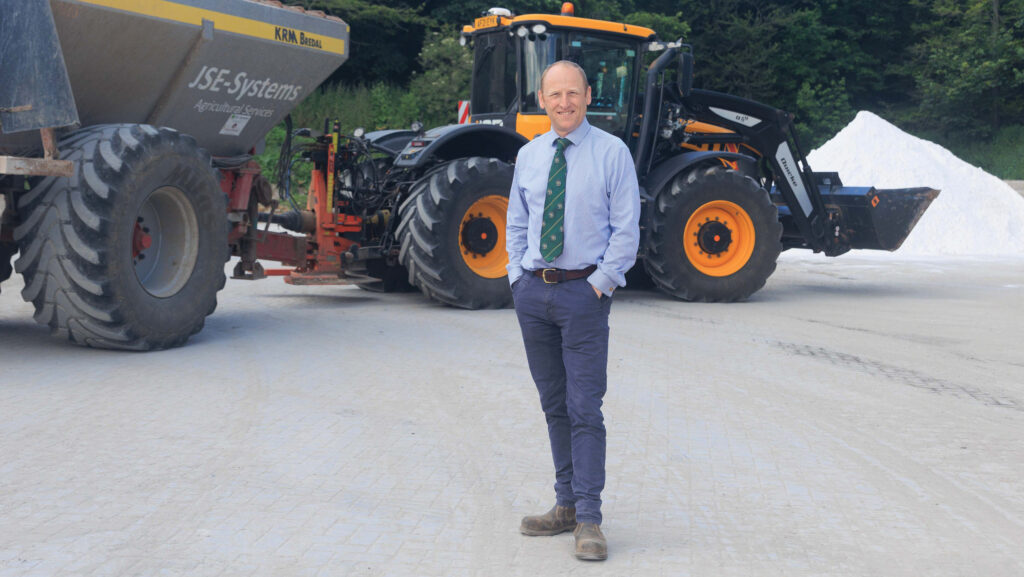
Nik Johnson © Tim Scrivener
The summer of 2024 saw most of the candidates in the 300-400hp category arrive at JSE’s HQ for a run out.
The only exceptions were New Holland, represented by proxy through sister brand Case IH, and Massey Ferguson, which was in the throes of replacing its 8740 with the 9S.
That left five contenders: the Claas Axion 870, JCB’s Fastrac 8330 and the eventual incumbent, Valtra’s S376, plus John Deere’s 7R 330 and an equivalent from the Fendt stable.
“The drivers had preconceived ideas about which was best,” says Nik.
But, to his surprise, it wasn’t Deere or Fendt that won out in the eyes of the operators, but rather Claas and Valtra.
“They loved the comfort of those two, and the fact that anyone can get on and drive them, which made my decision much easier.”
While the team was running the rule over the toys, Nik scrutinised the figures.
Upfront costs, servicing, warranty and best-guess resale values for each were flung into his number cruncher to give an idea of comparable running costs.
“Servicing alone varied by up to £2/hour, and there was a 20% overall difference in hourly costs between the top and bottom,” he adds.
Then there was the issue of availability. Prolonged negotiations with Anglian pushed the delivery deadline perilously close to spreading season, leaving little time between the order being submitted and field work commencing.
This proved the nail in the coffin for Deere – its US-built 7Rs unable to make it across the Atlantic in time – and Fendt, which was already working through a lengthy order book.
With Claas outpriced, all roads led to Finland.
Dealer support
The final factor Nik considered was back-up. And Agco dealer Chandlers was well placed in this regard, with six depots strung across JSE’s spreading territory.
“What I like about Chandlers is that they take a proactive approach to servicing,” he says.
“Our tractors can be anywhere between Ipswich and Scunthorpe.
“They remotely monitor each one’s location to catch them close to a depot as they near their service intervals; critically, without any input from us.”
Nik also requested each dealer spell out its approach to loan tractors in the case of breakdowns – something he feels buyers often neglect.
“A decade ago, we’d expect a stand-in tractor to just turn up, and we’d use it until ours was repaired,” he says.
“This isn’t the case anymore, which I understand – it costs money, and I’m not clocking hours on my machine while it’s in the workshop.”
However, potential outlays – typically calculated on an hourly rate – can get pretty punchy if they include depreciation (up to £20/hour on a £250,000 tractor) and servicing (£6.50/hour), as well as tyre wear and delivery.
“I’ve no problem in principle with covering some costs, but who is paying for the stand-in, and at what price?
“These conversations aren’t often being had; the arrangement needs to be clear so dealers and customers know where they stand.”
Almost niggle-free
JSE’s tractor fleet could make for the world’s toughest “spot the difference”, with all 11 carbon copies of one another.
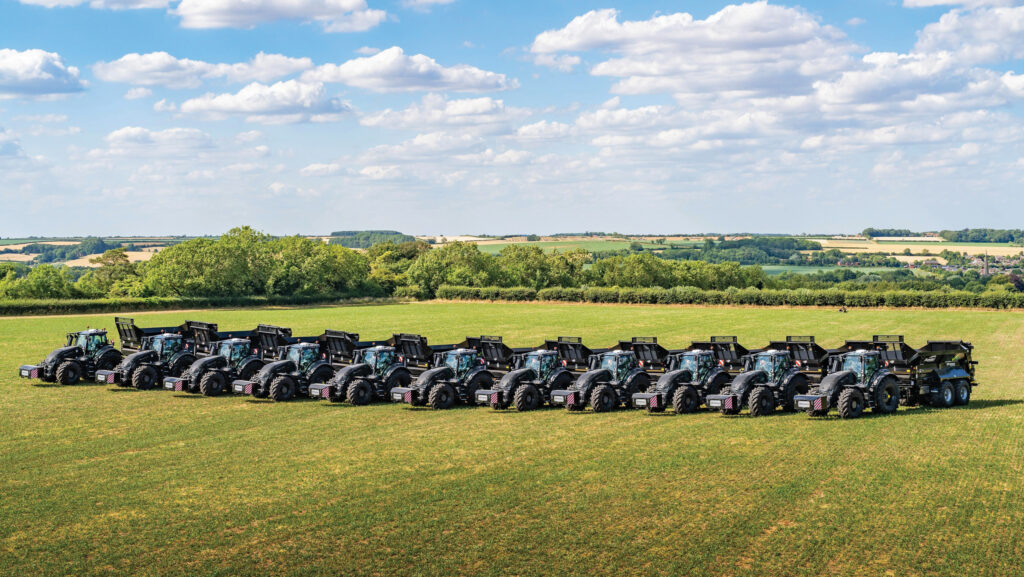
Valtra S376 tractor fleet © MAG/Oliver Mark
This includes front linkages, five spools, Valtra’s “comfort” pack – cab and axle suspension, comfy seats, decent lights – and Bridgestone 710 tyres, which are expected to last about 3,500 hours.
K80 ball hitches were fitted in-house post-delivery.
Valtra S376
- Annual workload 700 hours
- Engine 8.4-litre, six-cylinder Agco Power
- Max power 370hp@1,850rpm (400hp with boost)
- Max torque 1,550Nm@1,500rpm (1,700Nm with boost)
- Transmission Two-range ML 260 CVT 53kph
- Hydraulics 205 litres/min
- Lift capacity 12t rear, 5.8t front
- List price £335,355
“In truth, we specced them for ultimate resale value; if you’re buying more than one or two tractors and planning to change them then that can’t be ignored,” says Nik.
As for performance, they’ve barely put a foot wrong.
Though warrantied for five years, together they’ve accrued just 10 hours of downtime over the near 8,000 clocked, the brief lay-ups caused by a failed turbo and two sets of defective sound system speakers in one cab.
“You can’t fault the reliability so far – you’d be happy to see that sort of downtime on one tractor, especially given it was a brand-new model,” he adds.
The tractors have also proved perfect partners for the matching fleet of 11 blacked-out twin-axle Bunning Lowlander Widebody 250 HBDs, which are owned by Anglian Water.
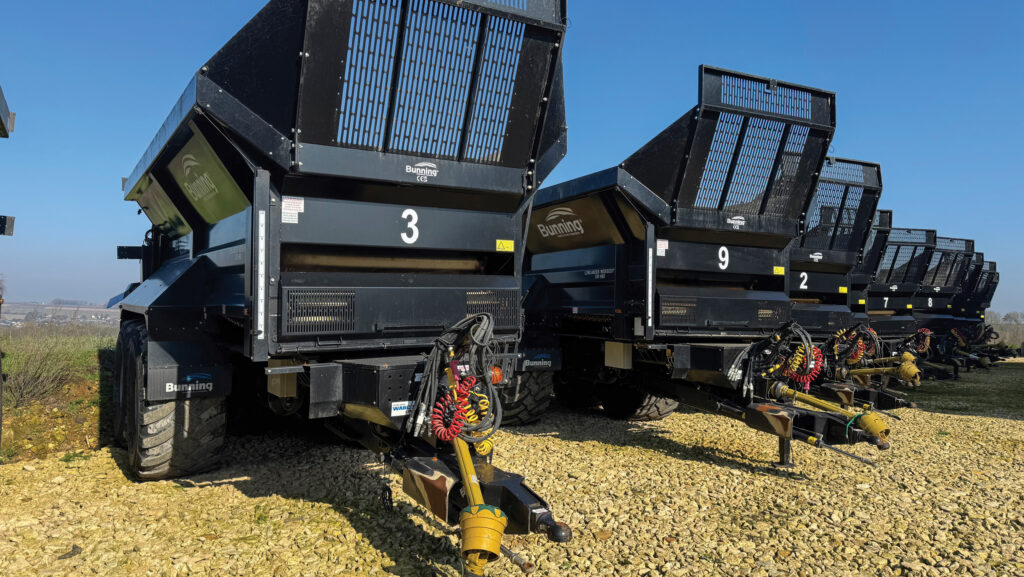
Bunning Lowlander Widebody 250 HBDs © MAG/Oliver Mark
“The power is where we want it to be. We might have got away with 350hp but we were conscious about hilly ground,” says Bertie.
“Pulling a 35t deadweight while spreading cake at 24m is hard work, so the 370hp [boosting to 400hp] is just right.”
They’ve proved good on fuel too, with each of the 11 six-cylinder engines typically slurping 30-35 litres/hour, making for a total fleet volume that’s about par with the seven Vredos.
Plus, running costs are significantly lower, with tyres, mirrors and windows all cheaper than those for a specialist self-propelled outfit.
And output has also risen by 10-15%, largely thanks to the direct mechanical drive to the Bunning spreading discs.
This is far better suited to handling huge volumes of product – 18t/ha at 6kph over 24m – compared with the hydraulically powered setup on the Vredos.
Software integration
However, one issue has stymied the otherwise seamless integration of the new tractors: their inability to talk the same language as John Deere’s Operation Center – JSE’s management tool of choice.
With spreading rate and location documentation critical for the biosolids contract, Nik’s current focus is on getting the software speaking.
This will allow any new customers to send boundary, tramline and obstacle information direct to the tractors – the business has already mapped some 50,000ha – and, in return, receive automatic field record updates.
As it stands, JSE is running two separate systems – Valtra’s Connect platform for biosolids spreading, and the Ops Center across the rest of the business.
“Connectivity between the office, machinery and customers is essential,” says Nik.
“Deere’s system has become the Microsoft Windows of agricultural software and the sooner we can get the tractors working with that, the better.”
Valtra S-series
A new cab, more powerful engine and a welter of previously unavailable optional extras were the highlights of Valtra’s revamped S-series when it was unveiled in September 2023.
But the biggest change to the Finnish firm’s flagship range was its provenance, with production of all six models returning to Suolahti following a major factory expansion and paint-line upgrade.
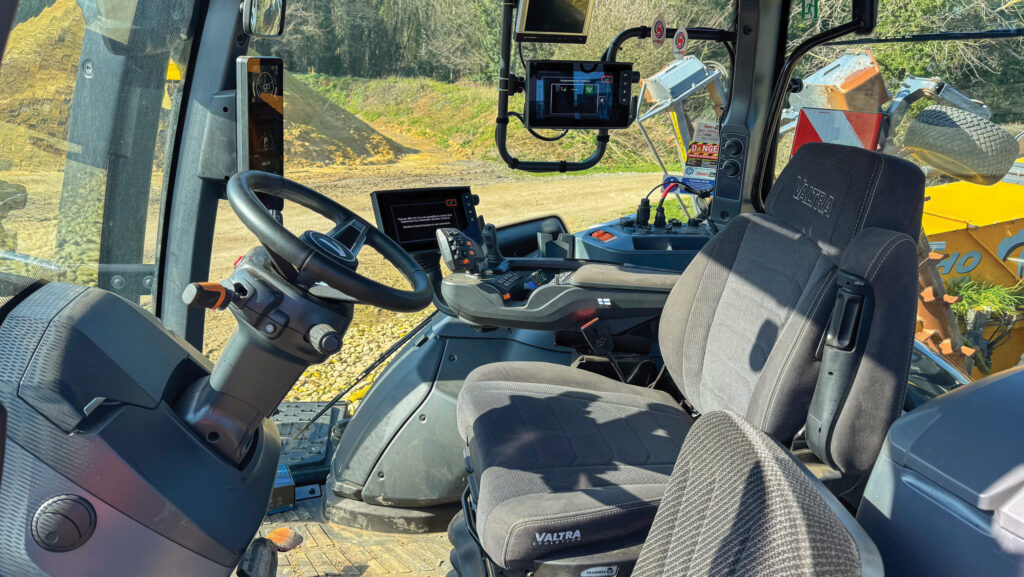
Valtra S376 tractor cab © MAG/Oliver Mark
This ended a two-decade build run at Massey Ferguson’s facility in Beauvais, France, during which time the S-series was effectively a redressed 8700S.
The move means the 8.4-litre Agco Power engine, Fendt-derived stepless transmission and five-pillar cab are all manufactured and assembled in Finland.
Outputs range from 280hp to 420hp, with the smallest four getting a 30hp boost and the fifth gaining an extra 20hp.
The big S416 gets access to its full 420hp at all times, with power channelled through the two-range stepless transmission.