Challenger tractor gets reverse drive conversion for tree pruning
 © James Andrews
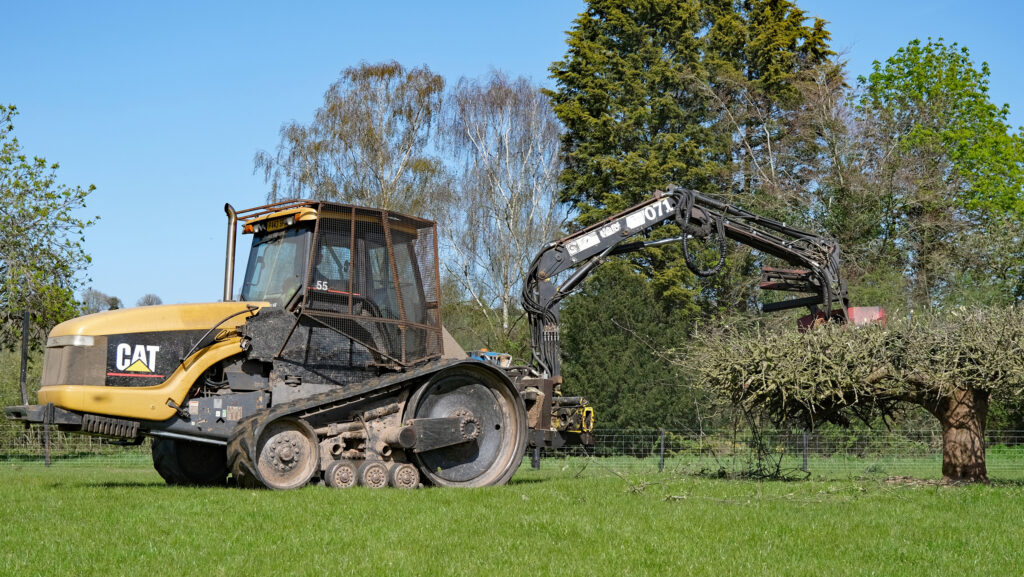
 After decades of hauling heavy cultivation kit, a 1990s twin-track crawler has found an unlikely second career in the cider orchards of Herefordshire and Worcestershire.
The Caterpillar Challenger 55 is the latest in a line of machines used by apple grower and contractor James Holloway to keep tree canopies in check.
See also: Workshop Legends: Articulated tractor king John Nicholson
With 250hp on tap and a kerb weight nudging 12t, it’s an improbable fit in orchards typically dominated by narrow specialist tractors.
Yet it’s the only tool that’s proved tough enough for the task, succeeding where previous workhorses have failed under the relentless workload.
Prepping the prime mover for its new vocation has required extensive modification.
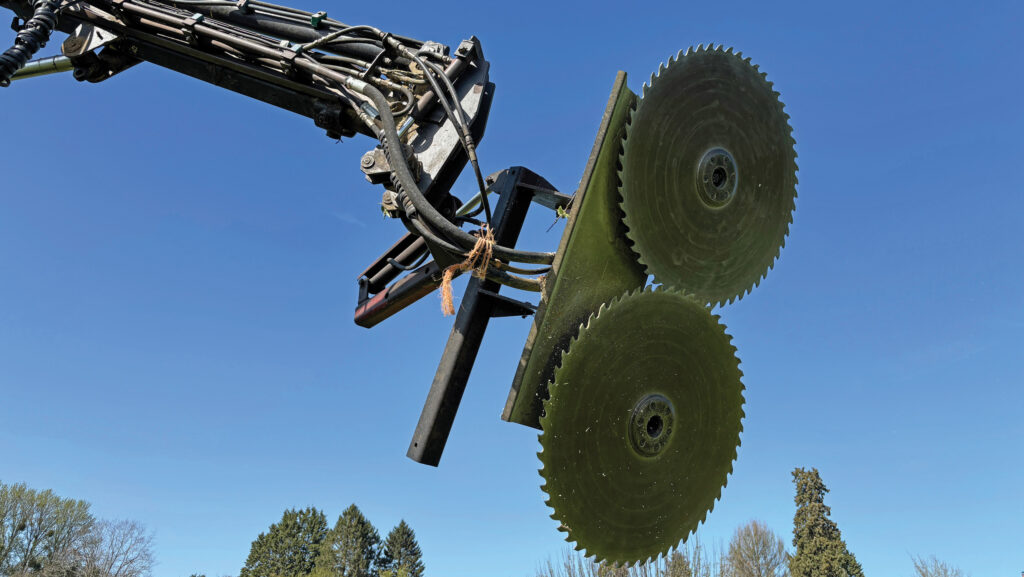
Chief among these is the fitting of a Hiab crane and Protech twin saw head at the back end; a combination that gives enough cutting power, reach and articulation to trim tall canopies day after day.
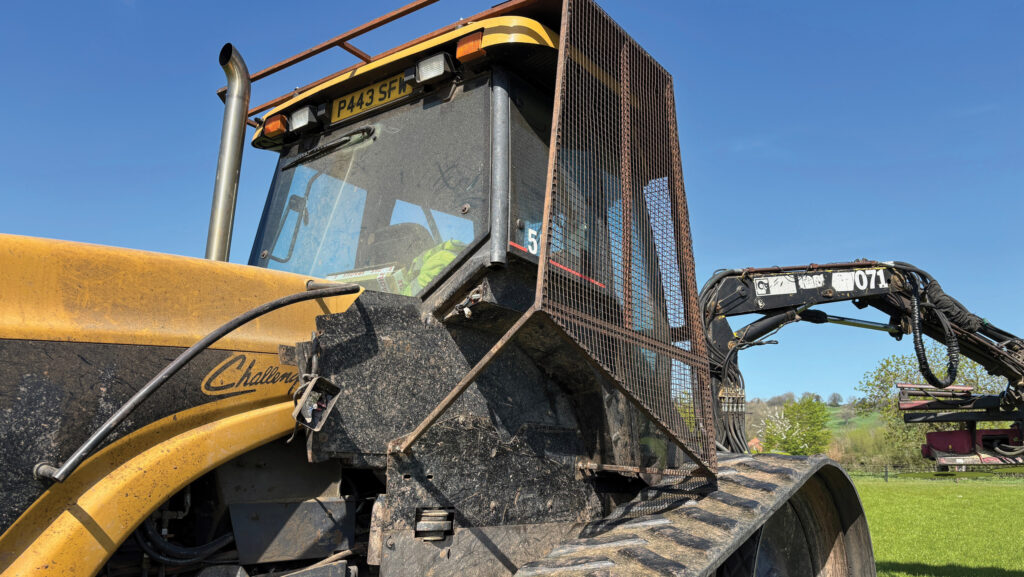
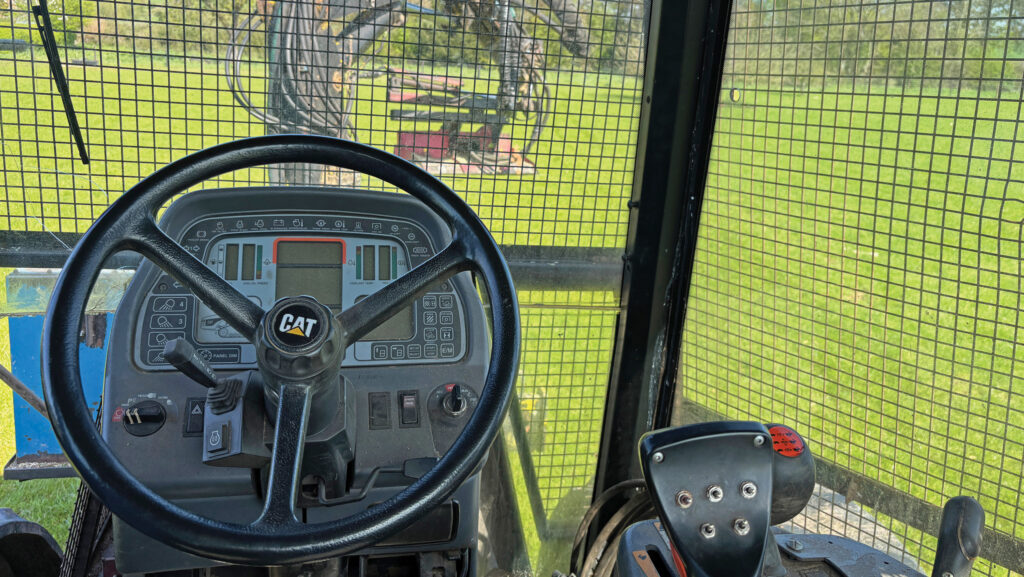
But James has also converted it to reverse drive – a process that involved removing the cab and turning it through 180deg before securing it in its new position.
The result is a clear, uninterrupted view of the saw head, allowing driver Nigel Price to guide the machine precisely along tight rows.
© James Andrews
Why a Challenger?
Long before the Challenger, James’s tree-top trimming service began with a saw blade fitted on an 8t Kobelco 360 excavator.
The jib and slew were ideal for positioning the cutting blades but it didn’t have enough oil flow to spin them, so a separate engine-powered hydraulic unit had to be added at the rear.
It worked for a while, but the lever steering was less than ideal and the constant motion soon put paid to the track motors.
Next came a Morooka tracked tractor, which was the first host for the Hiab and saw head combination.
A sturdy frame was built to secure this to the tractor’s link arm mounting points, and the controls and seat were turned within the cab to make it reverse drive.
This was a marked improvement over the digger, but was also uncomfortable to drive and wasn’t really tough enough for the job.
That’s when James went in search of a heavier duty alternative, eventually finding a 1997 Challenger 55 at a dealership in Lincolnshire. It had clocked more than 10,000 hours, but was still in good order and seemed a snip at £18,500.
Another attraction was that it came fitted with a heavy-duty front linkage, the initial plan being to mount the Hiab on this and keep the tractor in its original orientation.
They ran it like this for a season, but having so much extra weight on the front end threw the whole machine out of balance.
The tracks were the first casualty, cracking under the extra strain, followed by the far more serious problem of a broken casting holding the front idler.
They are like hen’s teeth these days, so after a replacement was eventually located and shipped over from the US, a rethink was required.
Turning the cab
The obvious solution was to make it reverse drive and, as it wouldn’t be possible to reposition the controls within the cab, they needed to rotate the whole structure.
For this, James and Nigel enlisted the help of independent agricultural engineer Steve Hodges.
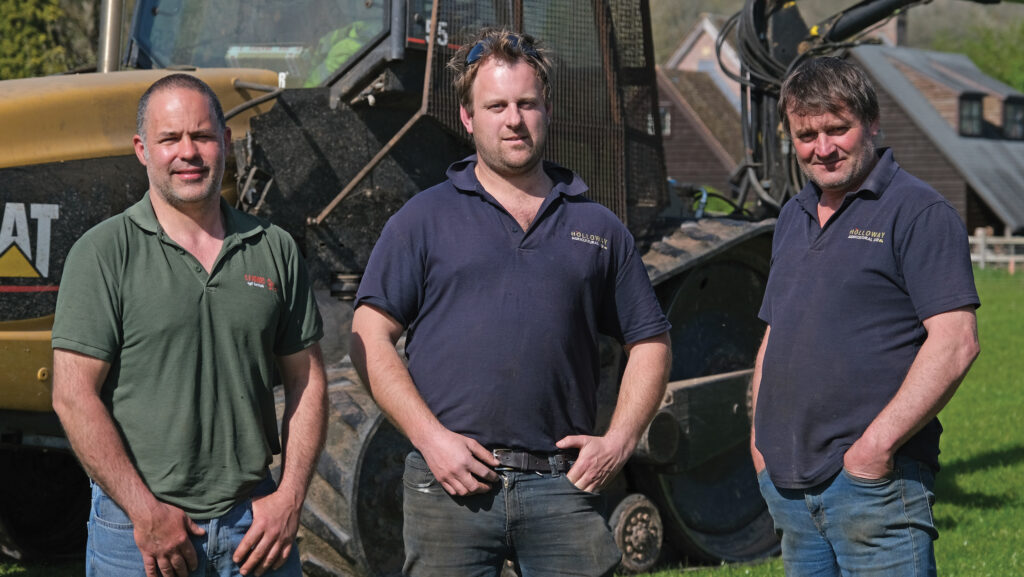
Left to right: Steve Hodges, James Holloway and Nigel Price © James Andrews
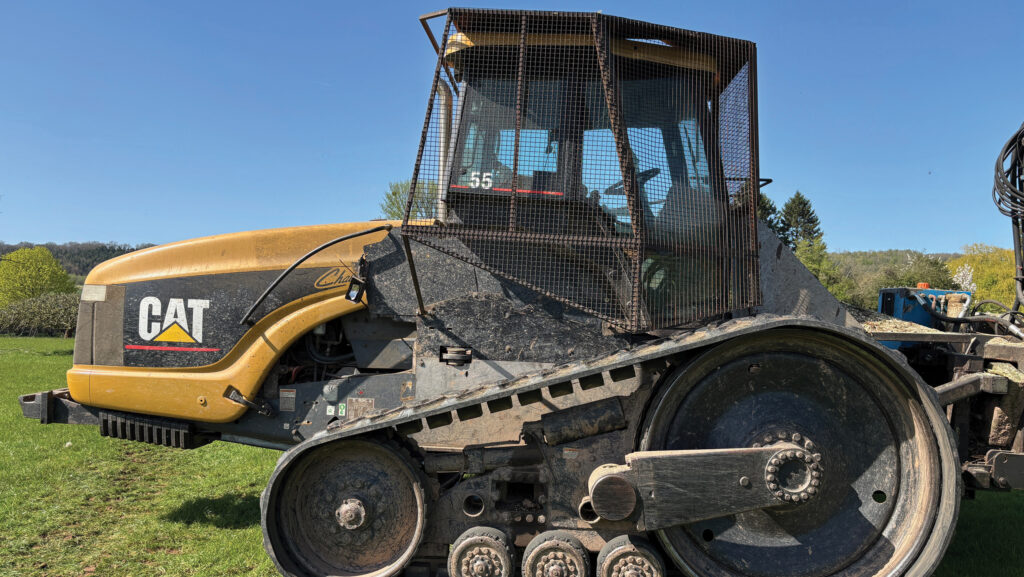
Lifting and relocating the workspace was relatively straightforward, requiring a simple subframe to be constructed out of two lengths of 6in channel.
But considerably more graft went into extending the cables for the spool valves and handbrake, making up new hydraulic and air-conditioning hoses, and modifying the wiring.
“We spent at least a day soldering extra lengths of wire into the four main looms,” says Steve.
© James Andrews
Another challenge was altering the door so that it would open over the large rear idler. The only sensible solution was to shorten the frame and get custom glass made to suit.
This was more arduous than hoped as the original had a slight curve, so they altered the metalwork to accept regular straight pieces of glass.
Finishing touches included fitting steel panels to blank off the rear arch areas under the cab and steel mesh guards to protect against flying branches.
These still need to be refined a little, as the door glass has already been cracked by a wayward twig that managed to breach the defences.
Better weight distribution
The Challenger’s new configuration is far better balanced than the previous front-mounted setup, with the engine acting as the perfect counterweight for the arm and saw head.
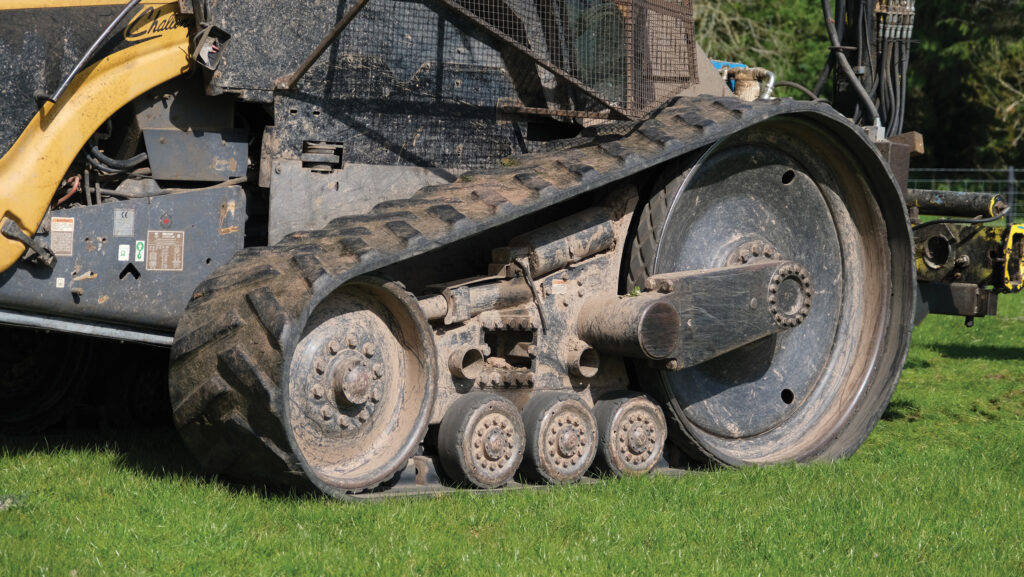
This puts even pressure over the length of the tracks, meaning it travels far better in soft ground and significantly reduces wear.
© James Andrews
James has also opted to replace the cracked original tracks with some well-worn second-hand ones.
“We don’t need lots of grip and the lack of tread means there’s far less scuffing when turning,” he says.
“Plus, I only had to pay £1,600 for them when a new set would probably be more than £8,000.”
Despite the turf-friendly rubber, the machine still needs a sensible operator on the seat who doesn’t spin it around too tightly, particularly in mid-winter when the season begins.
“I try to make small steering adjustments and loop around slowly at the end of each row, and it tends to make very little mess if you drive like that,” says Nigel.
Fewer gears
The only downside of the new configuration is that the powershift transmission is still in the same orientation, meaning it now delivers just nine forward speeds and a generous 16 in reverse.
For most applications there are plenty of ratios, but there are a few occasions where a lower gear would be helpful. The upper end is less of a concern, as the rig gets moved between sites on James’s HGV low-loader.
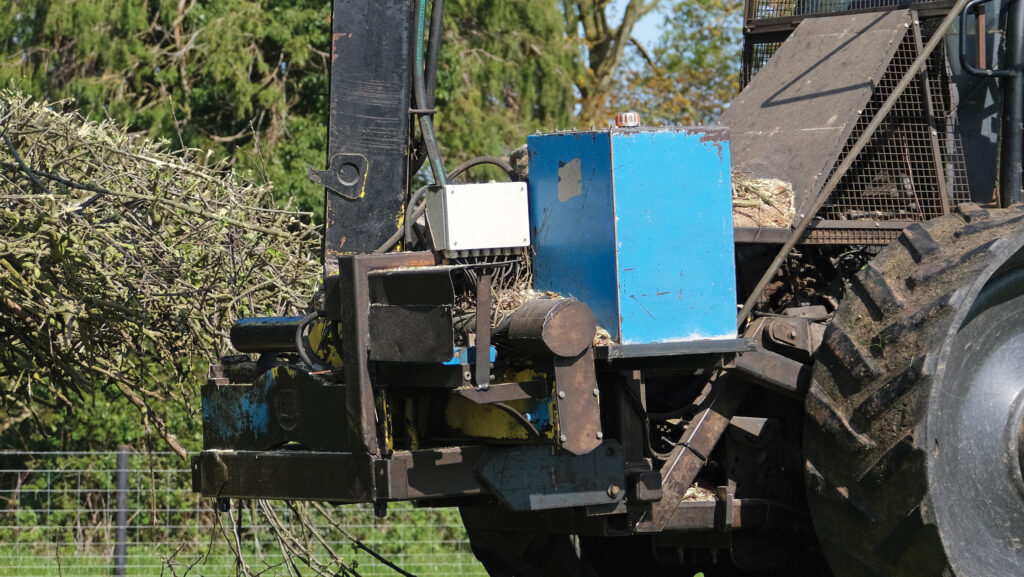
Hydraulics to power the Hiab © James Andrews
With 250hp delivered from its 7.2-litre six-cylinder engine, the Challenger has plenty of power in reserve; so much so that the 540rpm hydraulic pump powering the saw head can be run off the 1,000rpm shaft.
Setting the engine revs to 1,300rpm will spin this at about 600rpm, giving good cutting performance while helping to save fuel.
Electro-hydraulic control
As for the Hiab, hydraulic flow to its various rams is provided by one of the tractor’s spool valves set to constant pump.
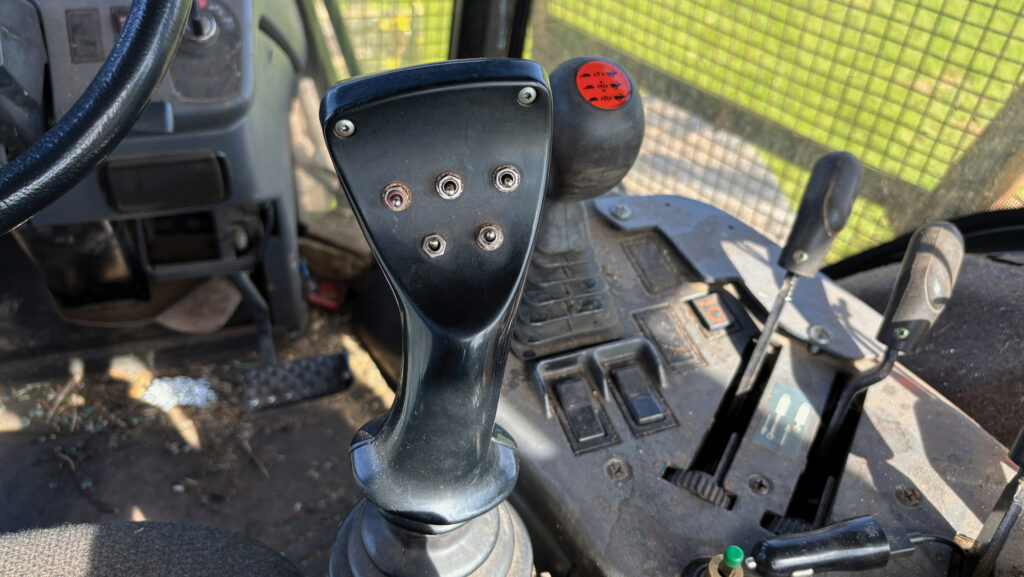
The oil is then fed through an electronic spool block, controlled by a multifunction joystick mounted next to the armrest.
© James Andrews
This gives fingertip control of the arm’s multiple hydraulic rams, which allow it to slew both ways, extend telescopically to 7m and adjust both the angle and pitch of the blades.
Having this much control means it can work in different row spacings and Nigel is able to finely adjust the angle of cut so trimmings fall neatly in the centre of rows, ready to be shovelled up later.
© James Andrews
To maintain peak cutting performance, James runs three sets of the 1,900mm cutting discs, which are sent away for professional sharpening every seven to 10 days.
Cab modification
After some 600 hours of trimming duties, the only complaint is the view of the saw blade in taller rows of trees.
One solution would be to fit a window in the cab roof, but James and his team are considering adding a hydraulic cab-tilting function instead.
© James Andrews
This would have a couple of hydraulic rams at the front to raise it by a few inches to give a clearer line of sight.
“I don’t even think we’d need to add a pivot as there’s probably enough movement in the original cab mounts,” he says.
Holloway Agricultural
From its base in Shelsley Beauchamp, Worcestershire, James’s contracting business, Holloway Agricultural, covers every service associated with growing cider fruit.
In addition to his Challenger tree topping machine, he has custom-made reciprocating cutterbars that offer plenty of adjustment for neatly shaping the sides of the canopy.
He offers spraying services too, and has a full suite of harvesting gear, collecting some 16,500t of fruit each season.
As well as his home county, he covers Shropshire, Herefordshire, Gloucestershire and Monmouthshire, and works with most of the main producers.
He also farms 100ha of cider apple orchards, grows salad onions and has an equine forage business.