First impressions: Fendt 1100 MTs get more power and better cab
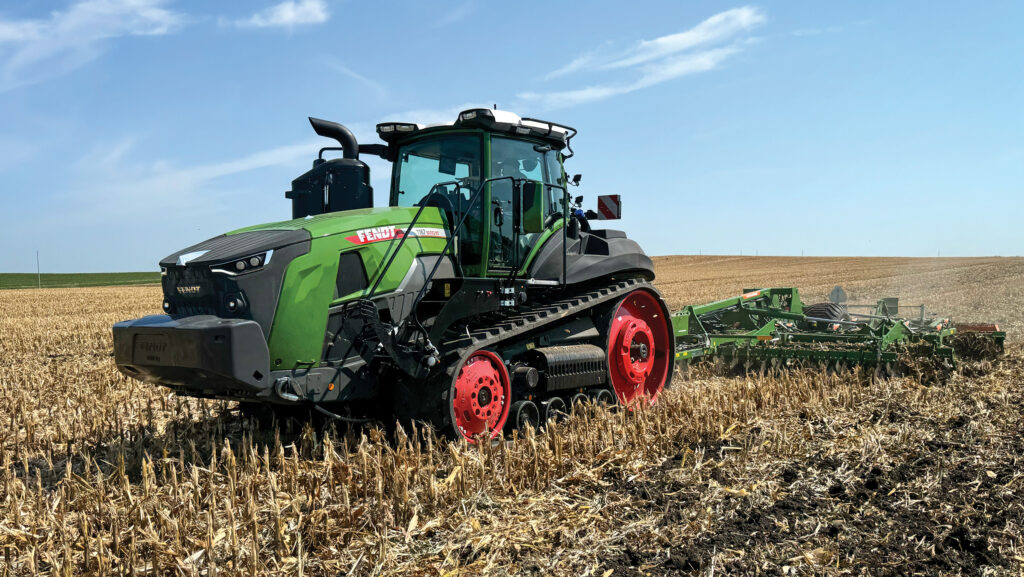 Fendt 1167 MT © MAG/Oliver Mark
 Wind the clock back a decade and Fendt looked like it might push crawler tractors to the brink of UK extinction.
The reputation of iconic twin-track brand Challenger was already gutter-bound following a spate of engine issues, and its E-series machines were losing favour as big farms stretched their tendrils to far-away fields that necessitated more road travel.
So, when the 500hp wheeled 1050 burst onto the scene with flexi-walled tyres and VarioGrip pressure control, many tracklayer diehards began questioning the wisdom of owning a specialist tilling and drilling machine.
By the time Fendt inherited those struggling MT700E and 800E ranges, the British market had shrunk from its 100-a-year peak in 2012 to nearer 70.
See also: First impressions: John Deere’s 8RX 540 breaks new ground
But thanks to a series of refreshes, some Germanisation and a loyal customer base of arable growers that prize power, output and subsoil structure above all else, sales have stabilised.
The firm’s four flavours of 1100 MT and three of the 900 MT are now reckoned to account for just over half of the UK market.
All are assembled at Fendt’s 66ha North American facility in Jackson, Minnesota – home to late-of-this-parish Challenger since 2002 – alongside mid-cabbed Rogator sprayers and TerraGator spreaders.
Fendt 1167 MT Vario
- Engine 16.2-litre, six-cylinder MAN
- Max power/torque 680hp/3,100Nm
- Transmission Vario CVT, 40kph
- Wheelbase 3m
- Hydraulics 220 or 440 litres/min
- Rear spools Up to eight
- Removable oil 83 litres
- Pto 1,000 or 1,000e
- Price £565,983; 1151 is £486,194
What’s new?
Nothing on the 900 MTs, which have remained unchanged since the hasty overhaul in 2017 that brought a slick Vario transmission and seven bores of Agco power.
By contrast, updates to the flagship 1100 MTs, from the 521hp 1151 to the 680hp 1167, were glacial. It took four years for German brains to develop a suitably strong stepless TA 400T Vario to replace the old-school powershifter.
The troublesome Cat powertrain was slung too, and cures came for the crude cab, archaic controls and back-jarring suspension (or lack of).
With the big stuff addressed in 2021, “Gen 2” is a less-radical refresh that partly replicates the suite of changes to high-horsepower wheeled models last year.
Among them, the long-awaited FendtOne cab interior and latest high-tech lighting system, plus a few subtle upgrades to improve fuel economy and get a bit more power to terra firma.
© MAG/Oliver Mark
Extra smidge of power
Spearheading the 1100-series’ battle against foes of four-track, two-track, half-track and wheeled guise is the 1167, which accounts for half of the range’s UK sales. It, as well as the 1162 and 1156, has gained a modest 7hp over its predecessor. The lesser 1151 enjoys a more generous 10hp rise.
While the smaller three run MAN’s 15.2-litre six-cylinder, the flagship gets an extra litre of cubic capacity to deliver its 680hp, making it the highest-powered CVT tractor on the market. Not that you’d know it from the cab – the bark sounds implausibly tame.
Recent tweaks include a piston rehash and ECU remap. The result is full torque from a whisker above idle and over a 400rpm range, and an apparent marginal fuel economy improvement – the extent of which is unconfirmed.
Nonetheless, Fendt promises it will be “best-in-class” – a class of two – to better what it claims is already a “30% advantage over competitor machines”.
Manufacturing a suitably strong single-range Vario has undoubtedly helped its cause, keeping engine speed aligned with power demand.
Deere only offers a stick-shifter on its 627hp 9RT 590. The twin hydromotors have been reinforced to handle the full output of the latest model, without requiring the pto or hydraulics to siphon off some of the torque. T
here is also a new “flex” mode for the TMS drive system, allowing operators to seamlessly switch from pedal to joystick control – something that can be retrofitted to existing machines.
Other updates include an exhaust brake function through the variable geometry turbo and a new hydraulically driven cooling fan that works independently of engine speed to further subdue noise and power demand.
Buyers can spec a reversing mode to clear radiator-clogging debris, there’s a passive dust extraction system for the engine filter and, like the wheeled tractors, a self-cleaning cab air filter to keep in-season maintenance to a minimum.
© MAG/Oliver Mark
Challenger-derived tracks
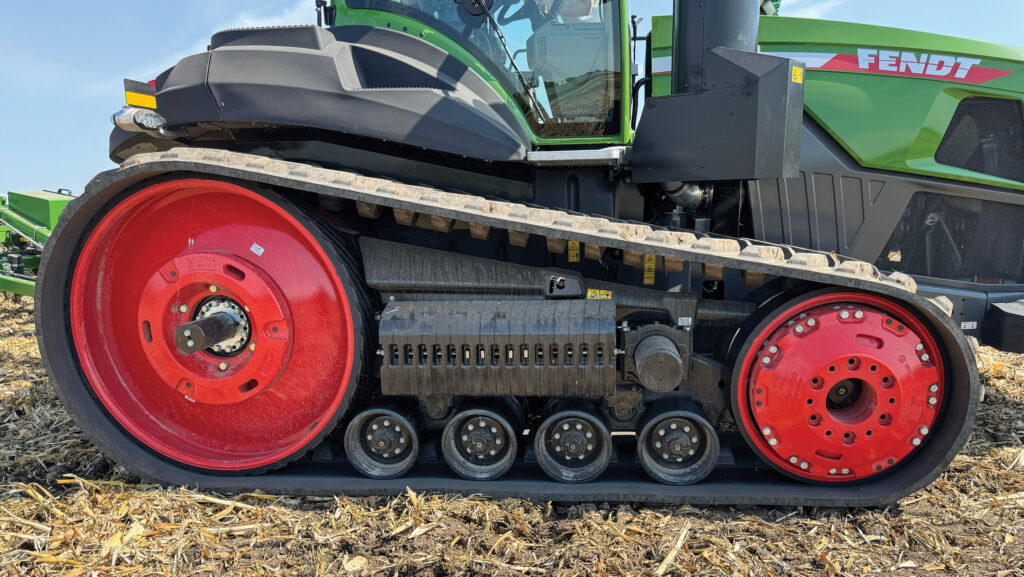
The one constant from the Challenger days is the MTS undercarriage. It features 10m of Michelin’s finest rubber, each side friction-driven by a large rear wheel aft of four pairs of mid-wheels and a front idler.
Fendt points to several strengths of this design, one being the particularly large front idler, which is easier on the belt and leaves plenty of air space to dissipate heat. Consequently, track costs are roughly half the not-unusual £20/hour of a four-track machine.
Another is the effective “six-axle” layout and 11deg of track-to-track oscillation that help maintain consistent ground pressure and an even load front to back.
Standard spring-and-damper suspension on the lateral “hard bar” keeps it level, while the optional Smart Ride Plus adds hydraulic self-levelling to the front.
As with any twin-tracker, it is reliant on topsoil for traction. Greasy ground is its kryptonite. But, when the going’s good, Fendt reckons wheel slip should be down two-thirds on a set of non-VF tyres. This relies on ballast, with up to 7t of nose, idler and mid-wheel weights – typically set up on a 60% front bias – adding to its naked 19.7t.
Longevity of the 700mm (27.5in) Michelin tracks will depend heavily on soil type and operator diligence, central to which is keeping them clean rather than cloyed.
About 5,000 hours is the typical high-water mark – about par with the tyres of a wheeled 1050 – but it can drop to 3,500 hours in the wrong hands or on unforgiving ground.
© MAG/Oliver Mark
Cockpit facelift
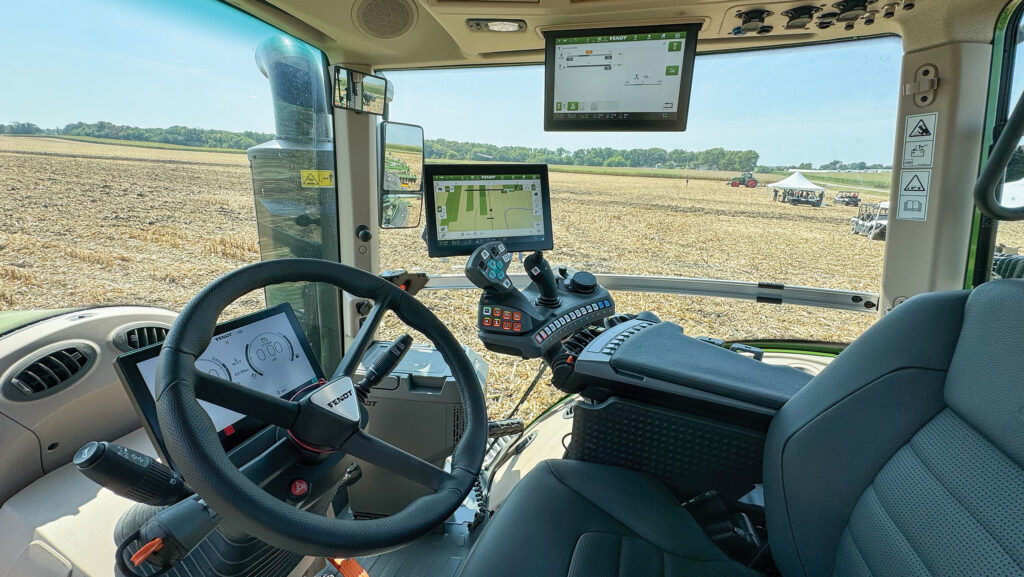
The cab will, finally, be home from home for anyone already operating a newish wheeled Fendt tractor or Rogator sprayer. Rollout of the FendtOne workspace brings the familiar – or scary – multi-function handstick, 12in armrest terminal, 3L joystick and digital dashboard.
Drivers are promised improved damping on the peasant-spec cloth or posho leather seat, get extra footrests and, if they talk nicely to the person writing the cheque, a compressor-driven fridge.
An extra 16 litres of diesel capacity – now 1,370 – should keep them in the field for a couple more minutes, too.
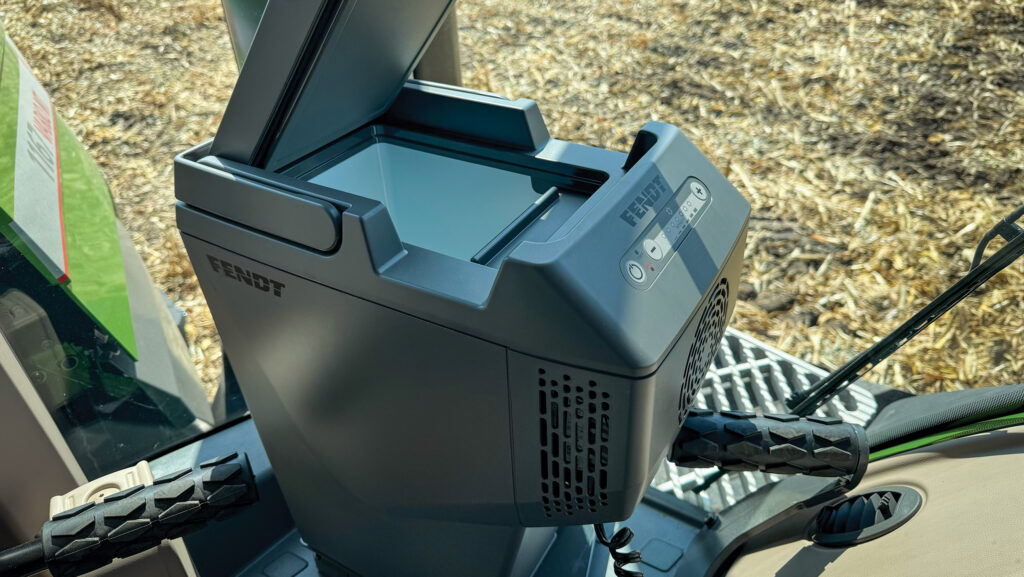
© MAG/Oliver Mark
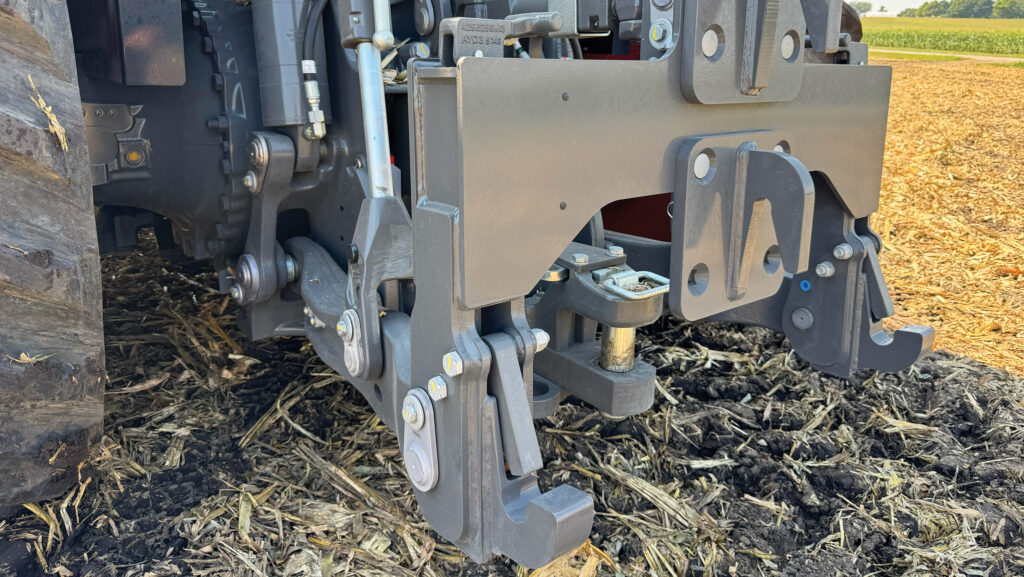
Options include a second roof-mounted monitor and the firm’s TI automatic headland turn system. This is slicker than ever thanks to an extra mode for the hydraulic steering drawbar or linkage.
As before, there is a pair of rams to push it left or right by up to 28deg, twerking the implement as if it’s one half of an artic.
Now, as well as the button-controlled manual shift and float/auto float settings that permit it to pivot freely, there’s a new “link” mode. This will work the arms according to tractor steering angle, reducing the tractive effort, slippage and scuffing when cornering.
Also new is Fendt’s Ultra Vision lighting package. The basic “essential” version comes with 12 work lights good for 55,800 lumens; the “elite” adds more of the same for an Emirates Stadium-rivalling 84,300 lumens.
With both come countless customisation options: five levels of brightness, four preset lighting profiles and a nifty mirroring function.
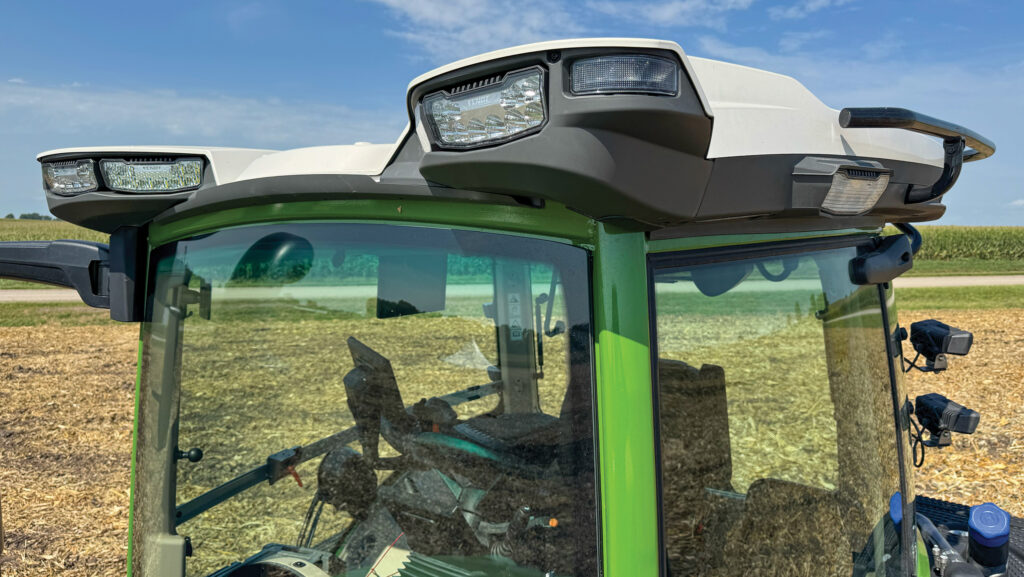
© MAG/Oliver Mark
Farmers Weekly verdict
No question, the 1167 has the power, traction and weight dispersion to deliver the intense bursts of work its list price demands.
Big farms on light soil, or those that drill early, are the 1167’s most obvious home. Those on heavy ground might prefer a four-track, and late drillers with blackgrass on their mind may edge towards the versatility of a smaller and lighter wheeled or half-track machine.
This is already in evidence, with John Deere reporting keen demand for its latest wheeled and half-track 8R 540 (634hp) at the expense of its own “small” 9RX artics and twin-track RTs.
Deliveries of the 1100 MTs are slated for early next year. The big boy lists at £565,983, plus about £45,000 for an eight-year/4,000-hour warranty.
|
Model |
1151 Vario MT |
1156 Vario MT |
1162 Vario MT |
1167 Vario MT |
|
Engine |
15.2-litre, six-cylinder MAN D38 |
16.2-litre, six-cylinder MAN D42 |
||
|
Max power |
521hp |
571hp |
625hp |
680hp |
|
Max torque |
2,500Nm |
2,700Nm |
2,900Nm |
3,100Nm |
|
Engine speed at max torque |
1,000-1,450rpm |
1,050-1,450rpm |
1,100-1,500rpm |
1,100-1,500rpm |