First impressions: John Deere’s 8RX 540 breaks new ground
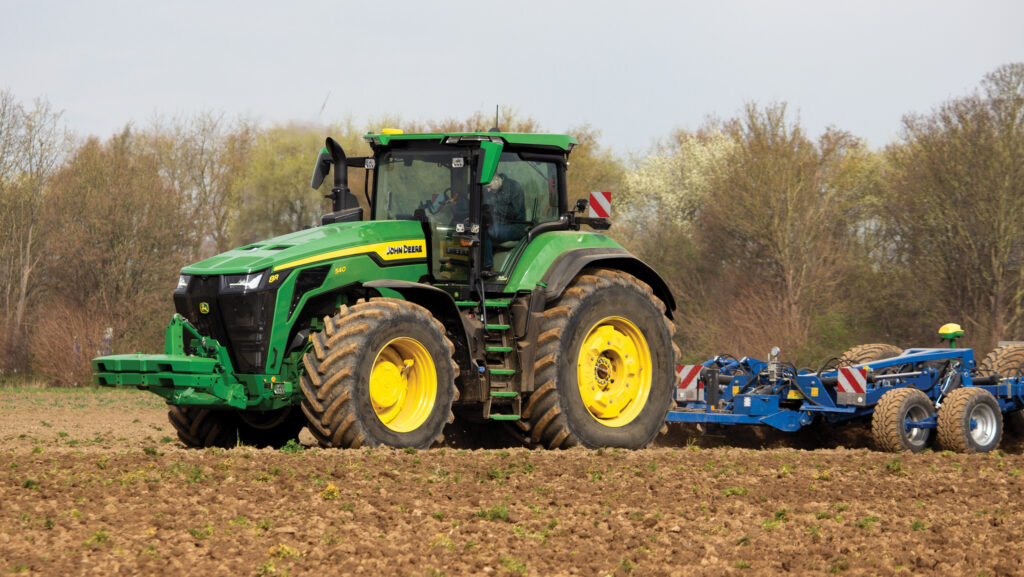 John Deere 8RX © MAG/Oliver Mark
 American heavy artillery of a friendlier type will be shipped across the Atlantic later this year when the first battalion of Europe-bound 8Rs and RXs departs John Deere’s Iowan factory.
There are six new “high horsepower” 8-series models in all, spanning three power outputs in wheeled and four-track format.
See also: First impressions: John Deere’s bonkers-big 913hp 9RX 830
John Deere 8R 540
- Engine 13.6-litre six-cyl John Deere
- Max power 594hp@1,700rpm
- Boosted power 634hp
- Max torque 2,695Nm@1,400rpm
- Transmission eAutoPowr CVT
- Hydraulics Up to 418 litre/min
- Rear lift 10.8t
- Starting list price £596,397 (50kph); 8RX 540 is £806,754; 8R 440 is £516,002
Alpha of the 8R range is the 540, with its 634hp boosted output making it the most formidable conventional tractor in production.
And the mid-ranking 490 also packs enough firepower to have stolen that crown, maxxing out at 579hp.
In effect, this pair has formed a new segment – one that poses a serious threat to comparatively oafish artics.
Case IH may well be sweating over the repercussions for smaller Quadtracs and, given the huge power overlap, there’s also likely to be some cannibalisation of Deere’s lesser 9RXs (440-640hp).
The omens look worse still for the firm’s twin-track RTs.
Already in a death spiral triggered by the launch of “standard” 8RXs at Agritechnica in 2019, these latest derivatives will likely kill them off for good in the UK.
Yet despite all this drama-mongering, it could be the “entry level” 440 that causes the biggest stir.
In a reversal of the tractor range orthodoxy, the least powerful model looks likely to be the volume seller and, at 524hp, lands in Fendt 1052 territory (550hp).
Peak power
Under the R’s Pinocchio-esque nose is the same 13.6-litre Deere engine as fitted in the firm’s 700hp X9 combine, F8 foragers and smaller 9-series artics.
Standard 8s (308-458hp) make-do with 9 litres; the ballistic missile-sized bores of “high horsepower” 9RXs offer double that displacement and are cooled by a reversible fan – something the bigger 8Rs go without.
The outputs mentioned earlier include a 40hp “peak power” boost, which comes into play from 1kph when under strain from a heavy pto, hydraulic or electric load.
And it’s now easier to fettle performance, thanks to three new quick-set modes.
Eco, standard and max activate different power curves, at one extreme helping reduce fuel consumption and, at the other, improving response on heavy draft tasks, without operators having to wade deep into the menu in search of custom settings.
Downstream of the power plant is Deere’s eAutoPowr electro-mechanical transmission, where electric motor generators replace conventional hydrostatic elements – a format already offered on the 8R 370 and 410.
It operates in the same seamless fashion as other CVTs, but without the wearisome whooshing sounds caused by forcing high-pressure fluid through pumps and pipes.
According to Deere, it should be marginally more efficient and significantly more durable, too.
There’s also scope to siphon off up to 100kW (134hp) from the generators to power tanker axles and the like.
However, the provision of this facility has proved a damp squib.
Seven years since its launch, development partner Joskin remains the only manufacturer to offer complementary equipment.
Wheels or tracks
Tracked RXs are still limited to 40kph but opt for a top-speccer on wheels and that rises to 60kph for the first time.
With this higher top speed come several new features to improve handling.
Among them, the same car-like, self-centring steering as 7Rs and a beefed-up, maintenance-free suspension system with active levelling to reduce body roll around corners and nose diving when the anchors are engaged in haste.
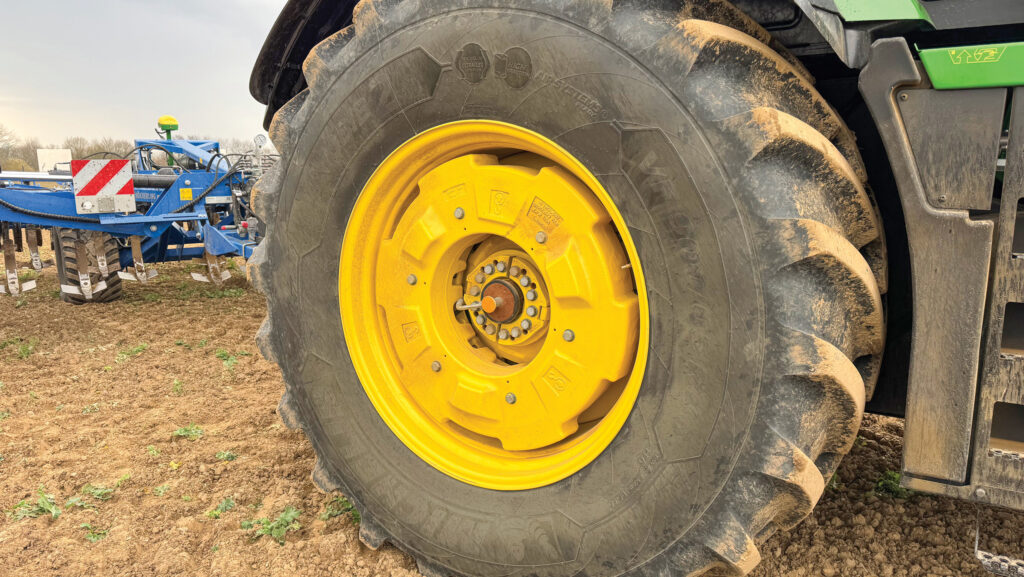
JD 8RX tyre © MAG/Oliver Mark
Allied to this is the option of “group 50” very-high flexion tyres such as the VF 900/65 R46s worn by the pictured demo machine.
As well their appealing aesthetic, the lower aspect ratio – sidewall height half tread width – promises to improve stability by minimising the bouncy-ball flex of their flanks.
For maximum effect, these need pairing with a central tyre inflation system, also optional, allowing pressures to be cranked up for tarmac and dropped for dirt.
This will lengthen the footprint, reduce compaction and improve power transfer, though whether they manage the latter as effectively as Fendt’s 1052 remains to be seen.
With the fully automatic torque distribution of the Germans’ VarioDrive four-wheel drive system so widely lauded, traction will be keenly inspected and dissected in field comparisons.
To help keep rubber biting into terra firma, Deere has added a new integrated front linkage capable of carrying up to four 700kg steel slices.
More ballast can be fitted to keep the backside pegged down – in this case, 950kg inner wheel weights and 820kg outers.
The RX is also available with a front hitch from factory, having previously been a retrofit affair.
But the biggest change on these models is the track units themselves.
They have been bothersome since launch, though subsequently improved through the fitment of wider idlers and oscillating mid-roller beams that pivot to distribute the weight more evenly.
And they now carry a different loop of rubber, with Canadian supplier Camso given its marching orders and compatriot Soucy, which already arms Deere’s combines, granted the gig instead.
Its 21in, 24in and 30in CustomFit P belts come with moulded drive lugs, more aggressive treads, and, most critically, are designed to run at low tension – something said to have significantly reduced wear.
They’re also longer. This has increased the footprint by 8% over those of an 8RX 410 to maintain the same ground pressure, despite the tractors being 2.5t heavier.
Almost driverless
The cab is riddled with artificial semi-intelligence; the integrated Starfire 7500 receiver allowing maps and bout lines to load automatically and field work to be completed with a single button push.
With the cockpit more comfortable than ever, and drivers little more than night porters, there’s a real risk of them dozing off – especially once they’ve consumed the contents of the fridge.
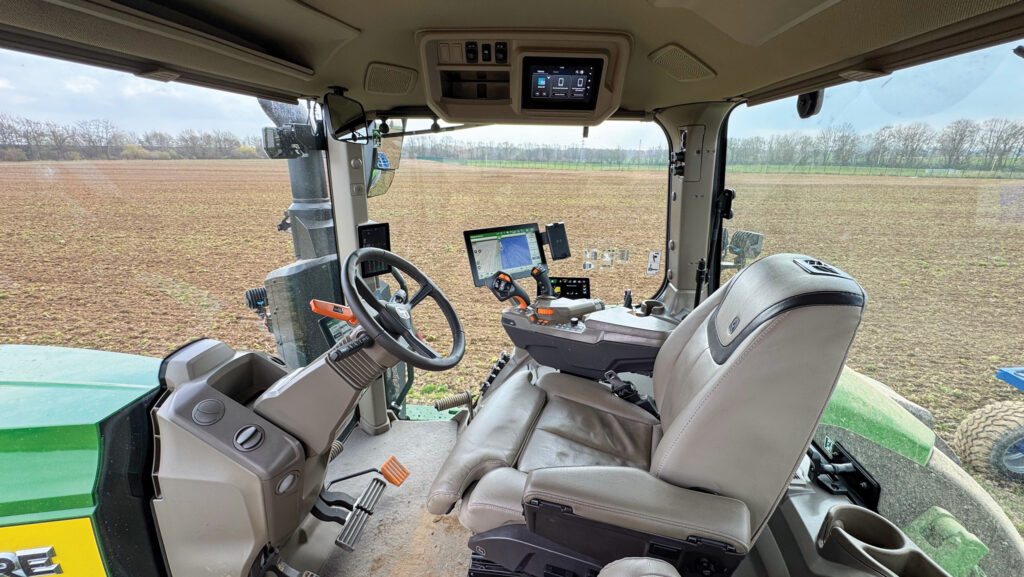
JD 8RX cab © MAG/Oliver Mark
The cab frame is the same as the 9RXs, gaining more foot and front corner space than smaller 8Rs so the seat can swivel freely through 65deg and partially recline into a lounger.
Fortunately for bleary eyes, visibility is excellent – forward in particular – thanks to the long but comparatively slim bonnet that pinches in near the windscreen to leave a clear line of sight to the front wheels.
Novelties include a start/stop button. Gimmicky maybe, but it does have the option of PIN-code activation that will automatically load specific operator settings for the seat, joystick and the like.
These are adjusted through a new 8in display on the armrest, which also manages multimedia and air-con.
Then there’s the CarPlay compatible touchscreen in the roof lining – a recent addition to all Waterloo-built tractors – plus the portrait-shaped A-pillar monitor.
And, to make air traffic controllers properly envious, the option of a second G5, allowing full-screen guidance and machine or implement info to be displayed simultaneously.
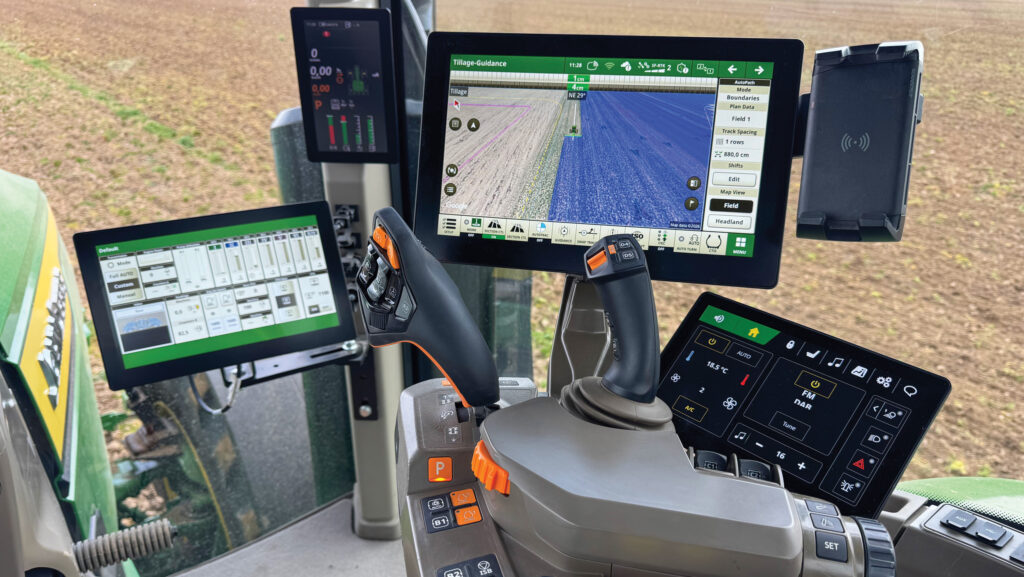
JD 8RX cab controls © MAG/Oliver Mark
Other nice-to-haves include a phone holder incorporating wireless charging, a seat top air vent that blows a breeze up the operator’s neck, and an electric door cinch to save them getting in a sweat trying to slam it shut.
FW verdict
List price is £700,000 for a base-spec wheeled 8R 540 and £110,000 more for an RX. Oof.
Yet these 8s will undoubtedly sell, and in healthy number if Deere’s prediction of a surge in demand for high-horsepower wheeled tractors proves true.
It certainly sounds plausible, with the extra versatility over an equivalent artic.
And even Claas’s Xerion to a certain extent, potentially allowing owners to work them a little harder each year, use them for a broader range of tasks, and reduce the time wasted on inter-field commutes.
They might not put the power to the ground quite like a Quadtrac – or even a Fendt 1052.
But, if the margin of difference proves slim, knocking rivals from their perch may come down to software rather than steel.
And there lies Deere’s trump card: thousands of farmers and contractors now rely on its vaunted Operations Center and buying green-and-yellow tractors allows them to get the best from it.
Order books for the deep-pocketed are open now. Deliveries will start in February 2027.
Tale of the tape
These new 8Rs have a 3.35m wheelbase, which is 30cm up on standard models and makes them 36cm longer nose to tail.
Yet their turning radius has only risen by 10cm to 7m on 710mm tyres, thanks to some radical chassis sculpting that sees it nipped in to just 11cm at the narrowest point.
They are heavier though, with a wheeled 540 coming in at 17t and the tracked version almost 22t – 3.5t and 2.5t more than their 410 equivalents.
As for the hydraulics, the rear lift limit is 10.8t and there’s the option of up to three pumps capable of putting out a combined 418 litres/min through six spools.