

McCormick X7.624’s in-cab controls are a work in progress
 © MAG/Oliver Mark
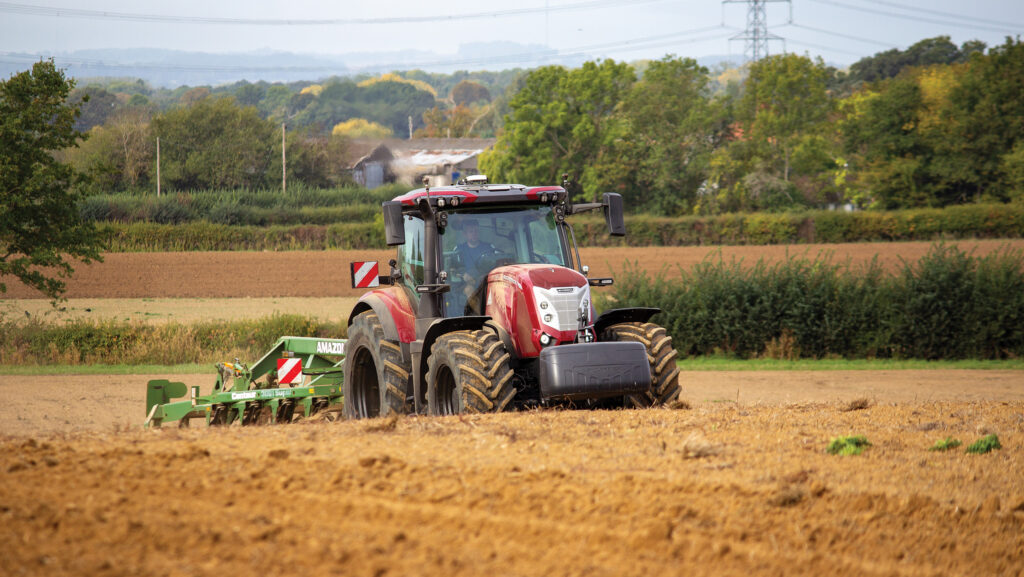
Nine new dealers have put pen to paper in the past 18 months, there is an updated 340hp flagship on its way, and a squad of Italian engineers is working feverishly to revise every facet of the cab. Could Argo Tractors have finally arrested McCormick’s tumbling UK sales?
The answer might be no. But the firm is making every effort to plug the perennial leak of market share – 0.6% at the last count – and though it has lost a couple of relatively big names from its distribution network, it continues to bolster its ranks: two this year, seven in 2025.
See also: First impressions: Sharper handling for latest John Deere 6R
Several are new to tractor sales, but their personal, local service will go a long way in making up for any lack of experience. It’s a tough time to take on a tractor franchise, so McCormick will be hoping they find their groove quickly and use the current market turbulence as a slipstream to usurp the odd New Holland and Massey Ferguson – its most obvious rivals.
After all, it has a solid and largely underrated range. And if it is to properly spread its wings beyond small loader tractors, one of the most important in its brood will be the 240hp X7.624.
This 2019-launched model comes with components from all the usual suspects. Eyes down for a full house: FPT engine, ZF transmission, Carraro front axle and Bosch hydraulics. Oh, and a Dromone pick-up hitch. Bingo!
McCormick X7.624 specifications
- Engine 6.7-litre, six-cylinder FPT
- Max/boosted power 230hp/240hp
- Max/boosted torque 966Nm/983Nm
- Transmission VT-Drive stepless, 50kph
- Wheelbase 2,820mm
- Turning circle 10.8m
- Weight 8.3t
- Gross vehicle weight 13t at 50kph
- Lift capacity 9.3t rear; 3.5t front
- Hydraulics 160 litres/min; four-plus-two spools
- On-farm starting price £147,500
- On-farm price as tested £168,497
What has changed?
It has also been subject to a steady run of improvements that centre around the contents of the cab.
Without the budget of John Deere et al – and their ability to hoover up smaller firms with transferable technology – McCormick has been playing catch-up for years. But it is attempting to put that right with a series of in-house developments.
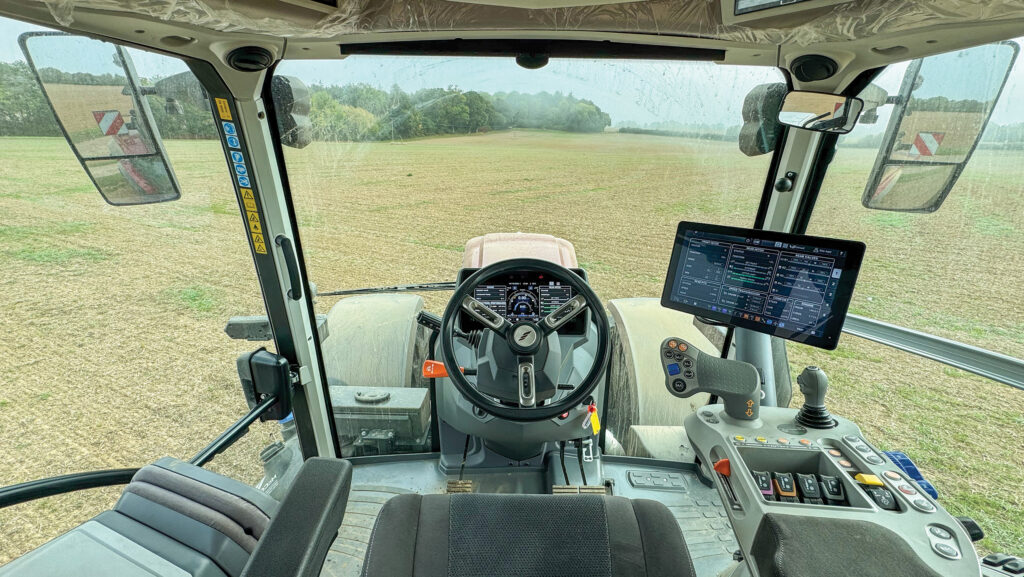
Phase one of this project was the introduction of the four-post “clever cab” on X7s and X8s at Agritechnica almost three years ago. It is appreciably spacious and cocooned by 14% more glass than before.
And not any old glass: Saint Gobain’s Sekurit ComfortSky, which comes with a thermal insulation coating (cooler in summer, warmer in winter) and enhanced UV protection that makes the rear window particularly dark. Perfect for taming rays; less good on a gloomy day and at night.
The roof has also been resculpted, now unusually deep to give operators 80mm more headroom. As for noise, McCormick claims a “best-in-class” 66dBa. The engine chunters quietly at times, but its occasionally inharmonious relationship with the transmission means that’s not always the case.
Other newish features include a small roof window, extra-large wing mirrors and a fancy seat with cooling, heating and a heat swivelling headrest. In summary, spec is up there with the best.
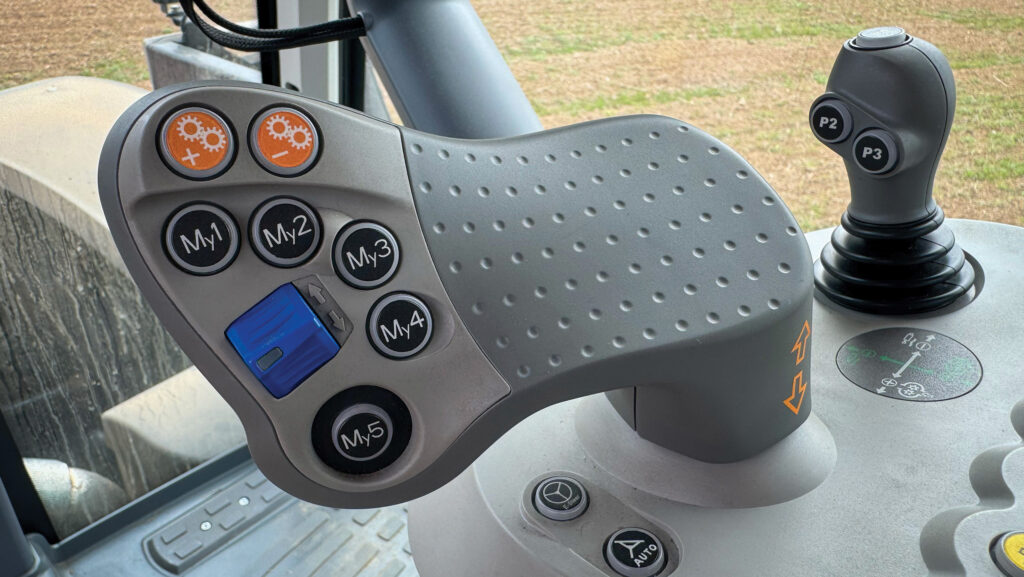
However, McCormick’s budget could only stretch so far. The armrest has hitherto evaded the designers’ attention, and it feels notably old-world. The buttons are simple and, consequently, likeable; the grey colour less so given its propensity to collect dust and dirt.
Plans for a major upgrade are afoot, which will include integrating the radio – currently an Alpine head unit with wired Apple CarPlay/Android Auto – into the screen.
© MAG/Oliver Mark
Touchscreen revamp
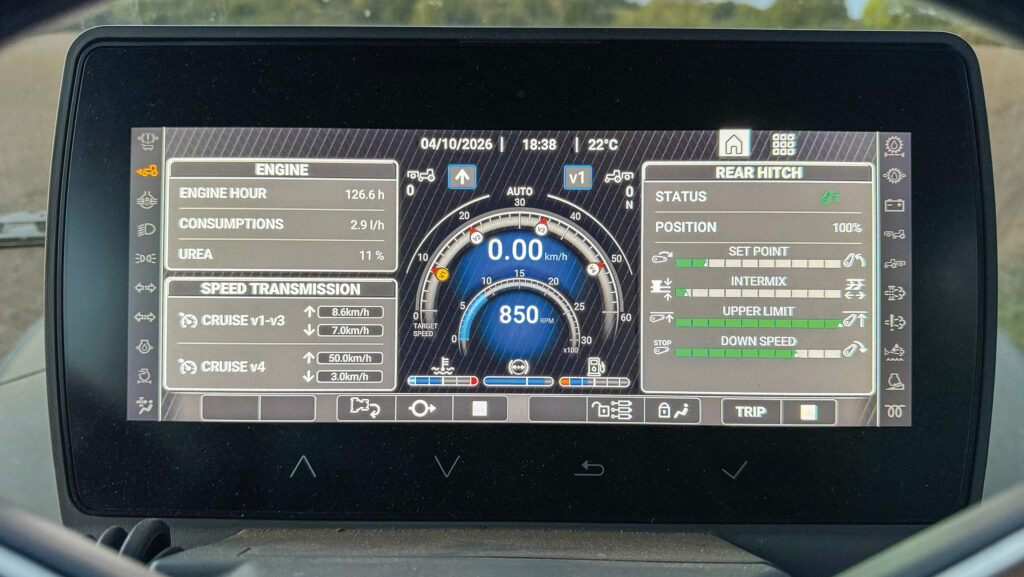
With the cab came McCormick’s 12in DSM armrest-mounted touchscreen, followed earlier this year by a thinner DSM Plus version and accompanied by a customisable digital dashboard of equal size. The former can control the latter, owing to their shared processor.
Frankly, it’s hard to love the digitised dash, though nor is it hateful. The good first: it can show all the tractor performance info on its series of moveable display tiles. This is important when the armrest monitor is being used for isobus implement control or guidance.
Downsides are that it can look confusingly cluttered, it’s not possible to enlarge the section that shows engine revs, fuel level and speed, and you can’t see the whole thing through the steering wheel – hence why other manufacturers have moved it to the A-pillar.
All the work settings are altered through the armrest touchscreen. The icon-based format is easy to navigate, though it’s a shame that details on the home screen don’t act as quick links to make adjustments. The graphics lack sharpness and the software is slow, but neither is a big deal.
McCormick now offers its own guidance system, which replaces the standalone Topcon units used previously.
The full package, including an RTK-ready CHC Nav receiver, costs £8,000, plus software unlocks for section control and variable rate. Operators can’t yet set a linkage or pto trigger to paint only the worked area on a field map, but an update for this is coming, as is a means of putting the map on the dash screen.
© MAG/Oliver Mark
Proven powertrain
Like New Holland, Case IH, JCB and Deutz-Fahr, McCormick continues to bank on the reliability and efficiency of FPT’s ubiquitous 6.7-litre engine. It has been in the X7 since 2013 and is, undoubtedly, a good choice.
The flywheel throws out 230hp – plus a 10hp boost – and up to 983Nm through a 1,400-1,800rpm band. Healthy torque backup helps it push through challenging patches of ground and there’s a “freeze” button that locks the engine speed and transmission ratio to help further in this regard.
The VT-Drive transmission has four imperceptible mechanical ranges – the most efficient power transfer occurs at 4, 11, 22 and 45kph – and four virtual ones, which the driver can adjust. Then there are two cruise speeds that must be assigned a “My” button on the joystick; the tractor wantonly drifted more than 1kph from these targets. And it could really do with a scroll wheel for quick speed tweaks.
Other features of note include a new “smart power zero” function that prevents creep by automatically engaging the brakes when stationary, a foot-activated engine brake and, with no park position on the shuttle, a handbrake.
The latter is fine in principle, but has a ludicrously long arc, is unsatisfyingly loose to the pinch point, and reaching to the floor to release it fully requires at least a month of Pilates training.
© MAG/Oliver Mark
Slick suspension
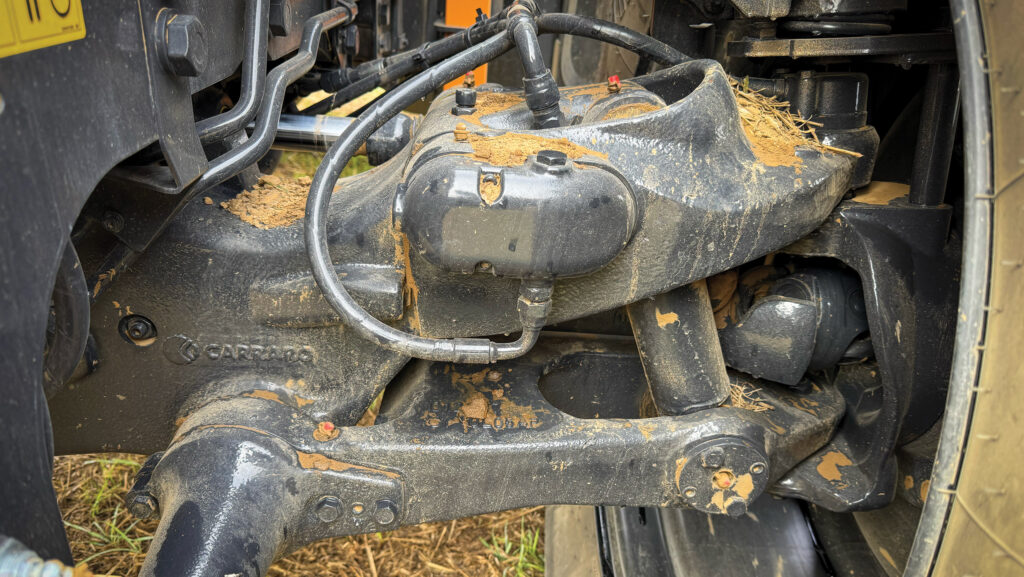
One of the best features is Carraro’s front axle with independent suspension. As owners of older Claas tractors will attest, it comes with strings attached: eight grease nipples each side.
But, paired with the semi-active, electrohydraulic cab suspension, the reward is a supremely smooth ride. The “super-deluxe” air-suspended seat also plays its part and, clad with Alcantara upholstery, is as comfortable as its name suggests.
A similarly supple material wouldn’t go amiss on the steering wheel. Instead, there’s a hard plastic seam running around its face, which gnaws away at the driver’s palm – especially when turning the wheels to full lock regularly.
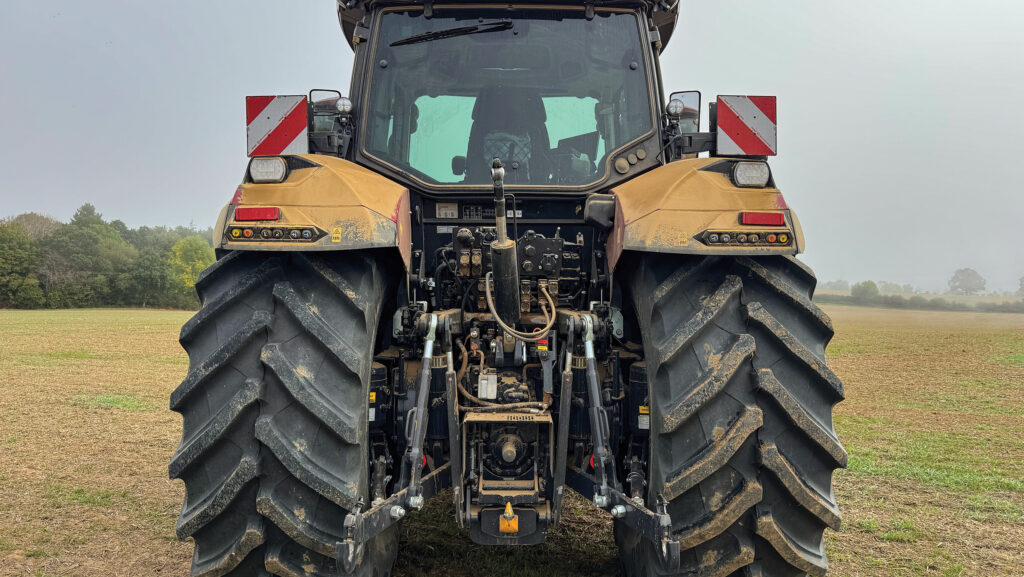
The hydraulics are also worth a quick mention. More specifically, the option of having four controls but six rear services, two of which are accessed via a diverter valve.
It is a bit confusing, in that spool number one must be set up on two of the joystick “My” buttons. Of the four conventional electric paddles, the first three work spools; the fourth controls the diverter.
This is a handy system in that it saves tying up one of these with the pick-up hitch or top link if it is seldom used, yet it can still be operated when required – without having to climb out the cab and soil clean hands. It’s also possible to allocate spools to the mini joystick for mowing.
© MAG/Oliver Mark
Farmers Weekly verdict
Not bad. The front axle suspension is silky-smooth and the engine and transmission are both time-proven on tractors that sell in far greater numbers – if not faultlessly married on the X7.
The cab, too, is bright, uncluttered and eminently pleasant to spend time in. But the drawn-out introduction of technology makes for a slightly odd mix of digital and analogue.
The screen’s slightly slow operation and Sega Mega Drive graphics are minor issues – and McCormick could do just as well going without it all. With plenty of farms keen on old-school horsepower, stripping these tractors back to their core components and selling them at a keen price could be a shrewd move.
It’s already working on bare-bones “eco” versions of the short-wheelbase P6-Drive models: same powertrain and whatnot, but with zero requirement for a touchscreen. More of that, please.
© MAG/Oliver Mark
Likes and gripes
Likes
- Smooth suspension
- Efficient and reliable engine
- Spacious cab
- Icon-based screen navigation
- Spool diverter a useful option
Gripes
- Slightly clumsy turning circle
- No scope to fit a second screen (additional displays are coming in early 2027)
- Bit-part integration of controls into the terminal
- Long-throw handbrake; no park position
- Skin-scratching steering wheel seam