

More driverless tech for Amos Power’s 85hp electric tractor
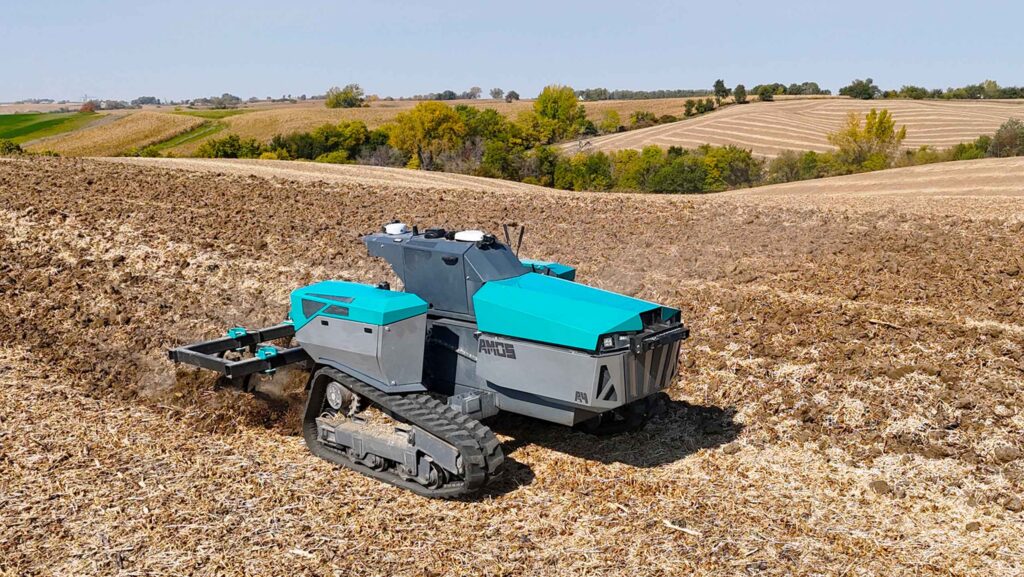 Amos Power’s self-driving tractor guided by FarmX Perceptive Navigation © Amos Power
 A US digital tech business hopes to emulate European manufacturers such as AgXeed by selling a twin-track driverless tractor for field work.
Weighing in at about 3t, the Amos Power machine runs on two triangular track assemblies, giving it an overall length of 3.2m, and has electric drive equating to about 85hp.
See also: £50k Sabanto Steward kit gets Fendt 700s working autonomously
It has been developed for field and orchard work such as cultivations and planting, weeding and vegetation control, with Amos claiming a run time of four to eight hours, depending on the task.
Having sold some units, the business has now been acquired by California-based agriculture software specialist FarmX, which two years ago unveiled Perceptive Navigation, a robotics platform that relies on sensors rather than satellite guidance.
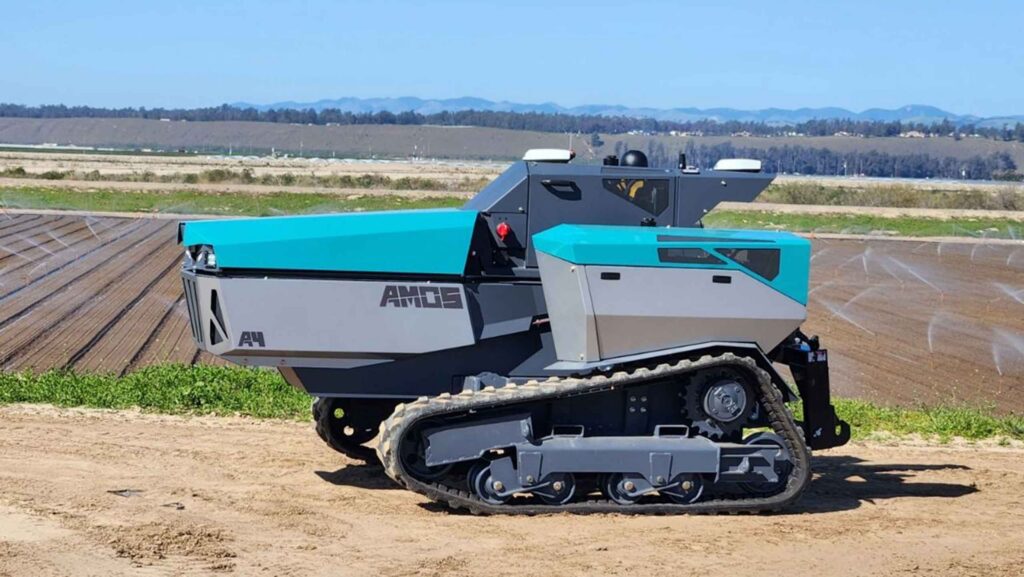
There’s battery electric power to the tracks © Amos Power
Perceptive Navigation Autonomy Kits can be licensed for installing on tractors, all-terrain vehicles such as UTVs and ATVs, and drones.
They consist of sensors feeding an on-board “artificial intelligence compute engine” that recognises and understands features such as trees, poles, boulders and branches.
FarmX says it will accurately control and position vehicle attachments with +/-2cm accuracy, and field mapping and task planning takes minutes, with no pre-mapping or detailed surveys required.
Another software product, OrchardPilot, provides autonomous navigation in orchards with a retrofit kit installed in a day, which has been proven across CNH, John Deere and Kubota tractors.
The company has acquired Iowa-based Amos Power with a view to offering a vertically integrated, data-driven agriculture system that combines artificial intelligence, machine learning, autonomy and electric farm equipment.
FarmX says it has secured funding to support Amos Power’s platform integration, expand customer support and scale up manufacturing.