

On test: New engine and transmission revitalise Fendt 516
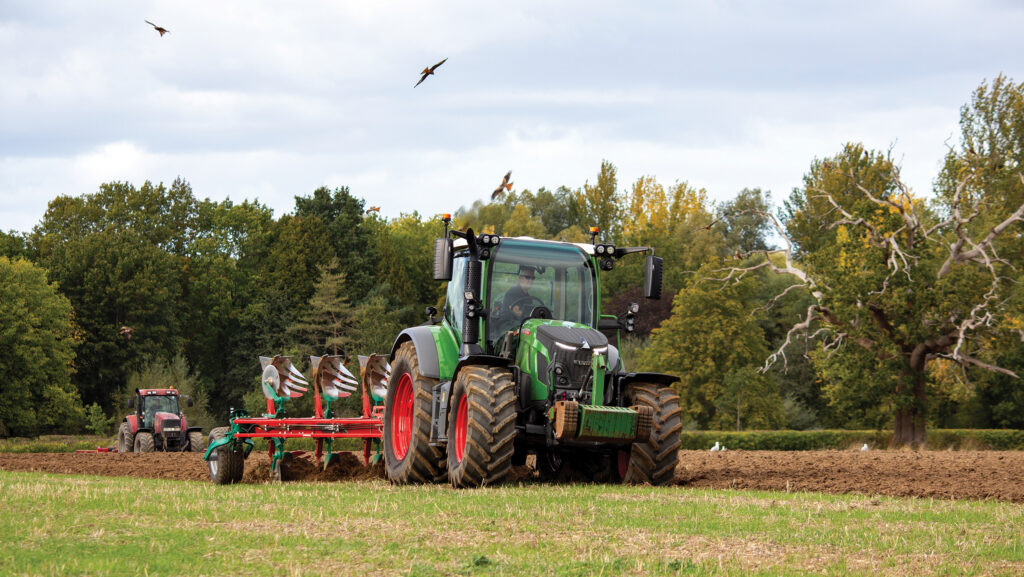 © MAG/Oliver Mark
Too small for heavy tillage and too dear for livestock-related duties, Fendt’s four-cylinder tractors have traditionally served as backfill for the ever-popular 724.
But the tables are turning. With the hencher 700-series occupying new territory, the 2023-launched 600s make for a tempting “downgrade”, and one step below comes the revitalised 500-series.
It starts life on reinforced footings thanks to a successful sales drive last year that turned the outgoing models from range also-rans to some of the firm’s hottest property. The flagship 516 has built a particularly strong head of steam.
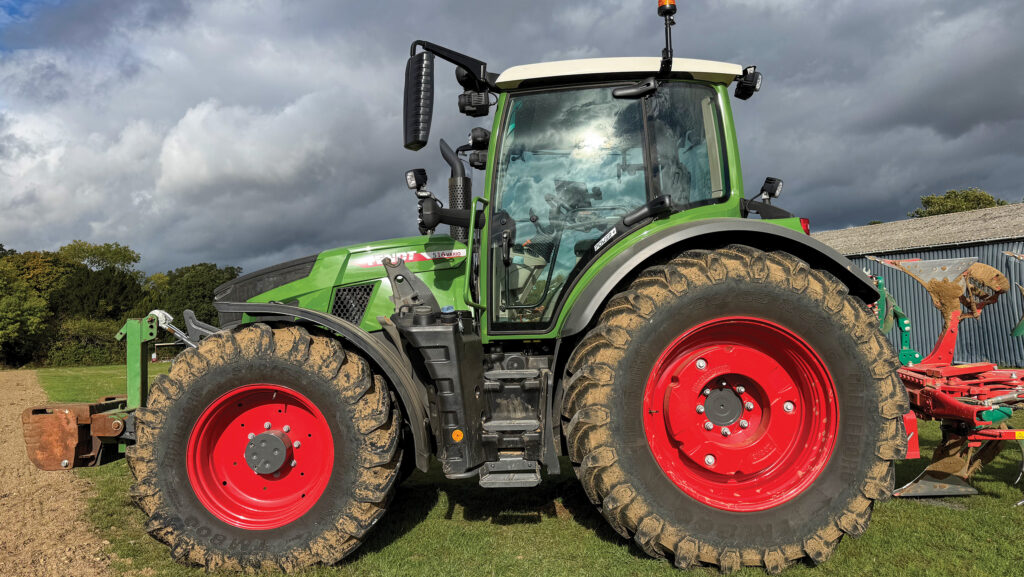
© MAG/Oliver Mark
See also: On test: Four-cylinder Claas Arion 570 proves punchy and nimble
How so? Well, for one, the firm was keen to flog the Gen 3 tailenders, so, unlike the competition, it didn’t apply an annual price increase. A discount of sorts.
Secondly, Fendt UK took it upon itself to pre-spec machines with a so-called “performance pack”. Rather than leaving dealers to navigate the alluring options list, it ordered several boatloads of machines in second-from-bottom Power Plus guise.
This cut out frills such as the drop-from-the-ceiling monitor, leather seat and double-acting link arms that come with Profi Plus – typically the default option on six-cylinder tractors.
Fendt sold a reported 120 of these sensibly specced 500s, plus another 50 with all the bells and whistles. Still no match for the poster boys in the 700-series, but it got the tractors in the hands of dozens of Fendt virgins across western England and north Wales. A raise for the marketing man, perhaps…
So, the omens look good for these latest 500s, which have received two major organ transplants. At their heart is now a bigger-bored Agco engine, which gains them almost one litre in displacement, and a mini version of the slick VarioDrive transmission, as seen on every range above.
Issues with Gen 3s were addressed too, not least with the addition of mid-mounted loader spools that free up the rear outlets for other duties.
The range was also recalibrated, with the 512 dropped – owing to its proximity to the 300-series – and a 515 added. Extra power across the board means this is now equivalent to the old 516.
Fendt 516 Vario
- Engine 5-litre, four-cylinder Agco Power
- Max/boosted power 164hp/174hp
- Max torque 792Nm
- Transmission VarioDrive stepless, 50kph
- Wheelbase 2.56m
- Turning circle 10.1m
- Weight 6,850kg
- Max permissible weight 11.75t
- Lift capacity 7,790kg rear; 3,420kg front
- Hydraulics 109 or 152 litres/min
- Spools Up to five rear, three mid-mount and two front
- List price £201,676
Agco provides the power
These Gen 4s close the book on Fendt’s love-hate relationship with engine supplier Deutz, irreconcilably soured by the soap opera that was the 800-series.
The ousted 4-litre unit, in residence since the 500s’ launch in 2013, had no such issues, but its Agco Power replacement makes it look pitifully small and torque-shy.
This 5-litre Core50 has already served time in the 600-series – fun fact: and a Komatsu forestry forwarder – and its benefits have been widely promoted: 25% fewer components, bigger pistons, lots of torque at low revs, yadda yadda yadda.
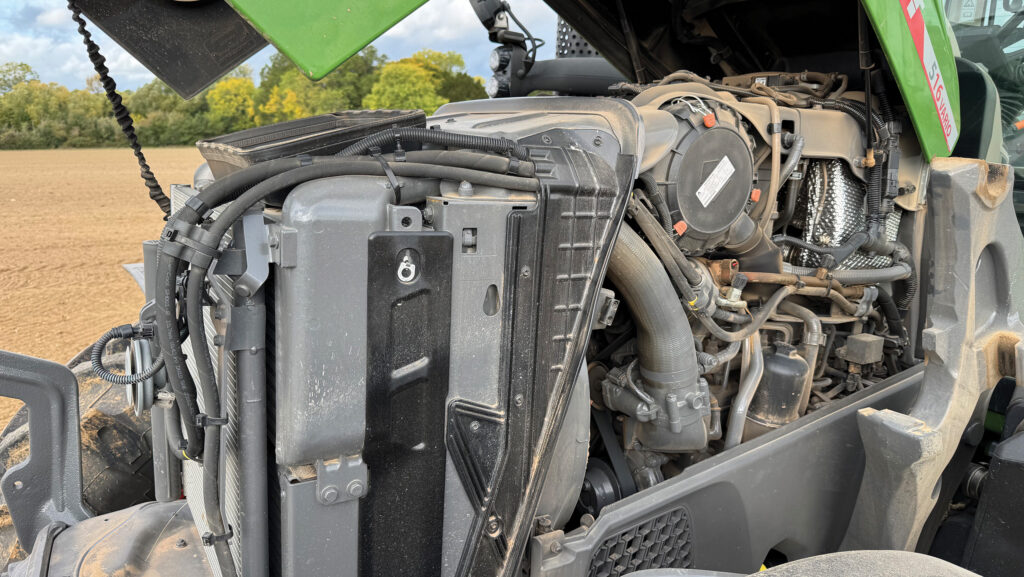
© MAG/Oliver Mark
As far as the 516 is concerned, the headline improvement is a near-100Nm rise in torque. This has it punching above its weight like a honey badger and, though its princely size means it will never be the baddest beast on the plain, it has a bloomin’ good go.
All four Gen 4s – the 513, 514, 515 and 516 – are also now granted access to the firm’s Dynamic Performance system for the first time. This equates to 10 extra ponies, but not in the conventional sense.
It’s a performance maintainer rather than booster, so will free a few more Shetlands to compensate for power leeches – not only the transmission, pto or hydraulics, but also the air-conditioning, cooling pack or compressor.
Like its Agco stablemates, it doesn’t recirculate exhaust gases to stifle emissions. The upside is that it runs cleaner and more efficiently; the downside is its thirst for AdBlue.
Typical rate is 10% of diesel, which is on the high side, but Fendt reckons the price would have to reach £3.45/litre before the cost-per-hour pendulum swings in favour of exhaust gas recirculation.
Likes and gripes
Likes
- Tight turning circle
- Whisper-quiet
- Torquey engine
- High payload
- Easy-access five-pillar cab
Gripes
- Short wheelbase makes ballast essential
- Poor-quality hands-free microphone
- Limited de-speccing options
- Wobbly wing mirrors
- Glitchy direction changes on joystick (pre-production gremlin)
© MAG/Oliver Mark
Sharp-turning VarioDrive
Everything from the 500-series upwards is now armed with the VarioDrive system, which has gradually wicked through the ranges since the 1000-series launch a decade ago. In this case, it’s the TA120, with one drive range and automatic adjustment of the torque split between the two axles.
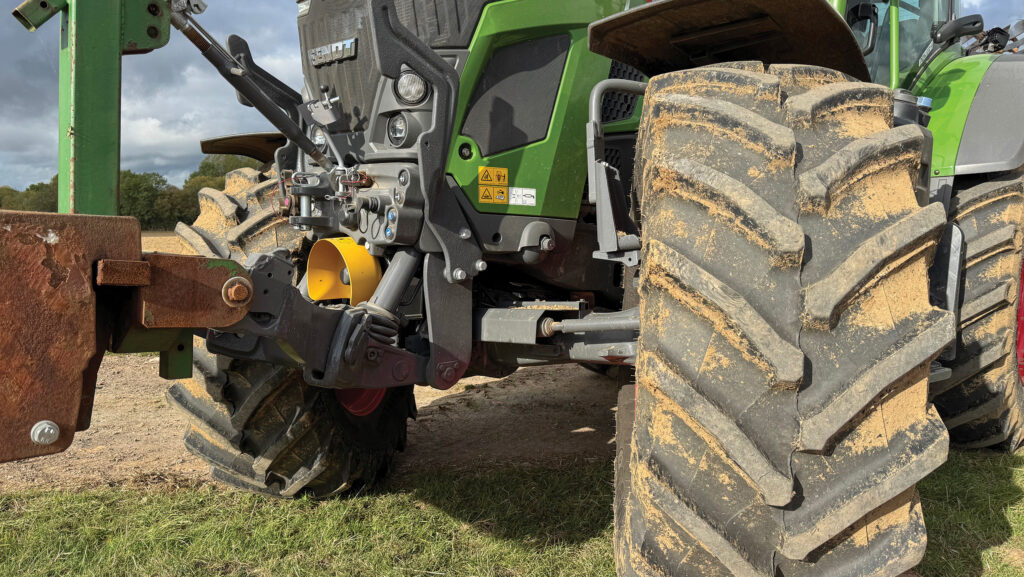
This allows the front wheels to turn faster than the rears to deliver what Fendt has coined the “pull-in turn effect”. It corners remarkably tightly without chewing the ground, meaning less damage to swards, less tyre scrubbing in yards,and less likelihood of overshooting the furrow when turning at a headland.
Trelleborg is certainly convinced of its merits. It now offers a rebate against a new set of ProgressiveTraction tyres – both front and rear – should they have less than 20% of the original tread after 5,000 hours.
Factory-fitted VarioGrip tyre pressure management is also an option – a rarity in this class.
© MAG/Oliver Mark
Short wheelbase
Gold stars to the engineers, who must have spent an inordinate amount of time shoehorning the bigger engine and transmission into what remains the shortest wheelbase in the segment.
This patience-testing game of three-dimensional Tetris involved accommodating the two hydrostatic pumps, clutch, transmission housing and large axles, without downsizing the 290-litre fuel tank.
The tractor is 400kg heavier all-told, concentrated around the waist to maintain a 60/40 weight split front to back. This, along with the beefed-up back end and extra braking power, has seen payload increase to 4.9t.
And total permissible weight is now 11.75t – a 1.3t lead on the equivalent Deere, and 750kg more than Valtra and Claas. This rise is critical given the short chassis and need for ballast with a heavy rear implement.
Gen 3s are highly regarded, but one thing that got up operators’ noses was the lack of dedicated mid-mount spools for a loader. It was an irritating oversight given 50% of machines are delivered with a Cargo – one that meant sacrificing the yellow and blue rear valves to the flow diverter.
But there’s now an independent valve block with up to three outlets for the loader, along with one double-acter on the nose and four at the tail.
© MAG/Oliver Mark
What about the cab?
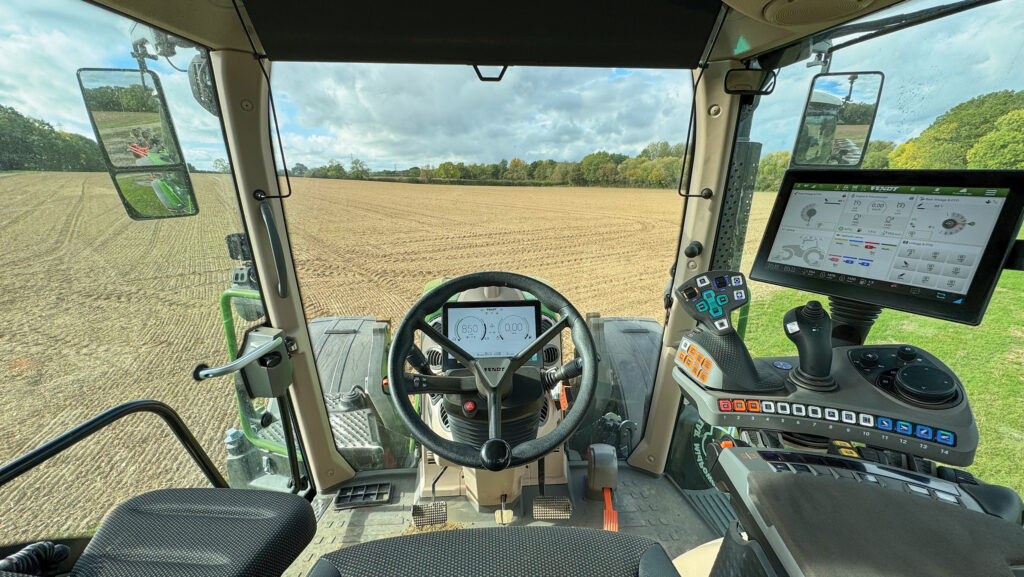
Not much to report – and certainly not much to dislike, unless you take umbrage at the lack of buttons dedicated to specific functions.
The five-pillar frame, still going strong since its launch on the 700s in 2013, is perfect for the job: spacious and with a small, easy-slamming door on the left. The steps are angled gently too, and the grab handle protrudes generously outwards. Embarkation gets no easier.
Improvements include a swivelling seat for the first time and a now-laminated front window that offers protection from stone chips and is less inclined to fog up. It also makes it quieter – gloriously so. It’s like being in an Audi saloon.
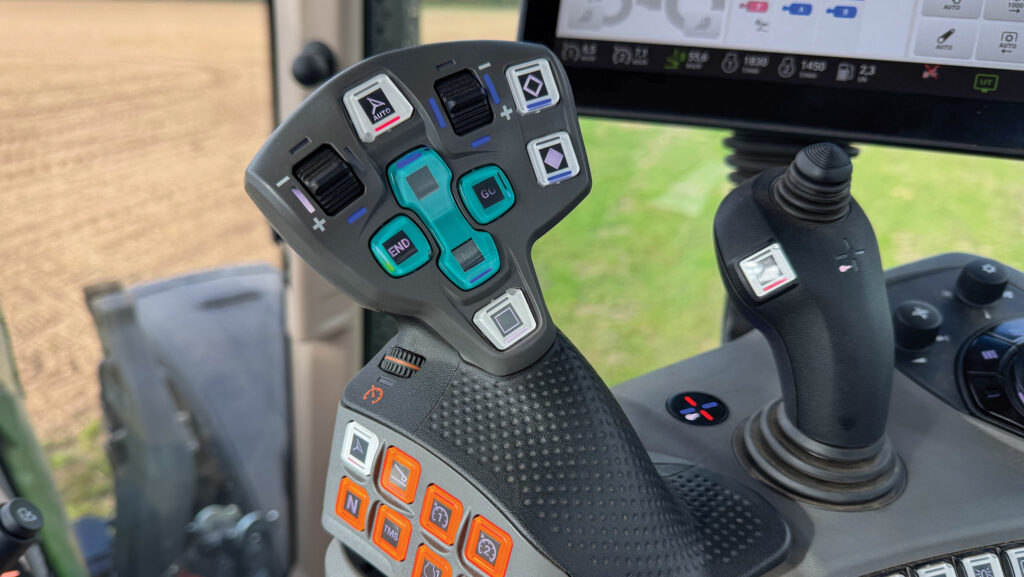
Only a few petty things let it down. Given the cockpit serenity, the ceiling-mounted microphones do an oddly bad job on hands-free calls, the joystick forward/reverse selector was glitchy (a pre-production gremlin) and the dangling wing mirrors wobble furiously.
© MAG/Oliver Mark
Controversially, this writer also felt the bus conductor steering wheel was a tad too big. Direct your uproar at a suitable online forum.
The rest of the controls need no introduction – they’re identical to every other model.
Farmers Weekly verdict
Make no bones about it – this is an excellent piece of engineering: smooth, quiet, powerful and manoeuvrable. The gripes list didn’t come easily, as should be the case with a “premium” tractor.
But as fine a thoroughbred as the 516 is, there are other horses in the race with a good bloodline and similar performance at a lower price. This will be a key factor where the buyer isn’t the driver.
Keeping to a sensible Power Plus spec – not much off entry-level in the Fendt world – will help in this regard, and the firm is also confident some six-cylinder owners will sacrifice piston count in the name of comfort and manoeuvrability. Weight blocks at the ready…