

What’s in Your Shed? visits an enterprising Finnish farmer
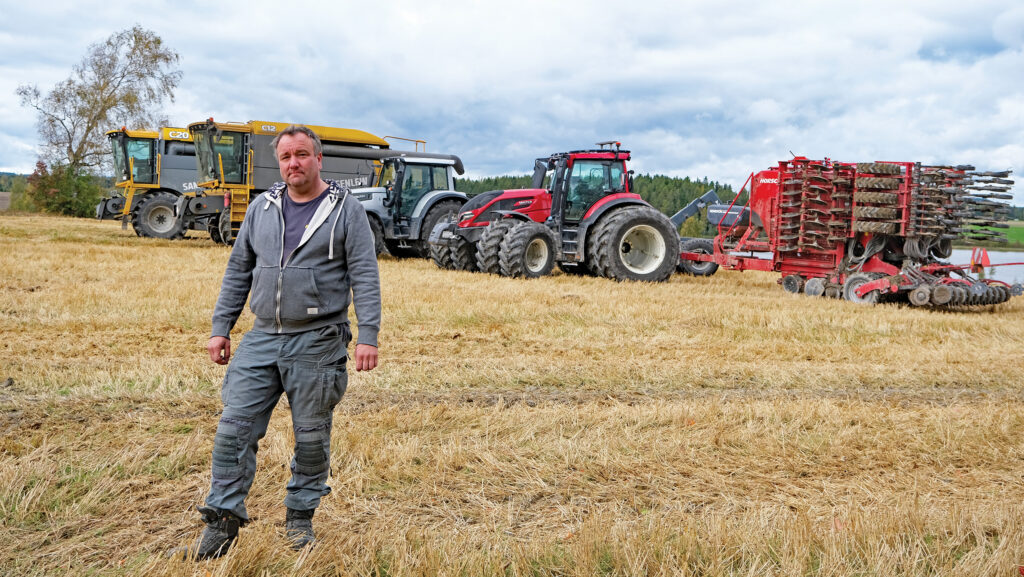 Anssi Mennala © James Andrews
Savage winters and soggy clay soils call for some serious boots, as we discovered when we met Finnish arable farmer Anssi Mennala
See also: First look: Revamped Valtra T-series gets 10-speed powershift
Farm facts
Vanha-Olkkola Farm, Jamsa, central Finland
- Farm size 500ha, 130ha of which owned
- Crops Winter wheat, winter triticale and winter rye, spring oats, spring barley
- Part owner of 1,150ha Estonian dairy farm
- Other Jamsan Paintball site, chief of local volunteer fire service, lay magistrate
How did you get started?
It’s difficult to make a living farming in Finland, so when I got the opportunity to take over the 90ha family farm I needed to find a way of making it pay.
The options were to get another full-time job and run it on the side, like many other Finnish farmers, or get bigger. I opted for the latter.
Initially, I hatched a plan to increase the farm size to 250ha and invested in the machinery I needed to do it.
When I achieved that, I came up with a new strategy to get to 400ha. I’m now farming about 500ha, but there’s still little in the way of profit.
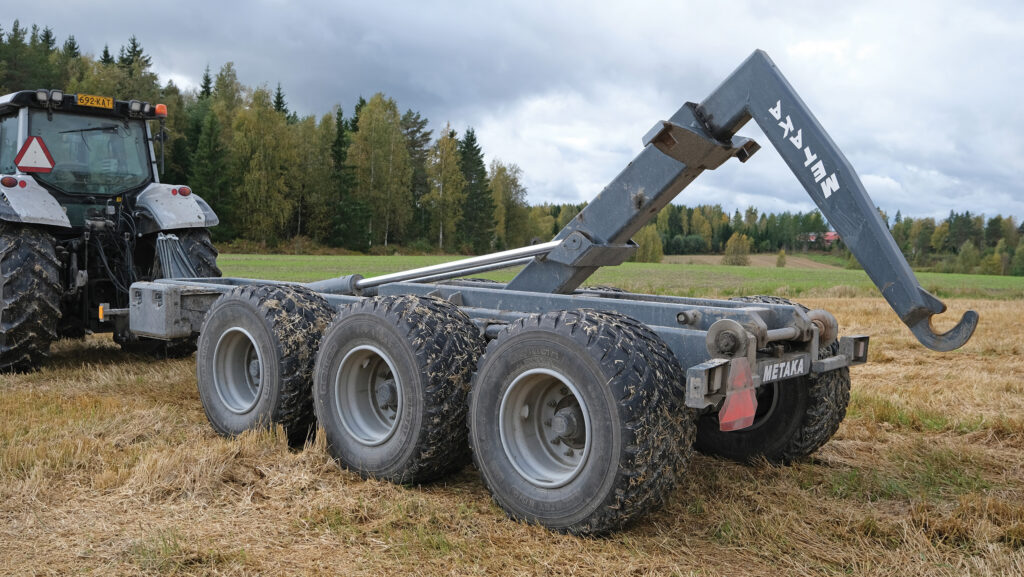
Metaka hookloader © James Andrews
So, I’ve diversified to bring in extra income. I’ve built one of the biggest paintball grounds in northern Europe, which covers 15ha and has 16 different game fields, I’m chief of the local volunteer fire service, and a ley magistrate.
I also have a controlling share in a 1,150ha dairy farm in Estonia [milking around 700 cows, with a total cattle number of around 1,500] which I help run alongside my own operation here.
It sounds like a lot to manage, but the home farm is pretty efficient these days thanks to block cropping and decent equipment that allows me to cover the ground quickly.
Plus, the winters here are long, harsh and boring. Arable farming usually shuts down completely from October to April, which gives me plenty of time to do other things.
Biggest challenges of farming in Finland?
We get five hours of daylight in the winter, lots of snow and temperatures as low as -40C, which is followed by a summer where it never really gets dark.
Autumn-planted cereals therefore go into deep hibernation and then race through their growth stages far too quickly during the long summer days.
We have to put on heavy seed rates of about 1,000 seeds/sq m, which is very expensive, and our average wheat yields are only about 6t/ha.
Then there are the heavy clay soils to contend with – they dig it up to make bricks locally, which tells you everything you need to know.
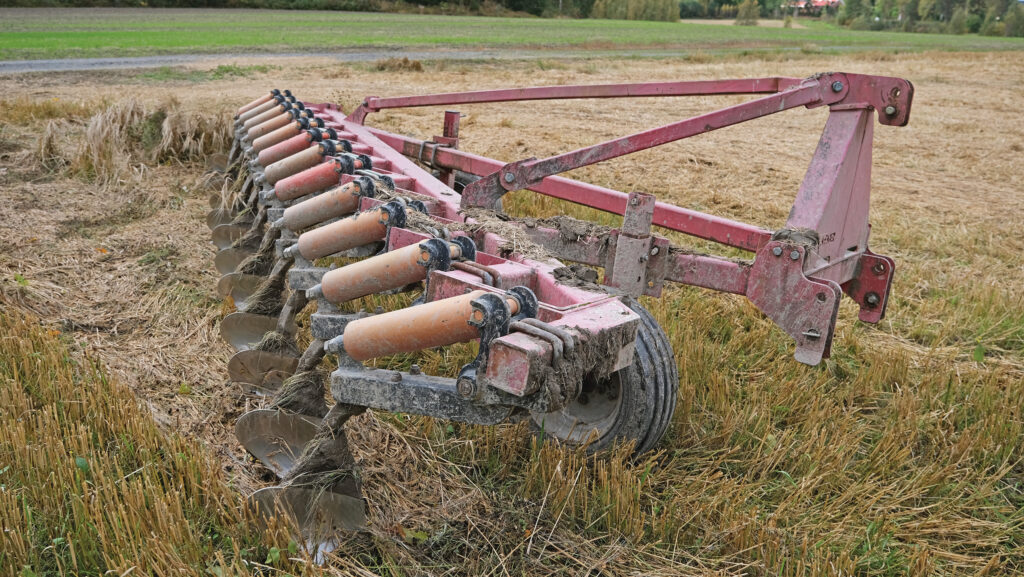
Faber skim plough © James Andrews
The ground is usually saturated by the autumn and stays that way until spring, so I’ve got some very wide tyres and dual wheels to keep machinery afloat and avoid compaction.
Anything that’s fitted with narrow tyres we call a submarine. My cut-off for drilling in the autumn is 20 September and I’m often unable to plant spring crops until late April or May.
Grain drying is another consideration, as we never get a chance to cut below 15% moisture. This summer was the driest on record and we managed to harvest some at 16-18%. Usually, we’re over 20%.
About 15 years ago I invested in a wood-fired grain dryer which I fuel using timber harvested from around the farm.
I was talking to a friend the other day who was using 17 litres of diesel per tonne to dry his grain, so it’s saved me a fortune.
Are you brand loyal?
Backup is the most important thing for me, so I’d be mad to have anything other than Valtra tractors and Sampo Rosenlew combines.
They’re built here and there are plenty of people who can fix them, which can’t be said for many other brands.
We do run the same tractors in Estonia, but the combine is a Claas Lexion 640 as there are a lot more of them than there are Sampos.
For the same reason, we traded in an excellent Seko self-propelled mixer wagon for a Faresin. It’s rubbish in comparison, but we made the switch because there are good mechanics to look after it.
Favourite machinery dealer?
I don’t really use dealers as most of my machinery comes direct from Agco Suomi [Agco Finland] or Sampo Rosenlew.
There are some great independent engineering firms and suppliers locally though, many of which are here because of the large paper mill.
This means it’s fairly easy to get machinery repaired or modified and I can often get cheaper parts than going direct to the manufacturer.
Favourite piece of kit?
The Sampo C20 combine. It’s a hybrid, so output is good, losses are very low and it produces an excellent sample.
Straw quality might not be a match for my C12 walker model, but that’s of no concern to me as all mine gets chopped – there’s just no demand for it.
I do a bit of testing work for Sampo and originally had it here as a development machine. It did a stint in Brazil and was then rebuilt before coming back to me. I’ve just bought it off them.
The cab is basic compared with a Claas and the technology is a bit out of date – just like Subaru cars – but it’s solid, reliable and works well in damp conditions, which are much more important.
And your least favourite?
When I took over the farm, we had a Juko HT4000 box drill that was awful. If we could have sown a hopper full of seed without a problem we’d have had a party. There were never any parties.
What are the biggest tyres you run?
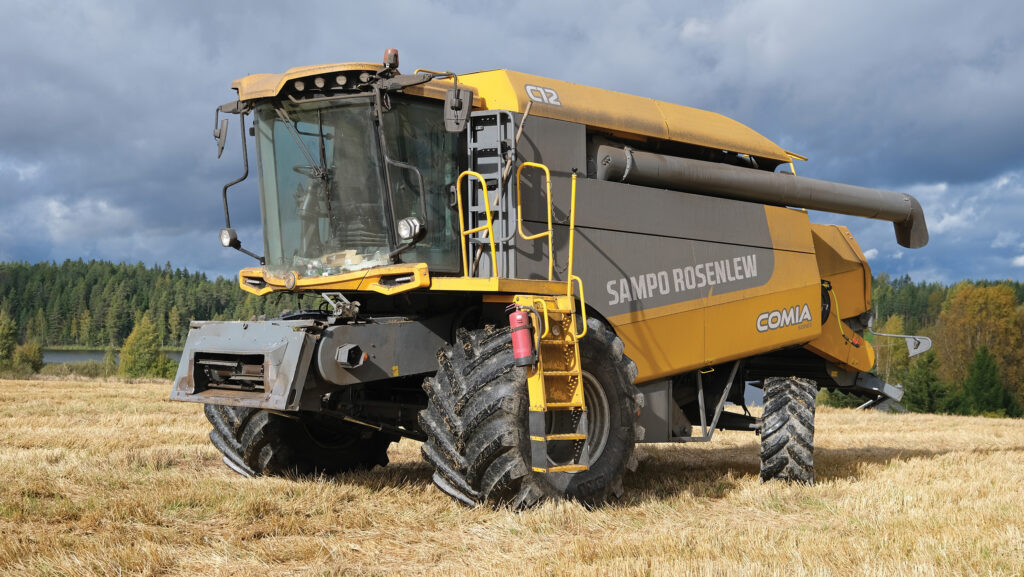
Sampo C12 © James Andrews
The 1050/50 R32s on the front of my C12 combine are the biggest single tyres. However, when the Valtra Q285 is set up for drilling it has a particularly large footprint to avoid it leaving wheel marks.
I’ve got dual 710s at the rear and dual 600s at the front, which I run at just 0.3 bar. You can barely see where I’ve been, even when the ground is sodden.
At this pressure, there are some sizeable bulges in the tyres, so I also need wide spacers to avoid the outers and inners rubbing. The outfit is huge as a result, sitting at 4.5m wide, although I am allowed to drive it on the road legally.
Best tractor you’ve ever had?
A Valtra T202 Versu. It was chipped to about 240hp and, without any emissions kit to strangle it, it punched well above its weight.
It gripped well too, had smooth suspension and didn’t give any trouble during the 5,000 hours of work I did with it.
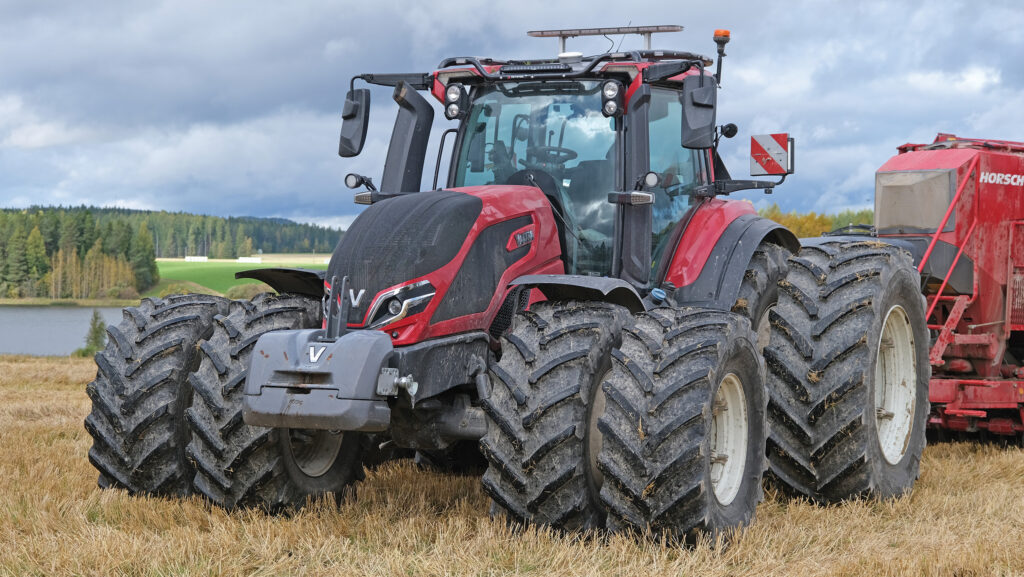
Valtra Q285 © James Andrews
The only reason I sold it was that I needed a bit more power to pull my 6m Horsch Pronto drill. The Valtra Q285 replaced it, which is also a great tractor; it doesn’t quite have the personality of the old one though.
My old Massey Ferguson 2680 also deserves a mention. It was the main pulling tractor here from 1982 to 2006, then it went to the Estonian farm where it notched a ridiculous number of hours running a slurry pump.
I don’t know exactly how many, as the clock stopped working years ago. It still runs and the plan is to restore it one day. I might even make it four-wheel drive using the front axle off an old 2620 that I’ve got sitting in the yard.
And the worst?
Not all the Valtras I’ve had have been good. A few years ago, I had an N141 HiTech that was plagued with transmission problems.
The gearbox was originally designed for much smaller tractors and I think 150hp was a bit too much for it, particularly as we pushed it fairly hard.
I had the gearbox repaired several times before trading it in. I feel sorry for the person who bought it next.
Oldest machine still at work?
A 5.6m Vaderstad Swift does most of my primary cultivation work. It’s a fantastic tool and leaves a nice open finish, but sometimes you just need to turn the soil over.
This is where my old 12-furrow A-Faber skim plough comes in. It brings up fresh ground without working too deep and I can cruise along at a fair pace with it.
After a quick buzz over the furrows with my 9m Potila Master tine cultivator, I’ve usually got a decent seed-bed for the Pronto.
Most overpriced spare part?
Anything that comes from the mainstream manufacturers tends to be expensive. We call it the marble desk premium – if the place looks too smart, you’re going to be paying over the odds.
When I’ve shopped around, I’ve managed to find some parts for a few euros that would be hundreds from those outfits.
Most expensive repair bill?
Probably the transmission rebuilds on my old Valtra N141. I can’t remember the exact figures, but I spent several thousand euros repairing that thing.
Best invention?
The biggest time savers are my custom hook loader grain trailer bodies that slot inside one another. This means we can take two to the field in one trip and drop them on the headland while we’re combining.
The driver then waits for the first to be filled before lugging them alternately back to the bins.
I’ve got several sets, so we can drop them off at strategic points, which saves a lot of travelling. It’s also much cheaper than having multiple trailers, and I’ve only got one set of running gear to maintain.
Another is my 33cu m bulk seed and fertiliser trailer, which has an auger at the rear for filling the drill and fertiliser spreader.
It has its own self-contained hydraulic system, so it can be left in the field and operated without tying up another tractor.
This is powered from a spool valve on the back of the drilling tractor, which is connected using a Fastec quick coupler.
All functions are remote controlled, so I can tilt the trailer and operate the auger from the drill platform. We did our calculations carefully, so there’s no risk of the trailer toppling when the body is lifted to full height.
The time savings compared with loading individual bags is massive, particularly with the high seed rates I’m using.
What couldn’t you live without in the workshop?
The best tool I’ve got by a long margin is my four-wheel-drive Mercedes Vito mobile workshop van fitted with BF Goodrich All-Terrain tyres.
It’s loaded with a full complement of power tools, a mini work bench and lots of removable containers that make it easy to swap tools to suit the jobs we’re doing.
There’s a big inverter for running chargers and I installed a computer and touchscreen so that it doubles up as a mobile operations centre. I can even run my grain dryer from it.
I’d be lost without my 3D printer too. It took me a while to learn how to use it, but I now make all sorts of custom hooks and components. It made several of the mounting brackets in the Vito.
Most embarrassing machinery mistake?
I got a bit too enthusiastic when pulling onto the road with the combine and managed to flip the header trailer, which was being towed behind, onto its side.
Someone called the emergency services and my fire department pager started to buzz just as we were about to tip the trailer back onto its wheels… I was being called to attend my own accident.
We finished up as quickly as we could and I called my colleagues to say: “nothing to see here”. They still sent me “top driver” trophy for my efforts though.
There was another on the Estonian farm: one of the drivers fell asleep while spreading slurry with an S-series Valtra and drove straight into an oak tree.
That tree had survived the Second World War and the Soviet Union, so the best the 400hp Valtra could achieve in that fight was silver. The oak was unmarked, but the front axle was torn off the tractor and it was a complete write-off.
What’s your everyday transport?
My only farm runaround is the Vito workshop van, which is far more useful than a double-cab pickup – those are stupid machines in my opinion, as the load bed is small and you have to crawl in to access the front of it.
I’ve also got a Subaru Outback, which takes me to and from the farm in Estonia.
Most surprisingly useful feature you’ve found on a machine?
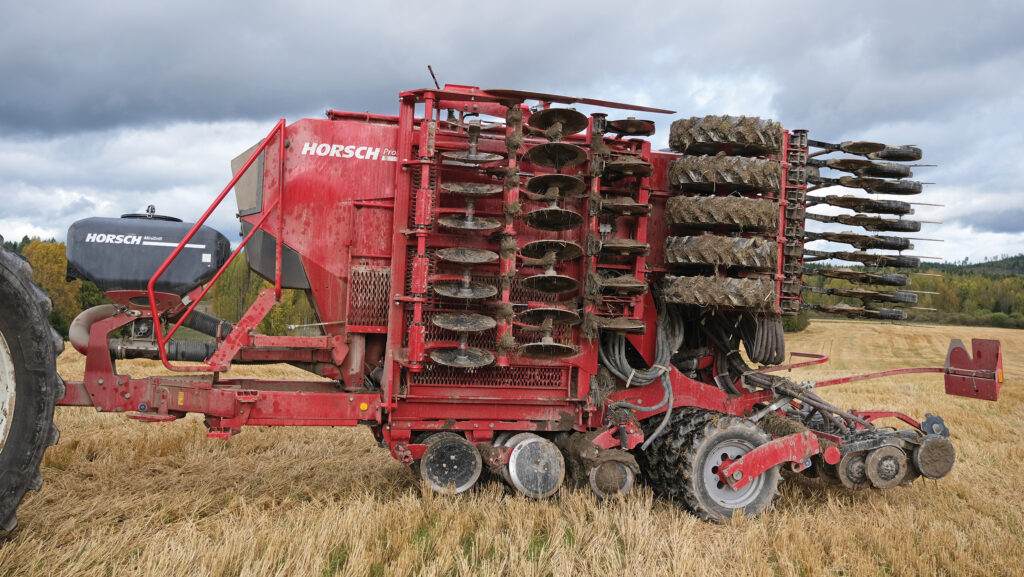
Horsch Pronto drill © James Andrews
I’m a big fan of auto-section control. I’ve got it on the Horsch Pronto drill, the Horsch Leeb trailed sprayer and the Amazone fertiliser spreader. It makes all of those jobs far more accurate and saves me wasting inputs on overwraps.
Most pointless piece of farm technology?
You’d think I’d be a fan of autosteer too, but I’m not keen enough on it to shell out for the unlock codes and signal subscription.
I just don’t think it’s worth it on a farm this size with lots of small 6ha fields. Instead, I do my drilling the old-fashioned way with markers, which works perfectly well.
We do have autosteer on the Estonian farm though, as there’s far more ground to justify the expense.
In the shed
- Frontline tractors: Valtra Q285, T234 and T172
- Classic tractors: Massey Ferguson 35, 135, 2620 and 2680
- Combines: Sampo Rosenlew C12 and C20
- Sprayer: Horsch Leeb LT6 trailed
- Fertiliser spreader: Amazone ZA-M hydro GPS -30 on Pellonpecco wheeled bogie
- Drill: 6m Horsch Pronto with PPF System
- Cultivators: Vaderstad Swift 560 and Potila Master 900
- Other: Mercedes Benz Vito mobile workshop, Metaka 240 hook loader, custom bulk seed and fertiliser trailer, Volvo EC160B LC excavator