

FW Survey: Widespread fear of government policy for 2026
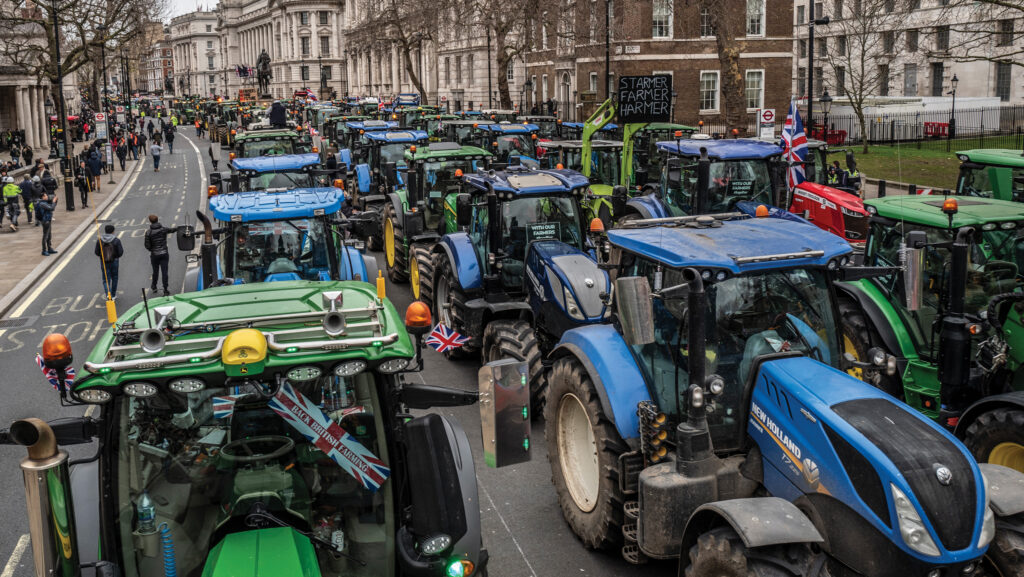 Farmer tractor protest in Westminster © Phil Weedon
 When it comes to the great British weather, farmers are nothing if not eternal optimists.
Every year we ask our readers what has been the greatest challenge they have faced in the preceding 12 months.
And for each of the past three years “extreme weather” has taken the top slot.
See also: FW Survey 2025: A year of improvement – for some farms
But when we ask them to predict the greatest challenges for the 12 months to come, predictions of yet more wind and rain slip down the rankings.
Rising costs
It is therefore little surprise to find that just 8% of respondents in the latest Farmers Weekly Sentiment Survey cite floods, droughts and storm-force winds as their primary concern for 2026.
Of greater concern is the prospect of rising input costs, the fear of deteriorating markets for outputs and, way ahead of these, an expectation that government policy will inflict more damage on the sector.
About the survey
- 783 respondents (was 767 in 2024)
- 83% owner occupiers, 13% tenants, 4% farm managers
- 328ha average farm size (was 245ha in 2024)
- 61 average age (was 59 in 2024)
- Wide regional spread
As ever, there are sectoral and regional differences to explore.
For example, when it comes to extreme weather, a much higher proportion of Welsh farmers identify this as their top challenge for 2026 – 13% compared with 8% across the whole survey.
Generally, farmers are less concerned about rising input costs for the year ahead than in the recent past, though beef and sheep farmers were a bit more pessimistic on this score than other farmers, according to our survey.
But when it comes to market conditions for outputs, concern has returned to 2023 levels.
Overall, 22% said this would be the greatest challenge they face in 2026.
And it is little surprise to see that 29% of those who grow cereals, 34% of those who grow oilseeds, and 36% of sugar beet growers feel especially challenged by this prospect.
Vegetable growers were even more despondent, with the sector still uncertain about whether the Fruit and Vegetable Aid Scheme will be replaced in any shape or form.
Government policy
With regards to government policy, it seems everyone is worried, with 50% citing it as their top concern.
There are some minor regional differences, with Welsh farmers more alarmed (55%), as the new Sustainable Farming Scheme kicks in.
While farmers in Scotland (where post-Brexit support policies are coming much more gradually and EU legacy schemes have at least another year to run) appear slightly more relaxed (43%).
The factors driving these concerns are not hard to fathom, with enormous policy change underway across the UK, and a great deal of uncertainty.
These changes are most advanced in England, where direct payments have already been whittled away to almost nothing, where replacement schemes are either not ready or have been closed without warning, and where any grant funding is both highly competitive and time limited.
This has created a situation of winners and losers.
Those who have been able to get into schemes have been able to recoup some of their lost support.
But those who have not are experiencing extreme cashflow difficulties.
Defra’s standard response to almost any question about agricultural policy is that it has “committed a record amount of funding to support sustainable farming”.
The word “sustainable” is doing a lot of heavy lifting in this statement, referencing new agri-environment schemes.
The reality is that the annual budget has not changed in more than a decade, while inflation has eroded more than 40% of its value since the 2016 Brexit vote.
And then there is inheritance tax (IHT), which affects all UK farmers and has occupied more column inches than any other subject over the past 12 months.
The arguments for and against are well rehearsed, but the reality is that 20% tax on assets over £2.5m will start to bite next April for a sector where a 1% return on capital represents a good performance.
Business prospects
Not surprisingly, the weight of these challenges, and the fact they are almost entirely beyond the individual farmer’s control, has had a significant impact on business prospects.
Our Sentiment Survey always asks how farmers feel about the next six months and the next two years.
For the first time in the nine years we have been asking this question, more than half (52%) describe themselves as “fairly” or “very” pessimistic.
As might be expected, arable farmers are the most downbeat – especially pulse and sugar beets growers – reflecting the continued downward pressure on crop prices.
Farmers who also said it was too late for them to mitigate against looming IHT reforms were especially despondent, as were those with less than 100ha.
It’s not all bad news, however, and there has been a slight upturn in the number who feel “optimistic” about 2026 (from 17% to 19%).
Such feelings are more pronounced among beef and sheep producers, pig and poultry growers, and Scottish farmers – a reflection of the fact that direct payments and coupled supports still feature strongly north of the border?
What else did we discover?
As was the case last year, we found that making provision for old age and for handing over the business in the years to come is woefully lacking in agriculture.
This is despite the rapidly approaching imposition of IHT, dubbed the “family farm tax”, which threatens to act as a drain on family farming businesses.
At least there has been a drop in the number of farmers who have no succession plan at all – from 27% to 21% in 2025.
These tend to be smaller farmers, younger farmers and those who say they will not be affected by IHT.
There has also been a slight increase in the number who say they have a viable pension plan – up from 51% to 54% in 2025.
Farm managers, farmers in Scotland, and those with more acres are the most likely to have made pension arrangements.
Despite the opportunities to top up farm incomes through carbon and biodiversity credits, and the encouragement in some sectors to earn a premium from measured environmental delivery, a majority of farmers say they have not undertaken any audit, and have no plans to do so.
This is likely to change as public money for agriculture diminishes in the years ahead, and the sector turns more to private funding to recoup the deficit.
Working in ag – how do you feel?
Every year, we ask farmers to describe how they feel about being a farmer in 2025, and every year words like “stressed”, “demoralised” and “frustrated” dominate the word cloud.
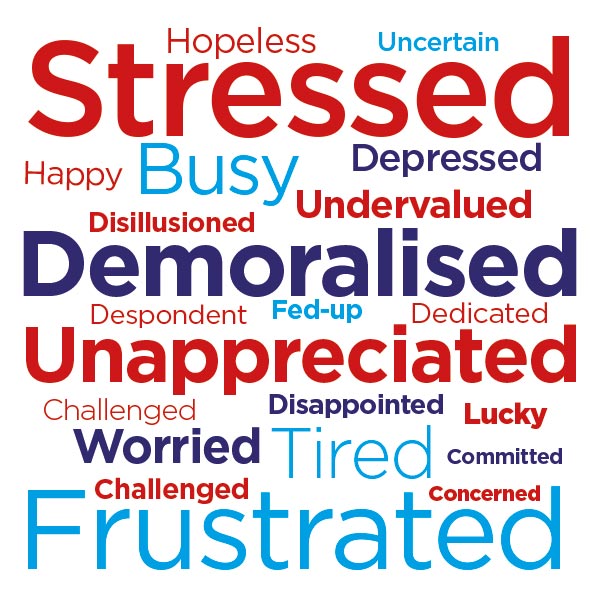
There is, however, some nuance to be found.
For example, there has been a slight drop in the numbers feeling “demoralised” this year, possibly linked to better times in the livestock sector.
But there also seem to be more farmers describing themselves as “unappreciated” and “frustrated”, no doubt related to the machinations of government.
The data also reveals that those who are feeling “uncertain” and “stressed” include a higher proportion of farmers who have no pension or succession plan.
While the most “appreciated” farmers are those who keep pigs, and the “happiest” farmers are in Scotland.
About our sponsor

Virgin Money is delighted to back the FW Sentiment Survey, which sheds important light on the state of British farming.
Our team of experienced agricultural managers is always on hand to provide advice and support for customers across the UK.
We have a long heritage in supporting the sector and recognising the long-term nature of farming.