

New NFU Cymru president outlines priorities
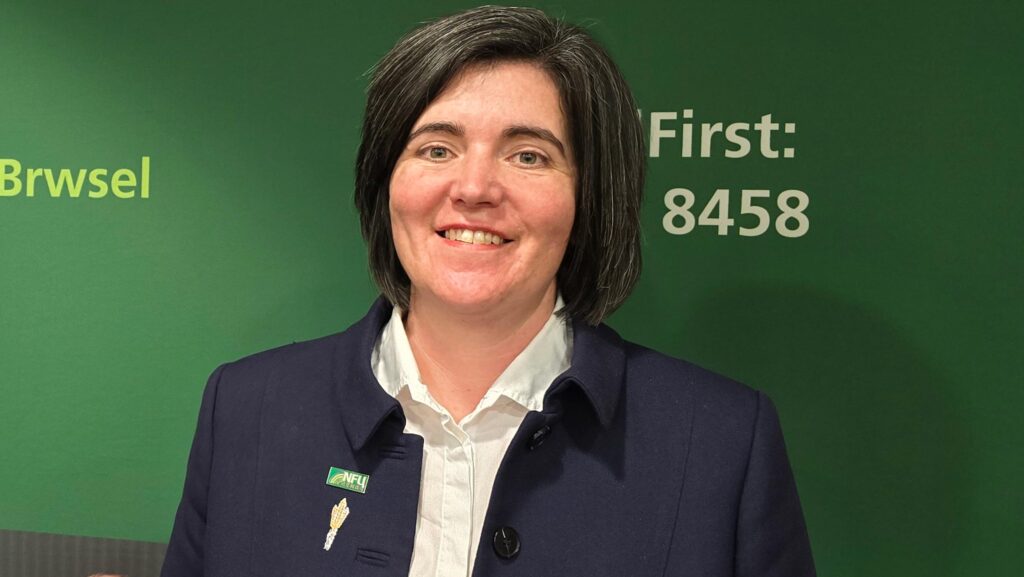 Abi Reader © MAG/Anne Dunn
 The first woman to lead NFU Cymru, Abi Reader, is no stranger to the demands that come with holding an official role while still farming full-time.
Having served as the union’s deputy president for the past four years and supporting former president Aled Jones, Ms Reader was elected to the role unopposed on Tuesday (20 January) at an NFU Cymru council meeting in Cardiff.
Ms Reader is a third-generation farmer, farming dairy, sheep and arable at Goldsland Farm in partnership with her parents and uncle in Wenvoe, Glamorgan.
See also: NFU Cymru elects new officeholder partnership
Speaking to Farmers Weekly, she says having spent four years as deputy president, “being able to take up the reins from Aled and pick up where he’s left off, it is really exciting”.
Passion for the job
Passionate about promoting food and farming to the next generation and the wider public, she is a co-founder of the Cows on Tour movement, regularly engaging with schoolchildren both on farm and in classrooms.
Her history with the union stretches over 14 years, when she first took up the vacancy of NFU Cymru vice-county chairman.
During her time in the union fold, she has also served as NFU Cymru Glamorgan county chairman, NFU Cymru dairy board chairman and NFU Cymru deputy president.
A former NFU Cymru Wales Woman Farmer of the Year, she was honoured by the Queen with an MBE in 2019 for her services to agriculture.
Her appointment to the top spot, she hopes, will inspire other women to step up, but stresses that the appointment wasn’t because she is a woman.
“I’ve been voted in because I’m a farmer,” she said, highlighting that gender and sector representation have little relevance to her appointment.
With a genuine excitement and passion for the task in hand, Ms Reader says the road ahead is a bumpy one with many challenges to face, including the Sustainable Farming Scheme (SFS), the Senedd elections and trade policy.
Sustainable Farming Scheme
“Though the SFS started 20 days ago, a lot of farmers are very frustrated because they don’t really know what that means and whether they want to go into it,” she said.
She added that the upcoming Welsh Senedd elections could bring challenges.
“We know we’re likely going to have a disruption in minister, and that could be quite difficult when we’re going through a period of significant change,” she said.
The SFS will require the next Welsh government to provide answers that the current administration has so far failed to provide.
This ncludes details on the “collaborative” and “optional” layers of the scheme, she says.
“There’s an enormous conversation to be had.
“If we look at hedgerows, we still haven’t worked out what a hedge is and whether it’s a tree or not.
“All those arguments haven’t gone away.”
Food security
An important element to consider, she says, is food security and the role of food production in that, something neither Labour government has grasped.
“Everybody’s going to have to change their mindset and realise that food production has got to become key.
“We cannot have people who are going hungry, not in a developed country like Wales or the UK.
“We’ve got to make sure that all those people [incoming members of the Senedd] are alive to the fact that food impacts everybody.
“It doesn’t just appear on a supermarket shelf.”
Ms Reader says concerns about the future direct support mechanism and the balancing of environmental needs with food production are set against a backdrop of ongoing issues such as bovine TB, rural crime, inheritance tax and trade.
“Take milk prices as an example, it’s a global issue, and there’s not a huge amount we can do about that specifically.
“But nonetheless, where our role fits, NFU Cymru is making sure the operating environment that these businesses have to work in is better.”
International trade negotiation
When it comes to international trade, the new president is clear that any negotiations carried out by the UK government must consider the implications for Wales.
“We have got representatives within Wales, within the Welsh government, who will be going forward to make our case to the UK government for trade.
“They need to understand the geographic and cultural differences in Wales, as well as the heritage.
“There are nuances in Wales, and we need to make sure that those elected to speak for us within the government deliver those messages,” she said.