

NFU Scotland pushes for £90m farm funding uplift
 © Adobe Stock
 NFU Scotland has intensified pressure on the Scottish government to commit to a multi-year, ringfenced increase in agricultural funding.
The union has warned that ministers now have “no excuses” after the UK Spending Review provided financial certainty for devolved budgets.
With the Scottish Budget due on 13 January 2026, the union is calling for a £90m uplift for farming and crofting in 2026-27.
See also: SNP urged to guarantee long-term farm funding
It argues this is essential to halt real-terms cuts and enable the sector to deliver on government priorities around food production, climate change, nature restoration and rural communities.
Speaking at an NFU Scotland (NFUS) press briefing in Edinburgh on Tuesday (16 December), director of policy Jonnie Hall said the union had made its position clear weeks ago and was awaiting a response from Holyrood.
Mr Hall said the policy direction set out in the Agriculture and Rural Communities (Scotland) Act meant farmers were now being tasked with delivering outcomes on food, climate, nature and people – but without guaranteed funding to match.
Farmers ‘asked to do more’
“If we’re going to deliver on those [objectives] we must be enabled to do so.
“And that requires funding from the public purse,” he said.
“That funding is an investment on delivering the outcomes that Scottish government is asking of us.”
He pointed to comments made by first minister John Swinney at AgriScot last year.
He said a “clear line of sight” on budgets would allow a multi-annual settlement for agriculture.
Mr Hall said the UK Spending Review in June had, in his view, given the Scottish government the necessary “line of sight”.
He added that farming was seeking only “a very modest share” – less than 1% of the annual block grant of £50bn.
A £90m uplift would take Scotland’s Agriculture and Rural Economy (ARE) Budget to around £691m in 2026-27.
NFUS president Andrew Connon said long-term certainty was critical for farm businesses making multi-year decisions.
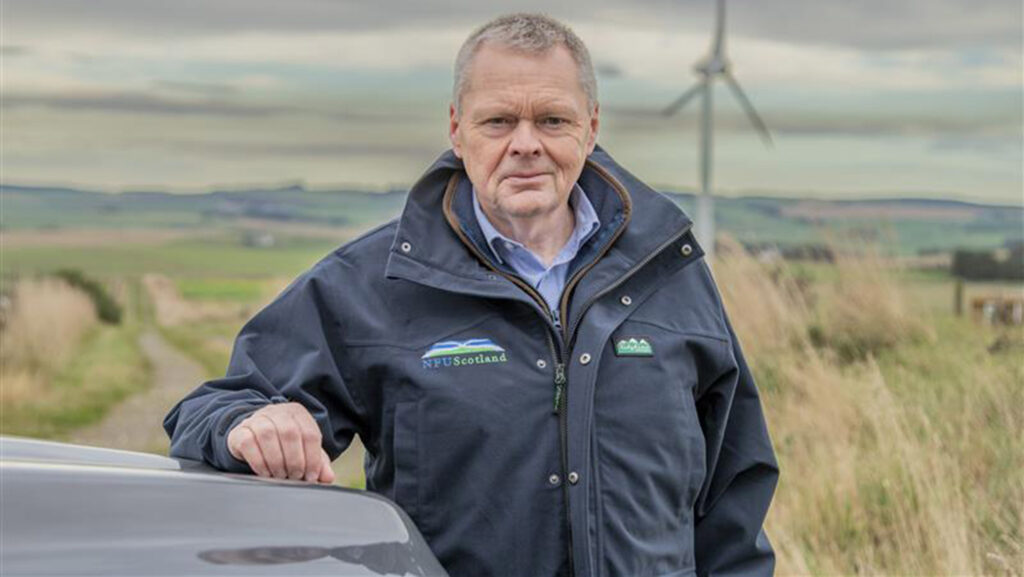
NFUS president Andrew Connon © Paul Watt
“If you’re breeding livestock, it’s a long-term investment.
“You can’t work hand-to-hand and year-to-year.
“We need confidence for a long-term approach going forward,” he added.
Agflation and real terms decreases
The £90m ask, NFU Scotland says, largely reflects inflation and to offset some of the real-terms declines in spending farmers have experienced in recent years.
It is significantly lower than previous estimates by RSPB Scotland of what would be required to meet biodiversity targets alone.
With the Scottish Parliament election looming in May, the union has warned the January Budget will be an early test of whether farming is genuinely being prioritised by the SNP ruling government.
Scottish govt response
In response, the Scottish government confirmed to Farmers Weekly that decisions around the agriculture budget will be announced on 13 January.
Mr Fairlie said: “Where we have the powers to protect and support the agricultural industry, we are doing just that with the most generous direct support package in the UK.
“We have continued to provide much needed stability and investment to our farmers and crofters – in stark contrast to policies elsewhere.”
He added: “The biggest threat to Scottish agriculture comes from the policies of successive UK governments which do not understand or indeed care about our farmers and crofters – from the family farm tax to the abolition of meaningful direct support initiated by the last UK government and continued by the current Westminster government.”
Explore more / Transition
During the series we follow our group of 16 Transition Farmers through the challenges and opportunities as they seek to improve their farm businesses.
Transition is an independent editorial initiative supported by our UK-wide network of partners, who have made it possible to bring you this series.
Visit the Transition content hub to find out more.
