

NFUS launches manifesto as ‘fragmented’ election looms
 © Adobe Stock
 NFU Scotland has launched its 2026 election manifesto, setting out a series of clear demands for the next Scottish government amid what political analyst Sir John Curtice described as “unprecedented” electoral conditions.
The manifesto was unveiled during the union’s annual conference and AGM in Glasgow by deputy CEO and head of policy Jonnie Hall.
He told delegates that the May 2026 Holyrood election would be “very pivotal and influential on the future prosperity of all of us, not just the agricultural industry, but individual businesses and farming families”.
See also: IHT reforms have farmers gripped by fear, says NFUS chief
“This is a key year,” Mr Hall said. “The elections create the political mandate, the legislative programme and the financial framework in which we’re all going to operate, and that will have a massive and very significant influence on Scottish agriculture for years, decades, generations after that.”
He said NFU Scotland’s manifesto was designed to move the debate away from “an endless list of issues” and instead focus on “how do we influence, how do we shape, how do we get the outcomes that we are seeking”.
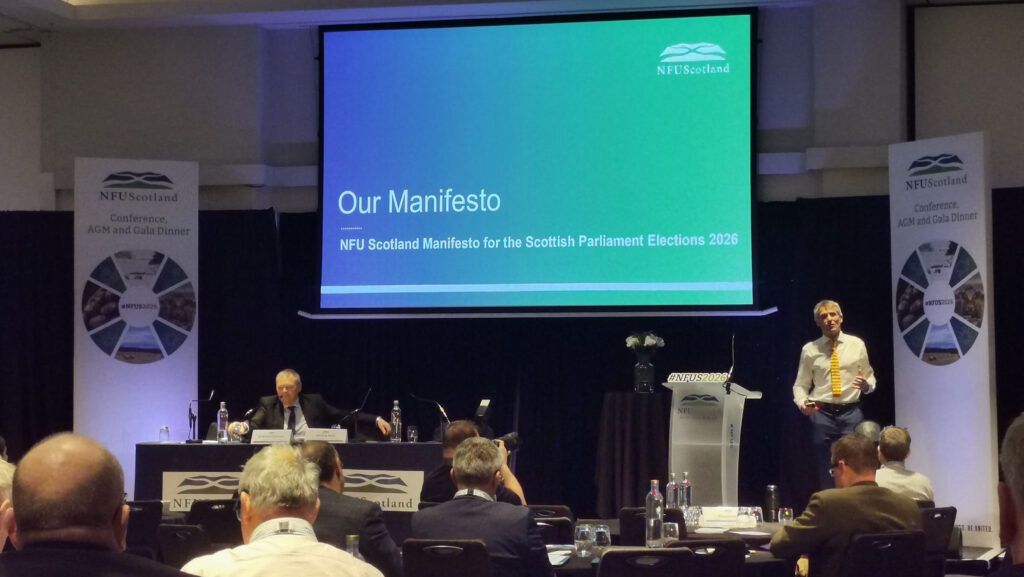
NFUS director of policy Jonnie Hall launching the manifesto © MAG/Philip Case
Key priorities include long-term, ring-fenced funding for active farming and crofting, a fair transition to the new agricultural support system, stronger action on supply chain fairness, proportionate regulation, labour availability, and a commitment to food production alongside climate and nature goals.
Mr Hall stressed that farmers must be “enabled, not regulated” to deliver outcomes, adding: “The role of government is to enable farmers and crofters to deliver the outcomes that government want, and to do that we need a vibrant, profitable agricultural sector in Scotland.”
‘Fragmented’ political landscape
The manifesto launch followed a keynote address from Sir John Curtice, professor of politics at Strathclyde University and research fellow at the Scottish Centre for Social Research.
Sir John warned that Scotland’s political landscape was now more fragmented than at any point since devolution.
He told delegates that the combined support for Labour and the Conservatives across Britain had fallen below 40%, while Reform UK had led GB-wide polls for much of the past year.
In Scotland, Sir John said the SNP remained ahead but largely because of the weakness of its opponents, rather than rising popularity.
He suggested the most likely outcome of the 2026 election was an SNP minority government, potentially reliant on support from one other party, possibly the Greens or the Liberal Democrats.
Based on an average of recent opinion polls, Sir John said the projected Holyrood seat totals would be: SNP 59, Labour 19, Reform UK 19, Conservatives 14, Greens 10 and Liberal Democrats 8.
On these numbers, the SNP would fall short of an overall majority and would require support from another party to form a government.
A partnership with the Greens, for example, would deliver a combined 69 seats – a working majority of nine.
“Neither government is popular,” Sir John added, referring to both Westminster and Holyrood. “The electorate is deeply sceptical about the competence of both.”
Against that backdrop, NFU Scotland said its manifesto was intended to secure firm political commitments regardless of which parties emerge in government after May 2026.
Key asks from the manifesto
Secure funding Multi-year, ring-fenced budgets; direct support for active farmers and crofters; capital investment for infrastructure, resilience and new entrants.
Fair transition Co-designed support schemes, phased change, clearer eligibility and simpler, proportionate compliance.
Food security and fair markets National production targets, Scottish produce prioritised in public procurement, fairer supply chains and export support.
Climate and nature delivery Food production at the heart of land-use policy, practical species management, protection of prime land and fair reward for upland and crofting systems.
Animal and plant health, skills and innovation Stronger disease surveillance, action on vet shortages, applied research, skills and rural infrastructure investment.
Labour, regulation and trade Scotland-fit seasonal labour schemes, lighter-touch inspections, reduced red tape and protection of Scottish standards in trade deals.