

Wales deputy first minister concerned SFS could be undone
 © Huw John PhotoVideo
The Senedd elections in Wales are just over 100 days away and current voting polls suggest a potential change in government from the current Welsh Labour regime is likely.
A new electoral system will change boundaries and increase the number of elected Members of the Senedd, taking the total number of politicians from 60 to 96.
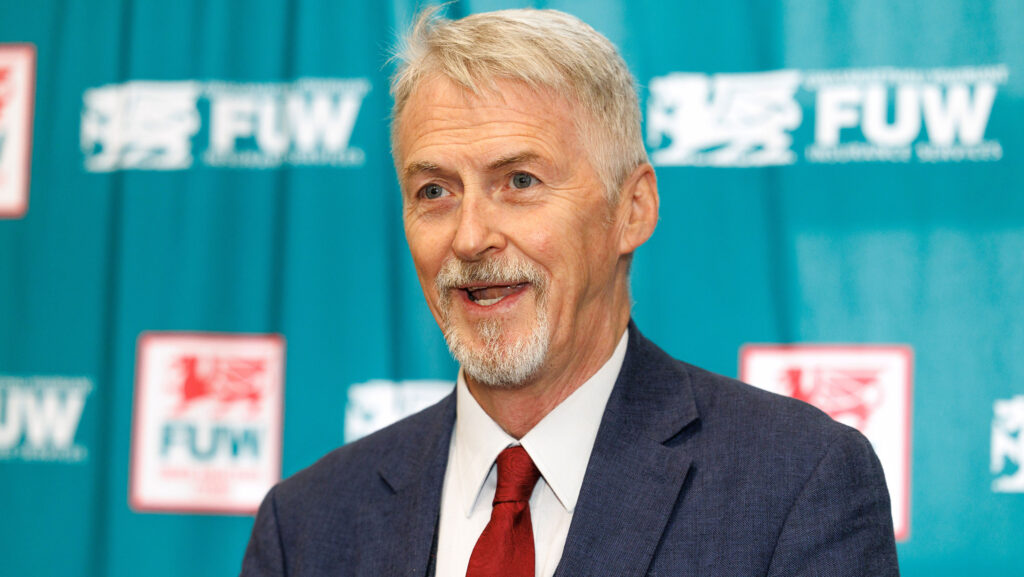
Current deputy first minister Huw-Irranca Davies, who also oversees the agriculture and climate change portfolio, believes it’s a good thing, but told Farmers Weekly, he is concerned about his policies being undone.
See also: Policy to the fore at FUW breakfast
“Changes in the electoral system, changes in the number of Senedd members, changes in the power, I think it will add to the power of that place [the Senedd], having not just more members, but a greater diversity of voices,” he said.
But he stressed it was important politicians understand rural communities as well.
“This coming together of interest with a vision of what the future of the countryside and farming looks like is immensely powerful, but it can be undone and unbalanced very easily,” said Mr Irranca-Davies.
Pointing to other parties, he said he didn’t think they believe in devolution, don’t have leaders in Wales and “believe in centralisation of power back to the United Kingdom and only the United Kingdom”.
Should those parties be elected to lead Wales, he says, they “could undo what I think is a pioneer in bespoke Welsh policy framework for farming and agriculture”.
All to play for
With all to play for, the deputy first minister urged voters to be cautious.
“Democracy is democracy, but sometimes my message to people would be, if you value the approach we’ve taken, and if you value the work we’ve done, do not take it for granted.
“The ballot box is where you express that preference, and if you want to risk undermining this, then there are genuine threats out there from other parties,” he said.
Mr Irranca-Davies added he was concerned that other parties would scrap the flagship agricultural support scheme, a move that “would put the fear of God through the farming communities”.
“The Conservative Party has said they believe that it should be taken away, and we should look at it again fundamentally – that is not the message from the FUW or the NFU or all the stakeholders, the 18 groups, including environmental groups, around the round table.
“There are dangers here in going backwards,” he said, adding that Reform UK presents one of the biggest dangers.
“Reform wants to centralise everything in the UK. Well, I’m sorry that would be to the singular disadvantage of the farming community in Wales.”
Securing the rural vote
Asked if he was confident that he had done enough to secure the rural vote in May, Mr Irranca-Davies said he had done all he could.
“We couldn’t have done any more, but it has never been to do with securing the rural vote.
“I sleep very soundly at night knowing that we’ve done the right thing for those rural communities, farming communities in particular, but right across the rural environment,” he said.
He stressed that this has been done in a way of genuine collaboration “with people, drawing on the best ideas, having discussions, sometimes arguments as well”.
The approach and the work done, he said, have got Welsh agricultural policy to a point where “we are all focused on giving that certain future for Welsh farming, Welsh rural communities, Welsh language, the viability of rural communities as well”.
Finalising the Sustainable Farming Scheme
Before the elections, there is, however, much work left to do to finalise the “Collaborative” and “Optional” layers of the Sustainable Farming Scheme (SFS).
“Everything that we need to get over the line by the time of the election will be over the line,” he stressed, though that won’t conclude the work stream of the scheme.
“Lots of good things will be in place by the time we launch with the Optional and Collaborative layers, but the exciting thing is that there’ll be even more work to do with those stakeholders.”
Balancing food and environment
While some have expressed concern that the SFS focuses too much on the environment and, by default, undermines food production and food security, Mr Irranca-Davies said, with geopolitical uncertainties, “we absolutely need to have a resolute focus on food security and food resilience”.
But, he said, it’s not simply in terms of the quantity of food produced.
“It’s how resilient it is to market shocks.
“We’re seeing issues now with dairy prices, not only in the UK or Western Europe, a global oversupply of dairy products and so on.
“But we’re also seeing the continuing war that needs to be resolved within Ukraine, and the uncertainty over that and where certain global players stand on that.”
He added that there are also wider pushes that need addressing, including climate resilience at farm level.
“Last year, the year before, the year before that, we are seeing an increase in propensity towards periods of drought and deluge, interspersed with each other, totally disrupting the farming cycle.
“So actually, the investment that we do in those environmental and climate resilience measures within SFS are not there to make us feel good, but to make a future for farming that is more resilient to some of those shocks.”
Future ambition
Addressing those combined challenges, he added, would be a challenge for the next government.
“I hope to be the minister in that government, taking this forward, but the challenge for the next government is to build on what we’ve done, and to build in even more of that resilience,” he said.
Explore more / Transition
Follow the experiences of our 16 Transition Farmers and access in-depth supplements, expert webinars, live events and practical content covering the challenges and opportunities facing farm businesses.
Transition is an independent editorial initiative supported by our UK-wide network of partners.
Explore the Transition hub for the latest insights, resources and events.
