Hot spell drives early barley harvest in eastern England
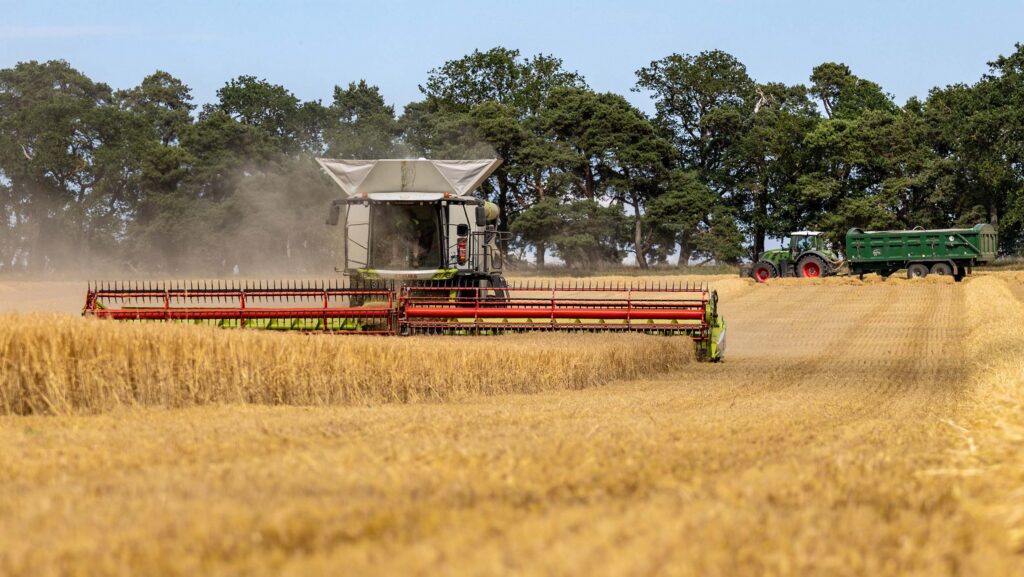 Winter barley harvest at Elveden Estate on the Norfolk-Suffolk border © Arthur Moody
 England’s winter barley harvest is under way several days earlier than expected after June’s heatwave rapidly ripened crops, with growers reporting exceptionally low grain moisture levels of just 9-10%.
Despite one of the driest springs in recent years, early yields have exceeded expectations on some irrigated land, although farmers warn crops on lighter soils are likely to be more disappointing.
At Elveden Farms, near Thetford on the Norfolk-Suffolk border, managing director Andrew Blenkiron began harvesting the winter malting barley variety Buccaneer on 26 June.
See also: Earliest-ever barley harvest for Suffolk farm as combines roll
“We kicked off on Friday cutting at 9% moisture,” Mr Blenkiron said.
“We’ve cut at that lower moisture before, but the biggest concern is the temperature going into store and the fire risk. You need good airflow to cool it down.”
The first fields harvested had received 30mm of irrigation in late April and early May, producing yields of between 6t/ha and 8.5t/ha.
“8.5t/ha is exceptional for us, given the season,” said Mr Blenkiron.
“But it’s the average at the end of harvest that we’re measured on.”
However, Mr Blenkiron expects barley yields to fall as combines move onto lighter, unirrigated land.
Ahead of harvest, the business also mapped all overhead power lines following a near miss during carrot lifting, urging farmers to remain vigilant around overhead cables.
PX Farms latest
Further west in Cambridgeshire, PX Farms managing director James Peck paused harvest on Friday 26 June after grain moisture tested at just 10.9% – lower than he had ever experienced in a winter cereal.
However, combining resumed at Scotland Farm, in Dry Drayton, today (Monday 29 June) after moisture content had risen to 12.6%.
“We had nine weeks of no rain,” he said. “The barley changed from soft and milky to rock hard in just a few days.”
The prolonged spell of temperatures above 30C allowed the crop to senesce naturally, avoiding the need for a pre-harvest glyphosate application.
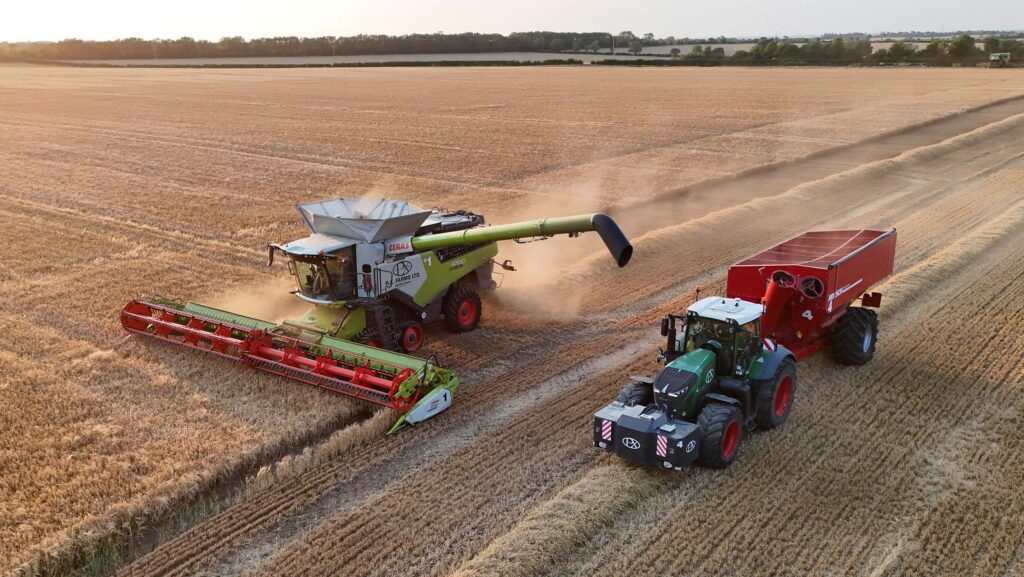
Barley harvest at Scotland Farm, Dry Drayton, Cambridgeshire © James Peck
The season is also providing an important comparison between conventional and hybrid winter barley varieties.
After growing hybrid barley since 2012, Mr Peck has drilled half the crop with the conventional variety Caravelle to assess whether lower seed costs can match hybrid performance.
“We’ve put in half the barley as non-hybrid and half as hybrid,” he said.
“My gut feeling tells me there won’t be much difference, but we’ll soon find out.”
With conventional seed costing about £30/ha compared with around £90/ha for hybrid seed, he believes a £60/ha saving could outweigh any small yield advantage.
Updating harvest progress, Mr Peck said the first field, 39ha “Longwildes” at Scotland Farm, had yielded 282.18t, averaging 7.2t/ha.
“The yield is a bit disappointing, but it’s only the first field. This could be the benchmark for the season,” he said.
The PX Farms team is using four Claas Lexion 8700 combines with 12.3m headers, supported by four Fendt 942 tractors and 27t Horsch chaser bins to cart grain from the field.
Suffolk farmers Peter and Richard Maddever started their barley harvest on Thursday 25 June at Scotts Farm, Cavendish – four days earlier than the farm’s previous record.
OSR harvest begins
Meanwhile, the oilseed rape harvest is also under way in eastern England.
David White, co-founder of RTK Farming, who farms 160ha of light chalkland at Hawk Mill Farms between Cambridge and Newmarket, began combining hybrid oilseed rape on Saturday 28 June at 8.5% moisture, with later samples falling to just 6.5%.
Statistically Sunday is the most common day to start. pic.twitter.com/2Q7GbC6gB4
— David White 🇬🇧+🇪🇺 (@RTKfarmer) June 28, 2026
Regenerative farmer Mr White chose not to use a pre-harvest glyphosate application, saying it “goes against my farming principles”.
Although the prolonged nine-week drought and recent spell of temperatures above 30C have resulted in smaller seed size, he believes the crop should still deliver a strong gross margin because of its relatively low growing costs and firm market prices.
“There won’t be many big heaps of anything for the traders to play with from the light lands of East Anglia,” he said.