

Opinion: Ag-tech holds the key to efficiency and longevity
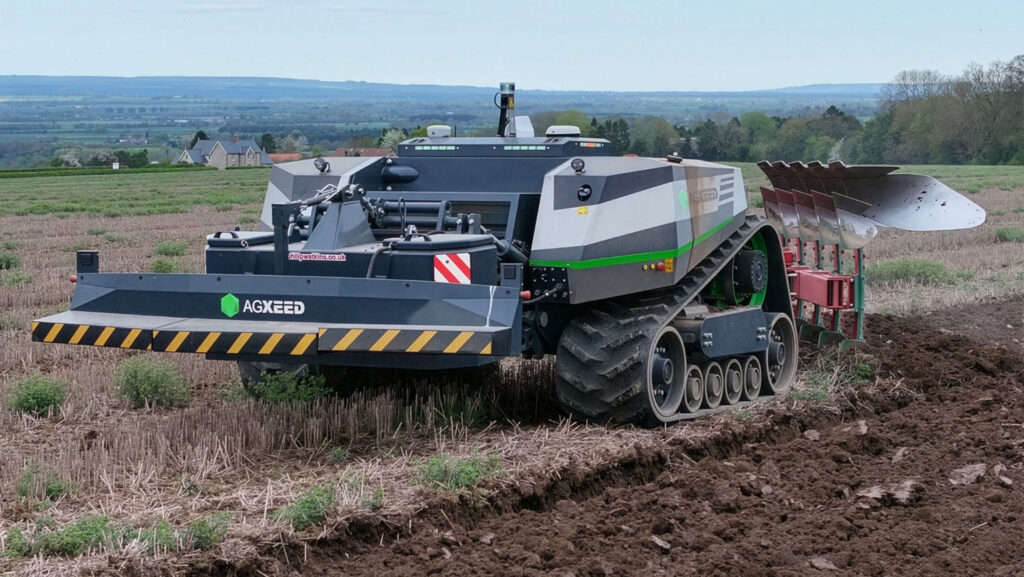 © AgXeed
The popular Amazon Prime series Clarkson’s Farm has done a huge amount to educate the general public about farming and food production.
For farmers, the show has served mostly as comedy gold as Jeremy Clarkson struggles to get to grips with all but the most basic of agricultural tasks. That is until now.
About the author
 Bernardo de Castro is vice-president for strategy at Hexagon’s agriculture division. Here he explains why Jeremy Clarkson’s interest in autonomous vehicles is a taste of things to come for the whole farming industry.
See also: Find all our opinion content in one place
In the most recent series – Season Five – the show’s host embarks on a quest to modernise his Diddly Squat farm by delving into the burgeoning world of autonomy and the efficiencies it can create.
Rather than simply serving up another helping of on-farm antics, this time the programme focuses in on a more pressing message for farmers; technology is the future – embrace it or be left behind.
One of the stars of the show is the AgXeed AgBot T2 – the first commercially available autonomous tractor in the UK. Underpinned by Hexagon positioning technology, it can cultivate, drill, fertilise, and apply pesticides with minimal human intervention, freeing up staff to complete higher value tasks.
This single change can lead to far higher farm productivity throughout the year, while at the same time addressing some of the key challenges we face in modern agriculture – labour shortages, rising input costs, and safety.
Benefits
As technology advances, the benefits of ag-tech will grow – from identifying and destroying weeds at individual plant level to recognising crop disease symptoms long before the human eye can identify them, driving quality, efficiency, and longevity for farming businesses.
Of course, autonomous technology isn’t restricted just to tractors.
On a visit to the Netherlands, Clarkson and his farm manager Kaleb Cooper were treated to a demonstration of drone-based spraying by master potato grower Jacob van der Borne.
Jacob’s drone uses just 50 litres of pesticide to spray a single hectare compared with Kaleb’s 125-150 litres/ha – completing the task in just eight minutes.
Extrapolate those efficiencies across a large arable-growing operation and suddenly the cost savings – not just in crop inputs but diesel and labour – add up to a huge number.
As Jacob himself remarked: “If you look into the future, 50 years or something, we will have tractors. But a lot of it will also be drones. This is how 80% of the world is going to spray their crops.”
Investment
According to the 2025 Farmdex Report by food giant McCain Foods, 68% of farmers in the UK see investment in technology as critical to the industry’s future.
More than 40% of those surveyed also stated they were optimistic about the role of technology in improving efficiencies.
So, whereas investment decisions might currently be delayed due to a lack of government support, there’s clearly an appetite to modernise.
But is the industry ready for the cultural shift autonomy and other technologies will bring?
Certainly, for much of the generation coming through, tractor driving is a rite of passage they won’t want to end any time soon.
And with strong allegiances to favoured brands, breaking those ties is also likely to be an obstacle in the long road to autonomy.
Efficiency
But as Season Five of Clarkson’s Farm demonstrates, efficiencies of the type that can be achieved by autonomy are no longer a choice for farmers – they’re a matter of survival.
And although the future may seem daunting, as with all new technologies, adopting autonomy will be a phased process.
Perhaps, therefore, by giving a window into the future, Clarkson has finally evolved from figure of farming fun to agricultural pioneer.
His efforts to modernise Diddly Squat show farmers have nothing to lose from autonomy and, potentially, a lot to gain.