

Opinion: Himalayan balsam presents a huge threat to crofters
 © Adobe Stock
 There’s an old trope about crofters being lazy. I still hear such talk from blow-ins and visitors.
The ironic Crofters’ Psalm goes: “Oh, that the peats would cut themselves / The fish jump on the shore / And that I in my bed could always lie/ And sleep for evermore”.
We do suffer periods of enforced inaction due to weather and daylight limitations here on the Atlantic fringe.
See also: Opinion – farmers have a ‘bone-deep resilience’ to endure tough times
About the author

But after months of dark, cold and wet, the grass gradually grows in sheltered spots, and the herbaceous plants start to emerge.
Growth happens almost covertly until, in June, we step outside and find ourselves assaulted by vegetation. It’s then that our hard work starts.
We have a good mix of native grasses and wildflowers on our croft, and unfortunately we also have the usual problem plants – dockens, rushes and bracken.
In-bye crofts are comparatively small, so every blade of grass matters.
But management of agricultural weeds is just part of life. What really annoys us is the unwelcome foreigner in our midst – Himalayan balsam.
How it first arrived, nobody knows. Its seeds spread easily by water, and the worst-affected crofts border our neighbouring township’s burns.
As summer progresses, formerly good pasture disappears under this rampant invader.
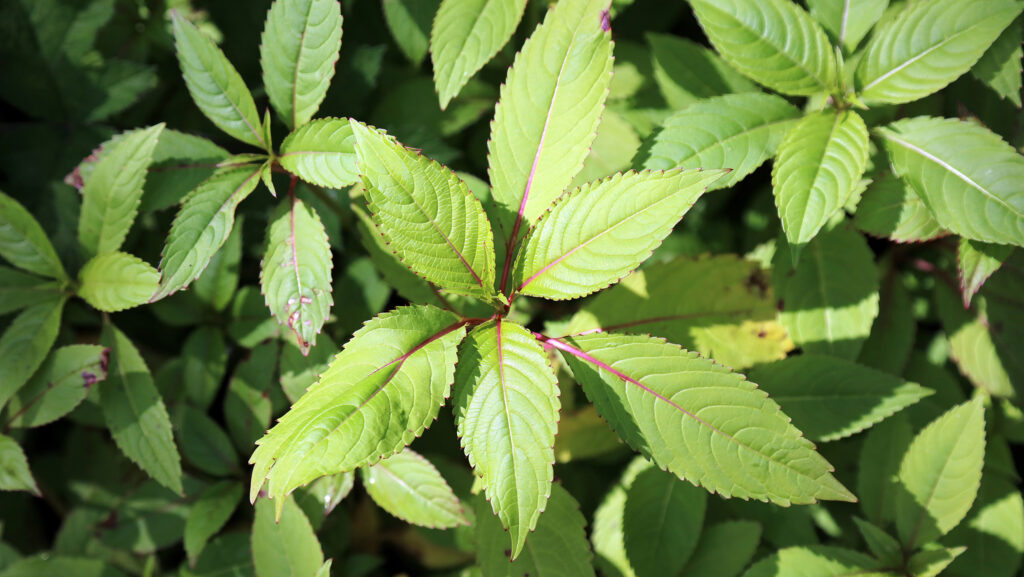
It grows up to 2m high in thick stands of bright green stems, lance-shaped leaves and sickly pink flowers.
A shallow-rooted annual, it broadcasts hundreds of seeds many metres from each parent plant.
Like other non-native invasives, balsam destroys native species by shading and crowding them out. It’s a major problem for local biodiversity as well as grass production.
We’re on the border with the next-door township, and a patch of balsam has appeared on the roadside verge of our best grass park. It grew hidden among the fireweed and wild raspberries, until it suddenly towered over them.
I walked the fence and found it sprouting into the pasture over a length of fifty yards, which shows how quickly it takes hold.
Honestly, my heart sank. It can’t just be cut down, because it’s woven through other plants that need to be kept – so the only option is hand-pulling each individual stem before it has a chance to seed. Days of work ahead, I set to it.
Being a crofter, after an hour I stopped for a tea break. Along the footpath came a new neighbour, Susanne.
She’s a capable gardener and fellow balsam-hater. Susanne isn’t a crofter, but she is interested in environmental matters and understands that crofting depends on communal effort.
To my great delight, she wanted to help. Her involvement means I can soon get back to the essential priority task of bracken-bashing.
Controlling alien species is a huge job. I haven’t yet mentioned our other problems, American mink and Rhododendron ponticum.
Control in our area is all done voluntarily, although yes, it is a legal duty. And I know we’re lucky to have a helpful neighbour.
But the opportunity cost is considerable – when we’re tackling invasives, we’re losing time for productive work during our short summer.
What we need are more allies like Susanne, willing to share the burden. Volunteering is a traditional part of township life, and it’s good for land and people.
So to those who talk of laziness, I say this – it’s many hands, not many mouths, that make light work.