

Opinion: Isle of Skye needs and ‘craves’ more cattle
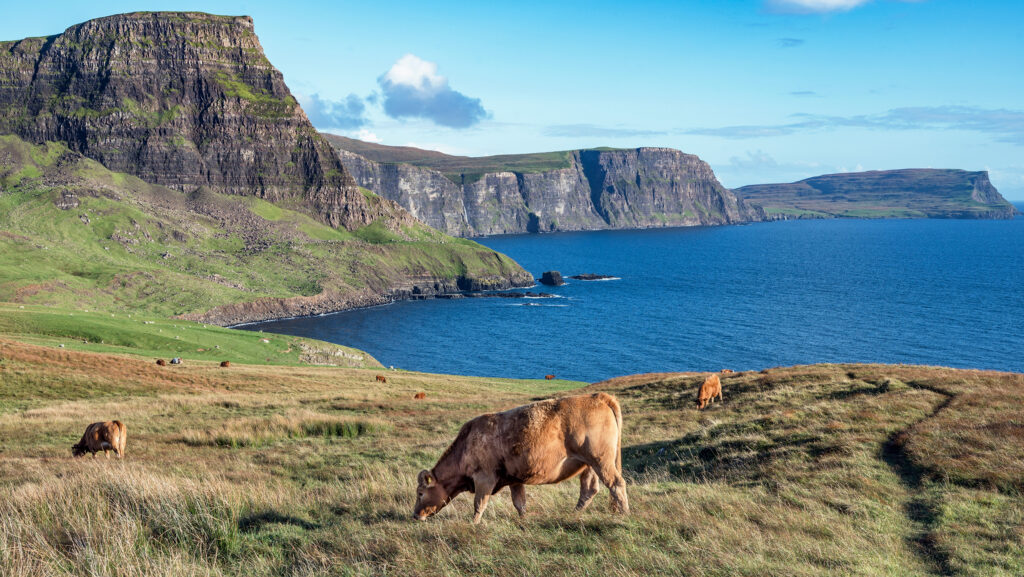 © Adobe Stock
It was mid-afternoon and, with dusk not far off, I decided I’d better leave my desk and take the terrier out.
We went down through next door’s croft to the beach, then up to the single-track road of the neighbouring township.
See also: Opinion – it’s hard to legislate against stupidity
About the author

Coming towards us on the road was a young crofter’s fold of Highland cattle. He was walking them between pastures in the traditional way – no livestock trailer necessary.
With a few helpers shaking feed buckets, the beasties trotted along, heads tossing. I stood on the verge watching them pass, and realised I had a big, involuntary grin on my face. Seeing the cattle made me feel elated.
There’s no rational reason for this. Although I’ve lived on dairy farms and a beef farm, and I manage estates where cattle are part of the farming mix, I’m no cattle expert and have never kept them myself.
But since moving to Scotland 13 years ago, my understanding of their importance has deepened.
The right breed in the right place is the best upland ecosystem engineer we can get. And there’s the rich, marbled beef that’s second only to local venison in the flavour stakes.
Skye’s herd has changed significantly over the years. In John Buchan’s 1919 novel Mr Standfast, hero Richard Hannay meets an ancient crofter who laments land management changes on Skye.
“Over in Skye wass [sic] the fine land for black cattle, and every man had his bit herd on the hillside.”
“Black cattle”, or kyloe, referred to a type of Highland – small, hardy and ideally suited to subsistence farming on our challenging ground.
But as agricultural policies, subsidies and demographics changed throughout the 20th century, so did Skye’s herd.
We have a photo from 1957 of a cattle sale in north Skye, showing the crofters, buyers and even the local MP gathered together.
Within the group is my husband’s grandfather, Alex, who was a Skye hill farmer and the island’s SSPCA officer.
He is smartly dressed in uniform, inspecting a pen of blurry dark beasts. And my husband recalls that there was always a milk cow on the crofts, even when he was growing up.
So, as late as the 1980s, cattle remained part of everyday life – the cattle’s annual cycle shaped the cultural rhythm.
Today, far more crofters keep only sheep. The ratio is guessed at about 20:1.
Cattle are more work and more expense. But the landscape craves balance. Chatting with a south Skye crofter the other day, we both agreed that the island needs more cattle.
Though native breeds are still farmed successfully and attract a premium price on the butcher’s slab, Continental crosses generally lead the sales.
We had a wet and cold summer, but September’s Dingwall and Highland Marts’ Portree sale was extraordinary – 1,400 cattle sold in nine hours for centre record averages.
Buyers want what Skye produces, so the argument for cattle is economic, environmental and cultural.
I look at the rough side of our croft, currently ungrazed while awaiting fence repairs, and think that it is indeed fine land for cattle.
Though we can’t justify a herd of our own, we’ve asked that local young crofter to walk his Highlands over to us next year.
He’ll get the benefit of the forage, and we’ll get the vegetation management – plus the innate pleasure of supporting a native breed in its homeland.