Beet armyworm outbreaks put maize growers on alert
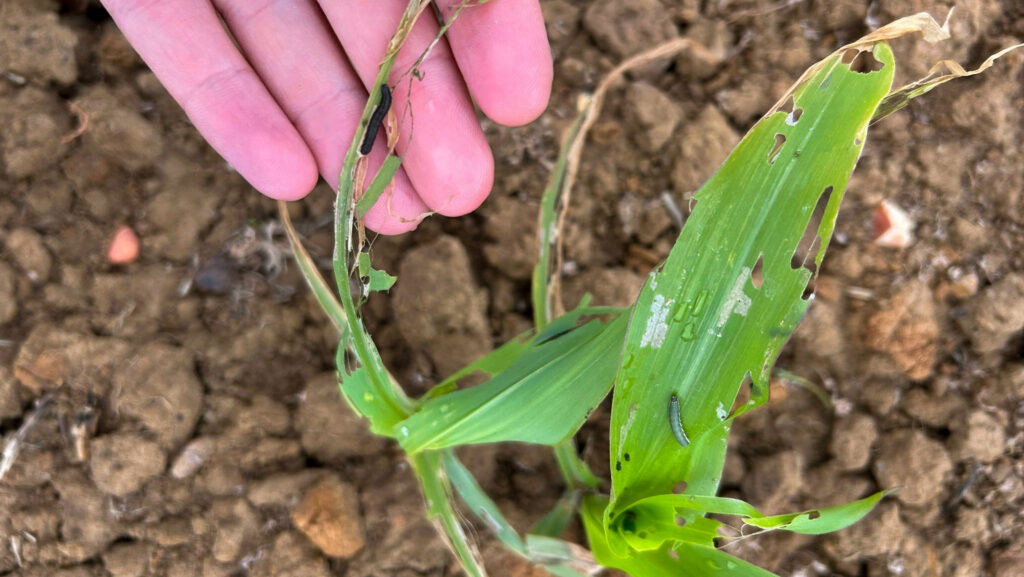 © Anna Dunford/Hampshire Arable Systems
 Agronomists are urging maize growers to inspect crops after an unusual series of beet armyworm caused significant damage to young maize crops along England’s south coast.
The pest has now been confirmed in maize crops in Cornwall and Dorset, while a further outbreak on the Isle of Wight is also expected to be confirmed as beet armyworm.
Similar reports from Devon suggest the migrant pest may have been present along much of the south coast following recent spells of hot weather.
See also: Coragen emergency authorisation offers beet moth relief
The findings initially caused concern because the caterpillars closely resemble fall armyworm, a notifiable quarantine pest capable of causing devastating damage to maize.
Much of the picture emerged through discussions between members of the Association of Independent Crop Consultants (AICC), who quickly realised apparently isolated findings were part of a wider event.
Apha testing
Laboratory testing by the Animal and Plant Health Agency (Apha) confirmed the insects were beet armyworm (Spodoptera exigua), rather than the more serious and notifiable pest species fall army worm (Spodoptera frugiperda).
Beet armyworm occasionally migrates naturally into the UK but rarely reaches damaging levels.
Brett Pointing of CCC Agronomy and AICC said the caterpillars had caused surprisingly rapid damage in affected maize fields.
The first signs were characteristic “window pane” feeding, where young larvae graze the surface of the leaf before progressively stripping away more tissue.
In the worst affected patches, there were as many as five or six caterpillars on individual plants.
“It looked a lot like fall armyworm, which is why we were so worried. We notified Apha straight away and they came and took a sample. It was confirmed as beet armyworm late last week.”
Localised outbreaks
The infestations appear to have been highly localised, which makes crop walking particularly important in a crop that’s often left to its own devices once final herbicides are applied.
He believes insecticide treatment is justified where economically damaging populations are found in younger maize crops.
“It will certainly pay for itself,” said Brett.
Contact-acting cypermethrin product Cythrin 500 EC is approved for caterpillar control in forage maize, along with chlorantraniliprole-based Coragen, which is more costly but has both contact and systemic activity.
Steve Cook of Hampshire Arable Systems and AICC has been involved in investigating several of the outbreaks and said cypermethrin had so far provided encouraging control.
Used to control outbreaks in both Cornwall and on the Isle of Wight, more than 90% control was observed by local agronomists.
Steve cautioned that the industry has very little experience of beet armyworm in UK field crops and no established economic thresholds exist.
“Crops involved so far have generally been around the eight-leaf stage, so treatment was certainly justified because they weren’t yet well established.
“If we were dealing with an infestation later in the season, when crops are thigh- or even waist-high, those more established crops would probably tolerate feeding much better.
“The difficulty is that we’ve never really encountered this before, so we don’t yet know how severe and economically damaging infestations could become,” he noted.
Rapid identification essential
Both agronomists stressed that the most important lesson from the outbreaks was the need to report unusual pests quickly so they can be identified correctly and dealt with in the most appropriate way.
Several of the first finds were initially suspected to be fall armyworm because of the similarity between the two species and the severe damage caused.
“If it was a notifiable pest like fall armyworm, then we really would need to get on top of it quickly to stop it becoming a UK pest,” said Brett.
Steve agreed that growers should never assume unusual caterpillar damage is harmless and urged any agronomist or grower to contact their local Apha representative.
Although Apha considers beet armyworm to be a regular migrant that does not normally survive UK winters, he believes climate change could increase the frequency of future incursions.
“I do worry about where things are going. We may have to put up seeing more of these sorts of things appearing in crops.”
AICC network
The outbreaks also demonstrated the value of professional agronomy networks in responding to emerging crop threats.
As reports began to appear from Cornwall, Dorset, Devon and the Isle of Wight, AICC members were able to compare observations almost immediately, helping build a picture that the incidents were linked rather than isolated.
“It meant that as soon as somebody had a worry about something, some of us were there with an answer straight away,” said Steve, who is also a Niab regional agronomist in the south.
Through discussions within AICC and Niab, agronomists quickly recognised that the outbreaks extended across much of the south coast, allowing advisers to alert growers to inspect maize crops more closely and report any suspicious findings to Apha.
Brett said that early reporting was essential, not only to confirm the identity of the pest, but also to protect UK agriculture from invasive species.
“This time, now that we’ve confirmed what it is, growers can be reassured. However, in future, if anyone finds something similar, it’s always worth getting Apha involved just in case it is more serious.”
Key points
- Beet armyworm has been confirmed in maize crops along the south coast
- Caterpillars rapidly strip leaf tissue from young maize, causing significant damage
- Initial concern centred on the possibility of fall armyworm, a notifiable quarantine pest, but Apha confirmed the insects were beet armyworm.
- Early insecticide treatment has given encouraging results
- Agronomists are urging growers to inspect maize crops regularly and report unusual caterpillar damage to Apha for identification
- Outbreak highlighted the value of rapid information sharing through AICC network
What is beet armyworm?
- A migratory moth whose caterpillars feed on a wide range of crops, including maize, beet, brassicas and vegetables
- Unlike fall armyworm, beet armyworm is a regular natural migrant into the UK and is not a notifiable pest
- Young larvae produce characteristic “window pane” feeding, grazing one surface of the leaf before creating progressively larger holes
- Older caterpillars can strip leaves back to the midrib and, in severe infestations, can completely defoliate young plants
- Eggs are laid in clusters, while caterpillars vary from green to brown and are often speckled with fine white spots, making field identification difficult
- Because symptoms closely resemble those caused by other Spodoptera species, including fall armyworm, suspected outbreaks should be reported to APHA for confirmation
- Apha believes beet armyworm does not normally survive UK winters, although adults regularly migrate into southern Britain during favourable weather