Caithness farmer grows over 10t/ha spring oat crop
 John Anderson © MAG/Emma Gillbard
 Growing crops on the far north coast of mainland Scotland can be a challenge, with heavy rain and gusty winds often limiting establishment.
But this didn’t stop Caithness farmer John Anderson from achieving more than 10t/ha for his crop of spring oats last harvest. And the best bit? He achieved this from just 50kg/ha of bagged nitrogen.
The bumper yield saw him win gold for the highest-yielding oat crop in the 2026 YEN Awards, with the variety Merlin achieving 10.09t/ha.
See also: Whisky slowdown hits Scottish malting barley
The secret to success, says John, is mixed farming and a long rotation incorporating grass to boost soil fertility and organic matter levels.
“We typically keep grass down for 15 years for our cattle and sheep, and then do seven or eight years of cropping,” he says.
The winning oat crop was treated no different to the farm standard.
Oats have long been grown on the farm located on Scotland’s North Coast 500 route, but for the past 12 years they have been grown specifically for the gluten-free milling market.
The robust nature of the crop lends itself to the exposed coastal climate.
As oats are naturally gluten-free, preventing cereal contamination is critical, which is why they are grown after a break crop of grass. John also grows a small area of continuous oats on rented ground away from the farm.
Short weather window
© John Anderson
Such long, cold winters mean spring cropping provides better returns than winter cereals.
In fact, the farm has not grown winter cereals since 1988, says fifth-generation farmer John, who works alongside his wife, Margaret, and parents John and Katrine.
The rotation consists of 250ha of spring oats, 200ha of spring barley and 200ha of grass.
The farm is home to 500 breeding ewes and 280 suckler cows. A small area of peas for silage and forage rape is grown for livestock feed.
The short establishment window and growing season are the biggest challenges, says John.
“Getting crops in the ground and harvested before the weather turns can be difficult.”
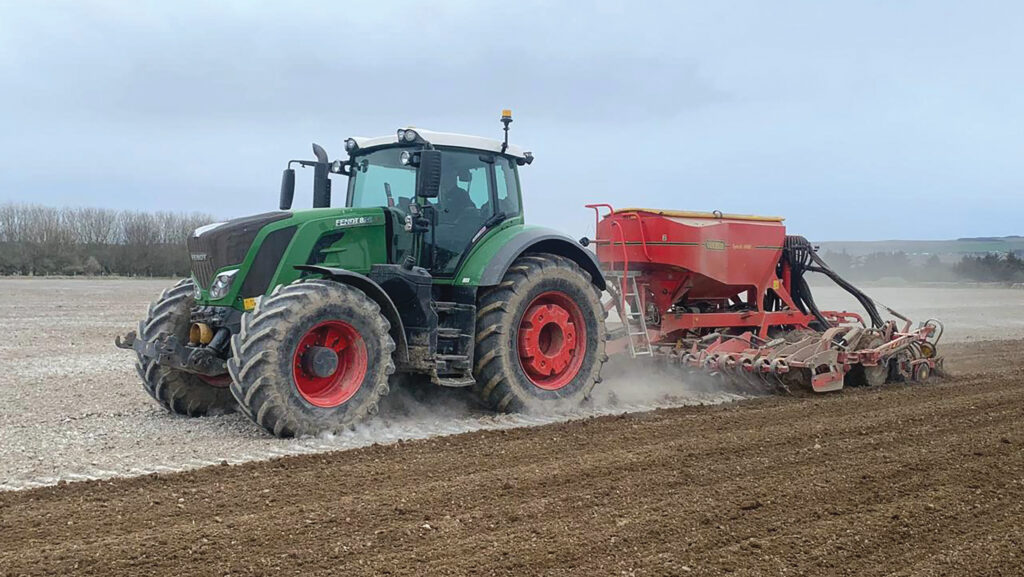
As a result, the farm operates a maximum cultivation strategy. Soil temperatures remain low in the spring, so ploughing is key to warming-up soils and getting plants off to the best start.
The winning oat crop was drilled on 15 April last year with a Vaderstad Spirit drill with 12.5cm row spacing and a seed rate of 450-500 seeds/sq m.
It was grown as a second spring oat, following a long-term grass ley. “We need a good thick crop; we don’t skimp on the seed,” says John.
Barley bull beef
John Anderson © MAG/Emma Gillbard
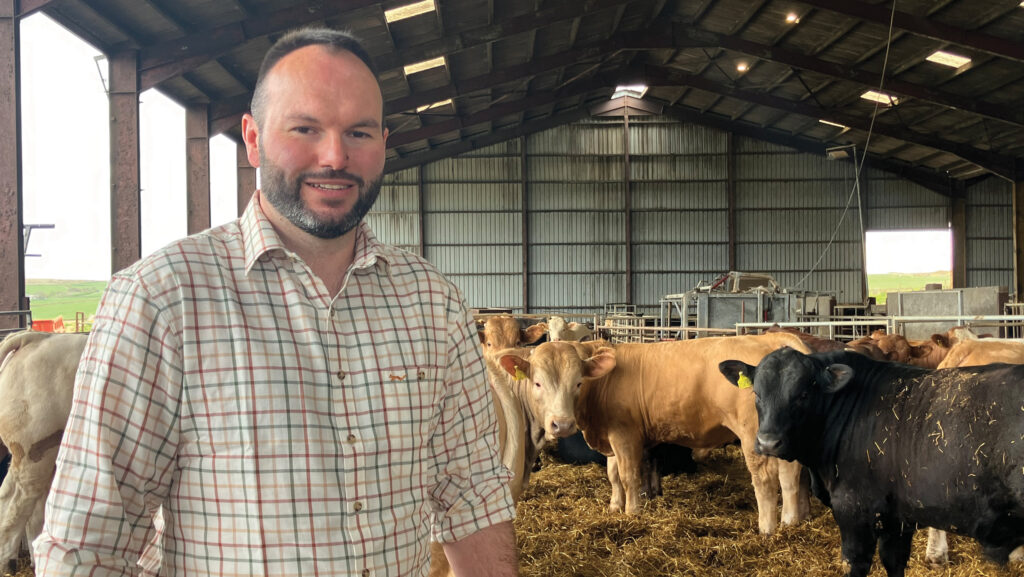
The farm runs a herd of Charolais and Stabiliser sucklers. All bulls are fattened using home-grown spring barley.
Charolais heifers are sold store at one year and the stabiliser heifers are kept on as replacements.
A proportion of the farm’s spring barley is sold as malt barley and the rest kept as livestock feed.
Nutrition
With lots of fertility and organic matter levels (7-9%) built up from the long-term grass leys, nitrogen applications require careful management.
“We knew it was a rich and powerful field, so we cut nitrogen right back to reduce lodging risk – particularly with our exposed location to coastal winds and heavy rain,” says John.
A total of 50kg/ha of nitrogen, 48kg/ha of phosphorus, 80kg/ha of potassium and 21kg/ha of sulphur was applied down the spout at drilling, as well as a dose of manure ahead of the plough.
A foliar feed was applied early in the season, aiming to feed the leaf, rather than the stem, to reduce lodging risk.
“When it comes to micronutrition, we frequently apply copper as oats love copper,” he says.
The YEN winning field had a pH of 5.3. “I have had experience in growing some high-yielding oat crops in some low pH soils proving that low pH is of no detriment to oats,” says John.
Harvest
© John Anderson
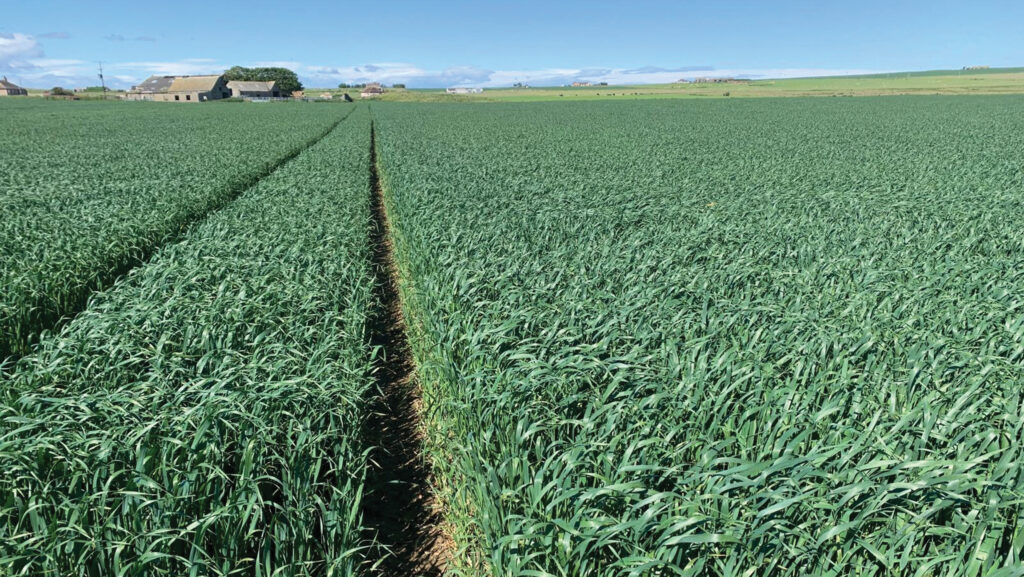
Harvest commenced on 10 September, meaning crops were in the ground for less than 21 weeks.
Typically, spring oats average 8t/ha, with yields peaking at 10t/ha. What set last year’s season apart was long daylight hours with plentiful sunshine which boosted photosynthesis and spurred on yield.
Low rainfall kept disease pressure at a minimum, alongside a focus on nutrition and a single fungicide spray to maintain a healthy canopy. Two plant growth regulators were applied.
It’s not unheard of for farmers in the north of Scotland to harvest in October, but for John and his family the past five years have welcomed earlier harvests.
“We’ve combined grain at moistures over 25%, but in last year’s dry conditions, we cut at 13% – that’s something we don’t usually experience,” he says.
Straw was quite brittle because of the dry weather, with straw yields coming in at 4.94t/ha (2t/acre). The winning crop was 84cm and grown in a 2.5ha plot.
Bushel weights came in between 55-60kg/hl, making crops suitable for gluten-free milling at Hamlyns of Scotland, located 170 miles away from the farm.
Contrary to most, John finds higher-yielding oat crops frequently have a lower bushel weight, and lower-yielding crops have a larger grain weight.
“A thin crop can be 61-62kg/hl with fewer grains per panicle, but each individual grain is larger,” he explains.
Looking forward
While the Thurso area remains predominantly livestock-based, centred on suckler cows and ewes, there has been a growing shift towards arable farming in recent years.
“We operate along a 15-mile band along the north coast with a variety of soils, but predominantly heavy clay which is suitable for arable,” says John.
John has significantly expanded his cropping enterprise over the past five years and values the balance that mixed farming brings to the business.
Looking forward, he is fully aware the farm’s northerly location limits crop marketability.
“If we wanted to expand the business, increased grass area and more livestock numbers would be the obvious move.”
This season’s spring oats were drilled in mid-April. Significant rainfall in March prevented sowing from taking place earlier.
April was particularly dry, with no meaningful rain. Warm weather and sporadic rain showers in May pushed on crop development.
John is feeling optimistic for the season ahead. He just hopes the grain markets reflect a fair price for growers.
Machinery fleet
The farm runs a mixed fleet of Fendt, John Deere and Claas tractors.
Owing to the short weather windows, an overcapacity of machinery is required to get crops drilled and harvested in time. John also has a 30ft Class Lexion combine.