Fungicide-resistant late blight strain detected in UK for first time
 © Tim Scrivener
 The presence of a concerning potato late blight genotype has been confirmed in the UK for the first time, following its discovery in volunteer potatoes in Suffolk last autumn.
The EU 43 discovery was revealed by David Cooke, plant pathologist at the James Hutton Institute (JHI) at a recent SAC Consulting Association of Potato Producers (Sacapp) technical update meeting in Perth on Friday (6 February).
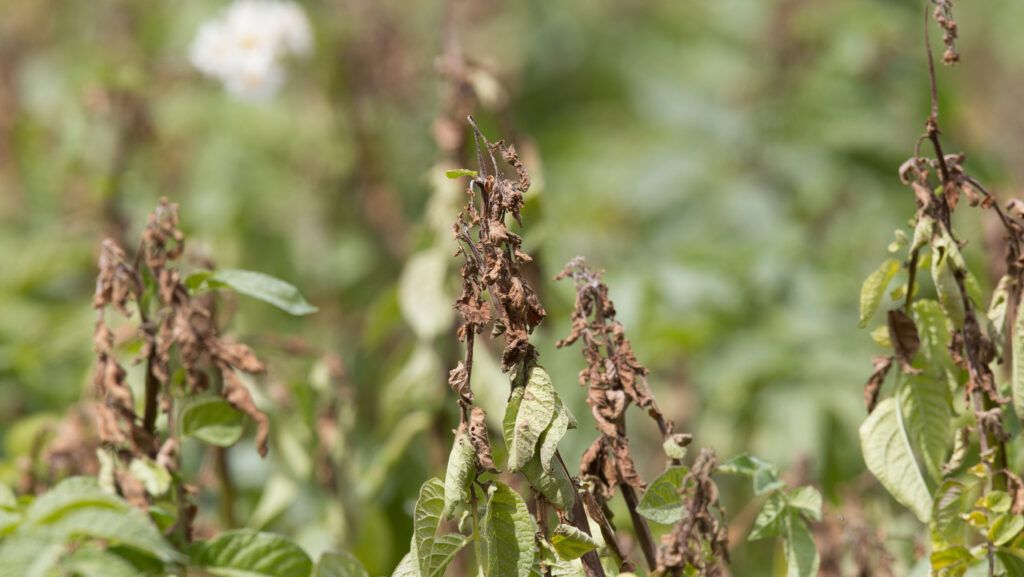
Hutchinsons agronomist Darryl Shailes found some heavily blighted volunteers during a routine field inspection in Suffolk in early November 2025.
See also: Why genetics must be central to late blight management
After sending the sample to JHI in Dundee, molecular testing subsequently confirmed it was EU43, a genotype resistant to both carboxylic acid amide (CAA) and oxysterol binding protein inhibitor (OSBPI) fungicides, including oxathiapiprolin.
“This is genuinely hot off the press,” David said.
“We have now confirmed one UK sample of EU43, and as expected from experience on the continent, it carries resistance to both fungicide groups.”
Late-season arrival
The volunteers were growing strongly into November under unusually warm and wet conditions, providing ideal conditions for late blight development.
David said the most likely source of infection is airborne spread from mainland Europe.
Weather data he presented at the Sacapp meeting showed strong wind and rain whipping up from northern France into eastern England during late October.
“We cannot prove it definitively, but the timing, weather patterns and known distribution of EU43 in northern France make wind-borne dispersal the most plausible explanation.”
Major headache
EU43 has caused major blight control problems in several European countries over recent years.
The genotype first emerged in Denmark, where repeated use of CAA fungicides selected for resistance.
From there it spread into neighbouring countries, including Norway, the Netherlands, Belgium and, most recently, France.
The concern for UK growers is that EU43 is resistant to two of the most important and widely used single-site fungicide groups in blight control programmes.
“The combination of CAA and OSBPI resistance is what makes this genotype particularly challenging, but the key message from Europe is that it can be suppressed if management practices are adapted quickly.”
Strategy switch
Dr Cooke pointed to Denmark as a strong example of how EU43 can be brought under control. After severe control failures in 2021 and 2022, Danish growers radically changed their fungicide strategies.
“They recognised that blocking sprays and repeated use of the same chemistry was driving resistance,” he said.
“By alternating actives, mixing modes of action and following resistance guidance much more strictly, the frequency of EU43 has dropped dramatically.”
Norway and the Netherlands have seen similar success after adjusting fungicide programmes and reducing selection pressure.
Conversely, France experienced a sharp rise in EU43 during 2025.
“The French industry was apparently slower to adapt their approach and that reluctance to change has clearly contributed to the expansion of EU43 there. It is a warning of what happens if action is delayed.”
Be alert
David stressed that the EU43 detection in the UK was limited to a single, late-season volunteer sample and was not associated with commercial crop failure.
“This does not mean EU43 is suddenly widespread in the UK, but it does mean we need to be alert.”
He outlined key priorities for the coming season, which include rigorous volunteer control, careful fungicide sequencing and continued adherence to Fungicide Resistance Action Group recommendations and fungicide manufacturer guidance when using blight products.
“In the UK, growers have been doing a very good job. Alternating chemistry, avoiding overuse of single-site fungicides and thinking strategically about programmes has kept resistance largely in check.”
He added that cultivar resistance and longer rotations will also play an important role in the future.
“Being forewarned is being forearmed. Knowing EU43 is here allows us to make smart decisions now, rather than reacting after control failures occur.
“This is one of the main objectives of the Fight Against Blight programme that, thanks to industry sponsorship, will continue into the 2026 season,” he concluded.