How one researcher is tackling late blight in potatoes
 © Blackthorn Arable
 What if improving disease resistance in potatoes was less about adding new genes and more about turning up the volume on the plant’s own immune system?
That is the premise behind the work of Lida Derevnina at the Crop Science Centre in Cambridge, where researchers are exploring whether strengthening the plant’s internal defence network could deliver more durable resistance to late blight and other key diseases.
See also: Elicitors offer fresh thinking amid blight control complexity
It is a shift in thinking that could reshape how resistance is built and how quickly it can be deployed in the field.
Growers’ needs
The work is being supported through a fellowship funded by the Cambridge University Potato Growers Research Association (Cupgra), as part of its long-term strategic efforts. It’s a connection that lead researcher Lida says has already influenced the direction of the project.
While her background is firmly rooted in fundamental plant science, engagement with growers and agronomists has created a sharper focus on real-world application.
“What farmers want and what I think they want are often quite different. We want the same outcome, but the way we get there can be very different,” she says.
That interaction has reinforced the need to develop not just new scientific insights, but tools that can be applied quickly and effectively in commercial varieties.
What is Cupgra?
The Cambridge University Potato Growers Research Association (Cupgra) is an independent grower-backed organisation that supports strategic and applied potato research.
Founded in the early 1980s by farmer John Green and researcher Eric Allen, the organisation works to connect growers, scientists and the wider potato industry to help drive practical innovation.
Cupgra’s guiding principle is to help “enable potato growers and industry to be successful and resilient through the translation and application of the best available science, knowledge and research”.
Short-lived resistance
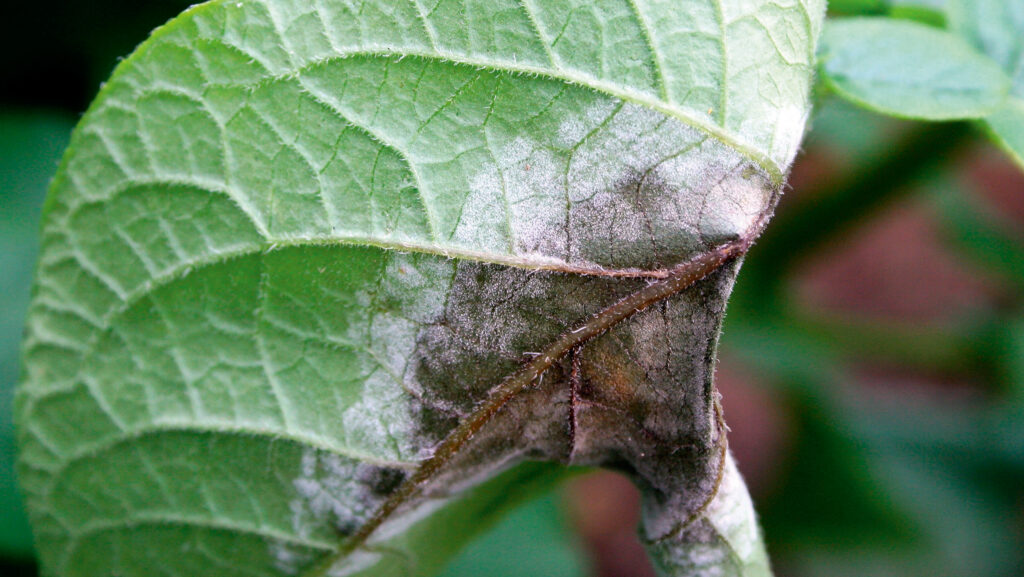
Late blight, caused by Phytophthora infestans, remains one of the most costly and unpredictable diseases for potato producers.
Despite decades of breeding, resistance often proves short-lived. New pathogen strains emerge, overcome plant defences and maintain a reliance on fungicides.
Traditional breeding focuses on introducing resistance genes – known as R genes – that recognise and guard against specific pathogen threats.
However, those pathogens evolve and when they do, those genes can quickly become ineffective.
“Resistance genes can take years to introduce into a crop, but in that time, the pathogen population may already have adapted,” says Lida.
Change of approach
Rather than continuing to add new resistance genes, Lida’s work is focused on the system that makes those genes function in the first place.
Plants defend themselves through a network of immune receptors. Some act as sensors, detecting the presence of a pathogen, and others act as helpers, triggering the defence response, often by killing infected cells to stop the disease spreading.
Research has shown that more than half of potato resistance genes depend on a relatively small number of these helper proteins, known as NRCs (NLR Required for Cell Death).
That makes them both a critical weak point and a powerful opportunity, says Lida.
“Instead of adding more resistance genes, we’re asking: can we make the existing helper system work better?”
Weak link
The importance of these helper proteins is not lost on pathogens, with studies showing that Phytophthora infestans and other pests have evolved effectors, or specialised molecules, that specifically target and disable these helper hubs.
When that happens, the entire resistance system upstream can collapse.
“You can have multiple resistance genes in a plant, but if the helper they rely on [to trigger the defence response] is knocked out, none of them will work,” Lida explains.
This has led to a new strategy which, rather than endlessly adding sensors, reinforce the helpers they depend on.
There are three main ways Lida’s team is exploring this.
The first is by making helpers harder to attack. By combining different versions of helper proteins, it is hoped that researchers can create variants that are more difficult for pathogens to suppress.
The second is by using gene editing tools such as Crispr, which allows very small changes to the potato genome – sometimes just a single DNA “letter” – that prevent pathogens from recognising and targeting these proteins.
Lastly, and perhaps the most striking approach, is simply to boost the activity of these helper proteins.
By increasing their number or expression, it is possible to enhance the effectiveness of existing resistance genes and even restore performance against more aggressive pathogen strains.
“We’re not trying to add something new; we’re trying to make what’s already there stronger,” says Lida.
Cupgra perspective: Backing longer-term solutions
For Cambridge University Potato Growers Research Association (Cupgra) members, supporting this type of research is about helping secure more stable and resilient potato production in the face of rising disease pressure and fewer available crop protection options.
Norfolk potato producer Sophie Bambridge, who is the organisation’s chair of directors, says the grower-backed funding it provides also gives researchers the confidence to pursue more strategic work with genuine long-term potential, such as the fellowship project led by Lida Derevnina, lead scientist at the Crop Science Centre in Cambridge.
“It is difficult for researchers to plan work properly without stable funding and we aim to support both strategic and applied research, even though growers are desperate for near-term solutions.
“And it’s not just the funding that is important. Linking researchers to growers through the fellowship also allows any output of the work to be quickly tested in real-world, commercial situations,” explains Sophie.
She believes this type of collaboration is increasingly important for the wider resilience of the UK potato sector, particularly as growers face mounting agronomic and economic challenges.
“It’s all about supporting the long-term sustainability of the sector, although it can sometimes be difficult to justify to growers that are struggling right now.”
Challenges remain
Despite the promise, significant challenges remain. Much of the work to date has been carried out in the widely used research variety Desiree, chosen because it is easy to work with.
Whether the same approaches will translate directly into other commercial varieties is still uncertain.
“That’s something we can only answer through collaboration with breeders,” says Lida.
There are also open questions on the durability of any changes. While strengthening the immune system may reduce the risk of resistance breakdown, it does not eliminate it entirely.
“Pathogens are very good at adapting. We can get ahead of them, but we can’t assume they won’t catch up.”
Beyond blight
One of the most intriguing aspects of this approach is its potential breadth, with potato growers dealing with a long list of pressures to which there are a narrowing range of solutions.
Because NRC helper proteins underpin resistance to multiple types of pests and diseases, including bacteria, viruses, nematodes and insects, strengthening them could deliver broader protection across the potato crop.
That contrasts with many traditional resistance strategies, which target a single disease.
“It’s about improving the overall robustness of the plant’s immune system,” says Lida.
For farmers, the longer-term potential is significant, but she is cautious about timelines.
She thinks this is more than five to 10 years away in terms of real impact, and researchers still need to get the technology working reliably in potatoes.
Once that hurdle is cleared, progress could accelerate rapidly, particularly compared with conventional breeding timelines.