Elicitors offer fresh thinking amid blight control complexity
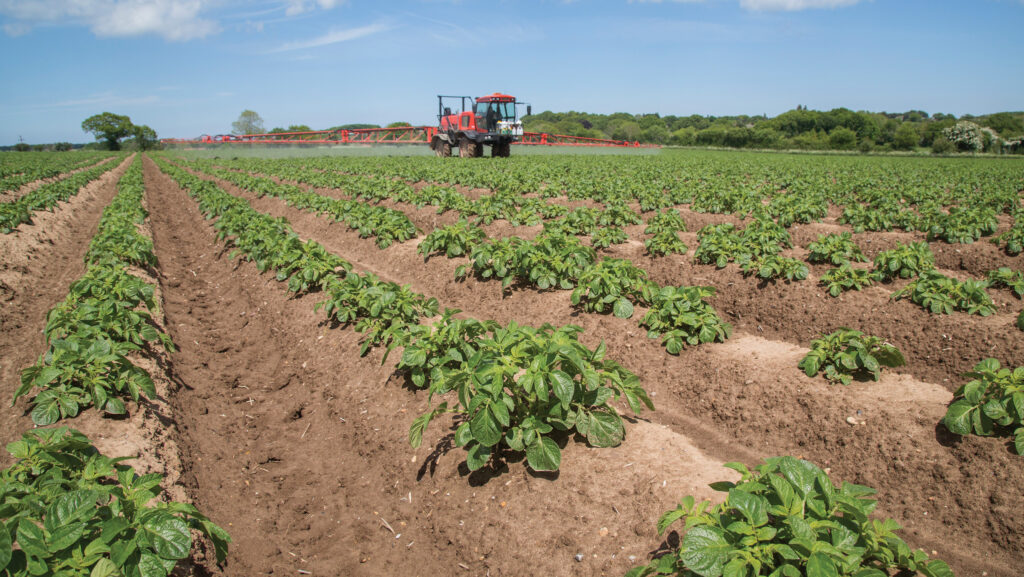 © GNP
© GNP Late blight control in potatoes is becoming an increasingly complex balancing act, as growers face a shrinking fungicide armoury and an evolving, aggressive pathogen that leaves little margin for error.
Against this backdrop, plant elicitors are emerging as an additional tool – not a replacement for fungicides – that could strengthen integrated pest management programmes.
See also: Advice on effective late blight control in potatoes
That’s according to Scotland’s Rural College (SRUC) senior plant pathologist Neil Havis, who notes that current blight programmes are under increasing strain.
“Blight is a constantly moving target and that means management strategies have to remain flexible,” he says.
That flexibility is becoming harder to achieve as the number of effective modes of action declines, with resistant genotypes emerging over recent years (see table).
SAC Consulting’s potato specialist Kyran Maloney agrees, pointing out that the challenge is not just about losing products, but maintaining robust programmes with the remaining tools.
“Growers are having to work harder to build programmes that are both effective and sustainable from a resistance management point of view,” he explains.
“You cannot rely on a small number of actives and expect them to hold up indefinitely.”
Key points
- Blight control becoming more complex
- Aggressive genotypes increasing pressure on timing and programme design
- Elicitors show promise in managing late blight and may have a supporting role in integrated programmes
- Products combining fungicides with elicitor effects may also help reduce resistance pressure
- Straight potassium phosphonate (at doses typical of those in fungicide products containing the active) shows strong anti-sporulant effects and blight control
- Phosphonate biostimulants applied solo offer limited control of foliar blight
Aggressive genotypes
The increasing dominance of aggressive genotypes has added another layer of complexity.
EU36 dominates late blight populations in Britain and cycles much faster under conducive conditions than previous strains, placing greater emphasis on timing and spray intervals.
At the same time, resistance management remains a critical consideration following the emergence of genotypes insensitive to key fungicide groups across Europe, particularly since 2019, says Certis Belchim late blight expert Lawrence Veryser.
That year, carboxylic acid amide (CAA) resistance – associated with mandipropamid (Revus) – was first reported in Denmark.
Two years later, a genotype insensitive to the oxysterol-binding protein inhibitor fungicide (OSBPI) oxathiapiprolin (Zorvec) was detected through Euroblight monitoring.
“Then we saw double-resistant strains like EU43 appearing – which can be insensitive to both CAAs and OSBPIs – and all the alarm bells started to ring. If nothing was done, it would just keep snowballing,” says Lawrence.
From a manufacturer point of view, he says it is important to have as many effective solutions as possible to protect products for the long term.
Lawrence and the team in Belgium investigated how best to reduce resistant genotypes in the field by inoculating potato plants with a 50:50 mix of CAA-sensitive (EU36) and CAA resistant (EU43) strains.
After two applications of fluazinam, the resistant population fell naturally from 50% to about 38-39%.
When fluazinam was mixed with CAA fungicide mandipropamid, the resistant population increased, as the treatment had greater activity on sensitive strains, allowing resistant ones to dominate.
However, when fluazinam was mixed with valifenalate, also a CAA active, the same increase was not observed – something Lawrence says was unexpected.
Defence genes
During development of valifenalate, laboratory studies measured expression of defence-related genes in treated plants, particularly those linked to pathogenesis-related (PR) proteins and cell wall reinforcement.
Results showed a clear increase in defence gene expression compared with other fungicides.
PR proteins such as glucanases (PR2) and chitinases (PR4) were significantly upregulated, alongside markers linked to signalling and structural defence pathways.
Lawrence says this demonstrates that valifenalate is not only acting as a fungicide, but also triggering the plant’s own immune response.
“The unexpected results in the selection trial suggest this elicitor effect may be helping the plant slow disease development and reduce resistance selection pressure.”
He says this helped shape the thinking behind Certis Belchim’s new product Areli, which contains valifenalate alongside the quinone inside inhibitor cyazofamid.
Supporting role
Approved in Europe in late 2024, Areli’s registration in Britain was confirmed in March.
Trials comparing Areli with straight cyazofamid (as in Ranman Top) showed consistent improvements in control, including against EU43, which can be insensitive to CAA chemistry.
This reinforces valifenalate’s dual role as both fungicide and plant elicitor.
From a practical perspective, this helps define how the two products should be positioned in programmes.
Ranman Top remains best suited to the end of programmes, where its strength in tuber blight protection can be maximised.
While it also offers tuber blight activity, Areli is better suited to earlier use, where its elicitor effect can help slow disease development and support resistance management.
“Areli is bringing something extra into the programme and gives us a way to use chemistry more sustainably by reducing resistance pressure while maintaining strong efficacy,” notes Lawrence.
Testing phosphonates
Valifenalate is not the only available active claimed to elicit plant defence responses, with phosphonates reported in scientific literature to have similar effects against phytophthora infestans.
Work carried out by SRUC researcher Ruairidh Bain set out to test how much phosphonate-based biostimulants contribute to late blight control under UK field conditions.
Treatments funded by McCain Foods in three trials in 2025 compared phosphonate-based biostimulants with Privest, which combines the conventional fungicide ametoctradin with potassium phosphonates.
Treatments were applied across rapid canopy development, stable canopy and tuber blight phases, under moderate pressure driven by genotype 36A2.
Results showed a clear separation in performance.
Privest delivered consistently strong control, while phosphonate-based biostimulants provided only modest reductions in foliar blight.
Where a response was seen, efficacy of the biostimulants was typically around 10-20%, and in some situations there was no measurable benefit compared with untreated plots.
Loss of control also occurred several weeks earlier than with the fungicide standard, and no meaningful effects on tuber blight were detected in what was a relatively low-pressure season for tuber infection.
Ruairidh says additional work, funded by the Scottish government, highlighted a strong anti-sporulant effect from a straight phosphonate fungicide, with significantly lower spore production compared with conventional protectant chemistry.
This supports the view that phosphonates may help suppress epidemic development, particularly in mixtures, providing a useful addition to programmes.
However, a key limitation to understanding is that it isn’t possible to separate direct antifungal activity from elicitor-driven plant responses.
So, while biostimulants containing phosphonates may have a role within integrated programmes, such approaches alone are unlikely to provide reliable blight control.
“FRAC [the Fungicide Resistance Action Committee] lists potassium phosphonates as plant resistance inducers, so they are recognised as having an elicitor effect,” Ruairidh says.
“But the industry needs a lot more demonstration of how well actives with only elicitor activity work and how consistently they work.”

© Blackthorn Arable
Encouraging signs
While elicitor-only approaches are unlikely to transform blight control overnight, Kyran believes there are encouraging signs they could strengthen programmes over time.
For the coming season, however, SAC Consulting’s advice remains consistent with recent years, particularly in response to resistant strains such as EU43.
“With what has been happening in Europe, we anticipated this situation,” he says. “Pay close attention to mixing and alternating across programmes – resistance management must be a core objective.”
He adds that vigilance and monitoring are critical, with understanding which strains are present essential for maintaining control.
“If you find active blight, submit samples to Fight Against Blight so genotypes can be identified and fed into decision-making. That information is vital for refining control strategies.”
GB late blight genotypes and fungicide resistance |
|||
|
Genotype |
GB status (FAB) |
Fungicide group affected |
Example actives |
|
EU_36_A2 |
Dominant in recent seasons |
None confirmed in GB |
– |
|
EU_37_A2 |
Very low frequency |
Pyridinamines (FRAC 29) |
Fluazinam |
|
EU_43_A1 |
Confirmed late 2025; key dual resistance concern |
CAA (FRAC 40); OSBPI (FRAC 49) |
Mandipropamid; dimethomorph; benthiavalicarb; valifenalate; oxathiapiprolin |
|
EU_46_A1 |
Present at low-moderate levels (regional) |
OSBPI (FRAC 49) |
Oxathiapiprolin |
|
EU_13_A2 (Blue 13) |
Very low/historic |
Phenylamides (FRAC 4) |
Metalaxyl-M |
| Source: Fight Against Blight/James Hutton Institute | |||