How wheat growers can stay ahead of yellow rust
 © David Jones
 Winter wheat growers are being urged to select the right variety, monitor their crops closely and spray if necessary next season to stay on top of yellow rust after two seasons of heightened disease risk.
Many popular hard milling Group 4 feed wheat varieties have seen their resistance to yellow rust fall sharply due to a mutation of a yellow rust race overcoming a key resistance wheat gene, making control more difficult.
Early infections of the foliar disease can lead to yield losses of more than 50% in winter wheat, and once the disease is established, it can be very difficult to eradicate.
See also: How high-protein spring barley can unlock bigger premium
Newer winter wheat feed varieties with better yellow rust resistance are now coming through plant breeders’ pipelines, and fungicide regimes are being revised to beef up rust control, especially early in the season.
“Pick the best variety, monitor it and treat it if necessary – so don’t let yellow rust get away,” says Steve Cook, Niab regional agronomist for the south of England,
Key wheat fungicide actives
- Amistar Strobilurin azoxystrobin
- Elatus Era SDHI benzovindiflupyr (Solatenol) plus azole prothioconazole.
- Folicur and other brands Tebuconazole.
- Miravis Plus+Era SDHI pydiflumetofen (Adepidyn), in a twin pack with azole prothioconazole (Era)
- Plaxium SDHIs isoflucypram (Iblon) and fluopyram, plus azole prothioconazole
- Revystar SDHI fluxapyroxad (Xemium) plus azole mefentrifluconazole (Revysol)
- Univoq Picolinamide fenpicoxamid (Inatreq) plus azole prothioconazole
Hampshire experience
Fungicide-untreated winter wheat plots at the Niab site showed the ravages of yellow rust, but he says there are many growers in this milling wheat area that grow the yellow-rust susceptible variety Skyfall, and so are used to dealing with the disease.
Growers around the Niab site at Sutton Scotney, just north of Winchester on Hampshire’s chalky downlands, are geared up to treat Skyfall early in the season with fungicides as soon as they see yellow rust – usually with an azole or strobilurin or a mix of both.
Steve points out that those who grow Group 4 hard feed winter wheats in the area are moving away from the very susceptible varieties, and he is seeing more Group 2 Arnie and even the older Group 4 hard feed variety Graham being grown in the area.
A mutation of the yellow rust Warrior race was first detected in early 2025 as it overcame the widely used YR15 resistance gene, and so severely reduced the resistance ratings of some of the most popular hard feed wheat varieties containing the gene, such as Champion, Beowulf, Dawsum, Typhoon and Scope.
© David Jones
Yellow rust resistance scores
Group 4 hard feed winter wheat varieties scores, with previous year’s scores in brackets, showing the sharp decline in resistance
- Beowulf 4 (9)
- Champion 4 (8)
- Dawsum 5 (9)
- Scope 4 (7)
- Typhoon 5 (9)
Alternative varieties
Clare Lehman, varieties specialist at Niab, says growers should now be moving away from these yellow rust-susceptible hard Group 4 feed varieties with the YR15 gene, as there are alternatives available for drilling in autumn 2026.
“Start the change away from these high-risk Group 4 varieties and minimise the risk of yellow rust. You need to stay ahead of yellow rust and don’t let it get ahead of you,” she adds.
Clare advises growers to prioritise moving away from Champion and Beowulf, which now score a lowly 4 for yellow rust on the AHDB’s Recommended List (RL) scale, where 9 shows good resistance and 1 is very susceptible. Dawsum and Typhoon botr score 5.
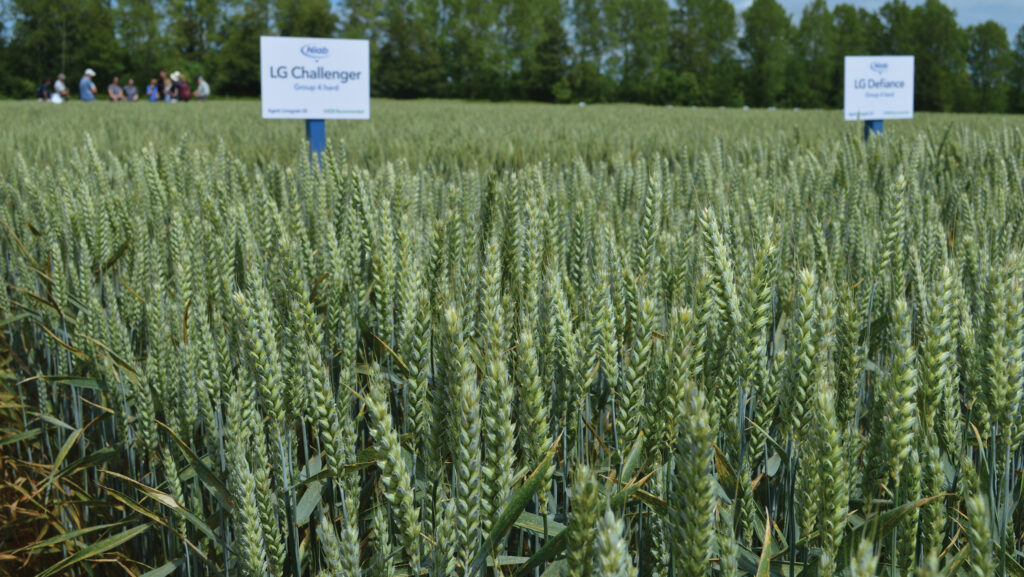
Two new hard feed wheats, Challenger and Defiance, will be available in limited quantities this autumn. Both have good yields, and Challenger is rated 7 for yellow rust while Defiance scores 8, but there are some concerns about its straw strength.
“Take advantage of the genetic resistance with these two. Defiance has the top untreated yield on the RL, while Challenger has a good all-round agronomic package,” she says.
These two were added to the RL late last year along with a new soft milling Group 4 feed wheat Sparkler, which has yellow rust resistance of 7.
In addition, other older soft feed wheats Hexton and Zealum score 8 for yellow rust, and the still popular old hard feed wheat Graham has a similar resistance score.
She suggests that hard feed wheat growers may also look at the newly popular Group 2 Arnie, or another widely grown variety, the Group 3 biscuit wheat Bamford, as wheats with good yields that may earn a bit extra with a milling premium. Arnie scores 7 for yellow rust and Bamford 6.
Candidates
Further ahead and coming up for entry into the RL at the end of year is a variety with good yellow rust resistance, the hard feed wheat Checkmate from KWS. This variety has a provisional yield of 108%, inbetween Defiance and Challenger, and potentially a top untreated fungicide yield on the RL of 96%, with a provisional rating of 9 for yellow rust and 8 for septoria.
Other feed varieties of interest with good yellow rust resistance hoping to join the RL later this year include Kraken from RAGT and Bastion, available through Agrovista.
Limited seed of the new wheat variety entrants to the RL will be available this autumn, with enough seed of Defiance to account for 8-9% of the certified winter wheat seed market, 2-3% for Challenger and 4-5% for Sparkler.
This means growers will still need to grow some susceptible varieties, so Steve suggests growers follow fungicide advice from Skyfall growers (yellow rust score 3) and also growers of the brown rust-susceptible Crusoe (brown rust score 3).
He says the TO timing is not always the right time to treat yellow rust-susceptible varieties. “The timing is when you first see yellow rust.”
Fungicide strategy
His advice for milling wheat growers of Skyfall is to consider an effective and economical T0 mix of tebuconazole for a quick knock-down and the strobilurin Amistar for more prolonged control of yellow rust.
T1 sprays could be based on good rust actives such as Iblon or Revysol, and, when combined with partners, can be used as products such as Plaxium and Revystar. The SDHI in Revystar, fluxapyroxad, is particular effective again brown rust for those growing Crusoe.
T2 sprays may be based around septoria-specific products Univoq or Miravis, with a strong rust active added if needed, and then a T3 spray is likely to be a mix of tebuconazole and Amistar.
AHDB fungicide performance data shows that Iblon, Solatenol and prothioconazole were leading products to control yellow rust, while Amistar also shows very good activity and Revysol demonstrates good control.
On the Hampshire trial site, an untreated plot of the yellow rust-susceptible Dawsum showed disease damage, with leaves three and four heavily infected and with little green leaf area remaining. However, a typical yellow rust fungicide regime had worked well on another plot.
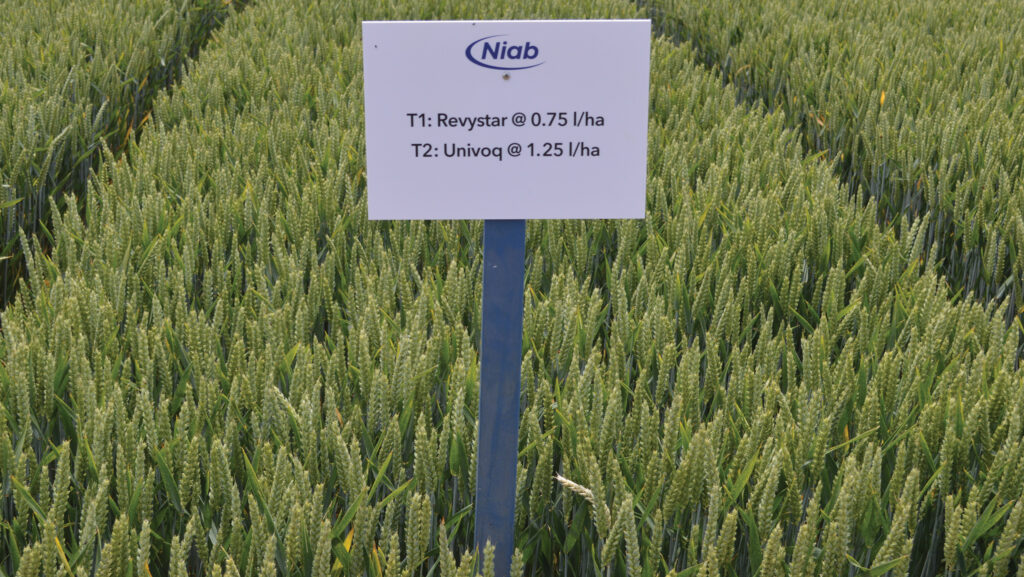
That plot of Dawsum had a fungicide regime that included 0.5 litres/ha of Amistar at T0, 0.75 litres/ha of Revystar at T1 and 1.25 litres/ha of Univoq at T2.
‘Challenge to keep on top of rust’
Tom Coleman, who farms 1,200ha at Lower Norton Farm, where the Niab site is based, grows 450ha of winter wheats such as Group 4 hard wheats Typhoon, Beowulf and Scope, along with Group 2s Arnie and Palladium.
“Yellow rust has been a challenge to keep on top of this year, and we are looking to reduce our yellow rust exposure,” he says.
The farm had traditionally grown Group 4 hard feed wheats, but has recently started to move to to some Group 2s as these varieties have shown yield improvements, good disease resistance and offer the chance of a small milling premium.
For next season, Tom is looking at Challenger and Defiance for autumn drilling to replace some of his old Group 4 yellow rust-susceptible ones, and also to increase his area of Arnie.
The people quoted in this article were speaking at at a recent Niab open day in Hampshire.