Trial investigates nanofibre tech benefits for wheat disease
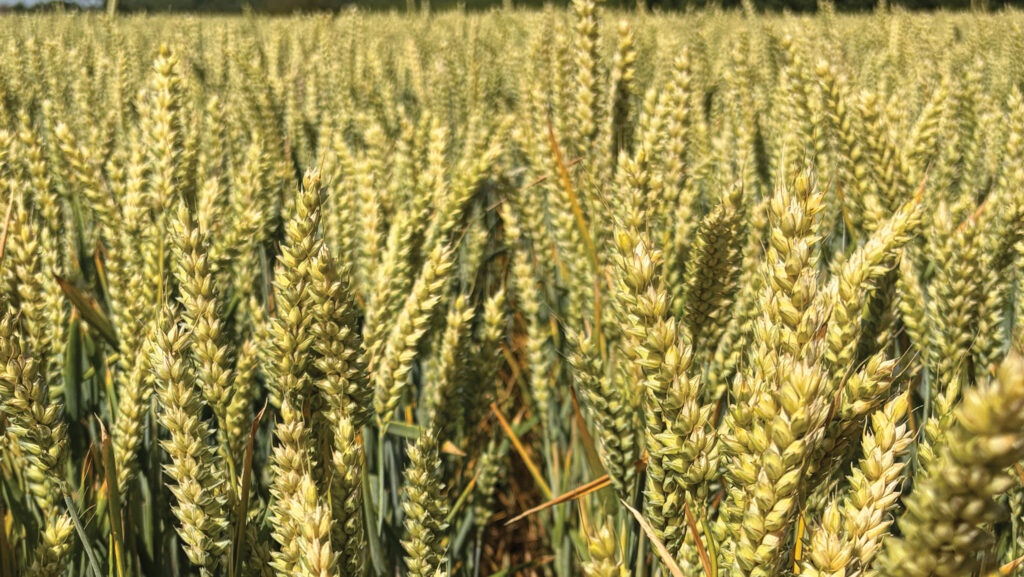 Extase wheat treated with Nanomesh © MAG/Richard Allison
 Novel cellulose nanofibre technology is being trialled as a non-chemical solution for tackling foliar disease in wheat, which also makes crops more resilient to dry spells by reducing water loss.
At Agrovista’s AgX trial site in Northamptonshire, the firm’s soil specialist Chris Martin explains that the product acts as a physical barrier making it harder for pests and diseases to penetrate the leaf.
Produced from bamboo, the nanofibres act as a mesh that Japanese researchers at the University of Tsukuba found prevented the infection of soya bean plants with Asian rust disease.
See also: How next-generation wheats will benefit late drillers
In the UK, Agrovista has been trialling it as an alternative to multisite fungicides in wheat disease strategies.
However, in dry years Chris says it is bringing benefits as an anti-transpirant, reducing water losses from leaves. This is resulting in crops that can better withstand dry spells and is delivering a yield lift.
Visitors at the trial site saw a plot of Extase second wheat which had received the product at growth stages 31 and 39 (T1 and T2) along with a foliar sulphur product and amino acid biostimulant, but no fungicide.
A trial carried out last year showed how using Nanomesh combined with three biological products achieved 13.3t/ha, which was comparable with the yield with the conventional fungicide approach.
Chris highlighted the yield lift when it was combined with conventional fungicide programme, which he said could be down to the anti-transpirant properties last season, which was very dry. Trials with the are ongoing to refine the approach.
Yield analysis of the four systems |
||
|
System |
Yield (t/ha) |
|
|
Nanomesh only |
9.35 |
Nanomesh (four applications of 1 litre/ha with tebuconazole at the second application) |
|
Nanomesh plus biological products (Innovation range) |
13.31 |
Nanomesh + amino acids + Wholly K (foliar potassium) and a biostimulant (3alo T6P) |
|
Conventional fungicide programme |
13 |
T0: Cello (prothioconazole + spiroxamine + tebuconazole) on 12 April T1: Vimoy (isoflucypram) + Aviator (bixafen + prothioconazole) T2: Myresa (mefentrifluconazole) + Priaxor (fluxapyroxad + pyraclostrobin) T3: Profi AZ (azoxystrobin) + Tebucur (tebuconazole) |
|
Conventional plus Nanomesh |
14.37 |
As above plus Nanomesh applied at the T1 and T2 timings |