Why climate change adds to septoria threat in wheat
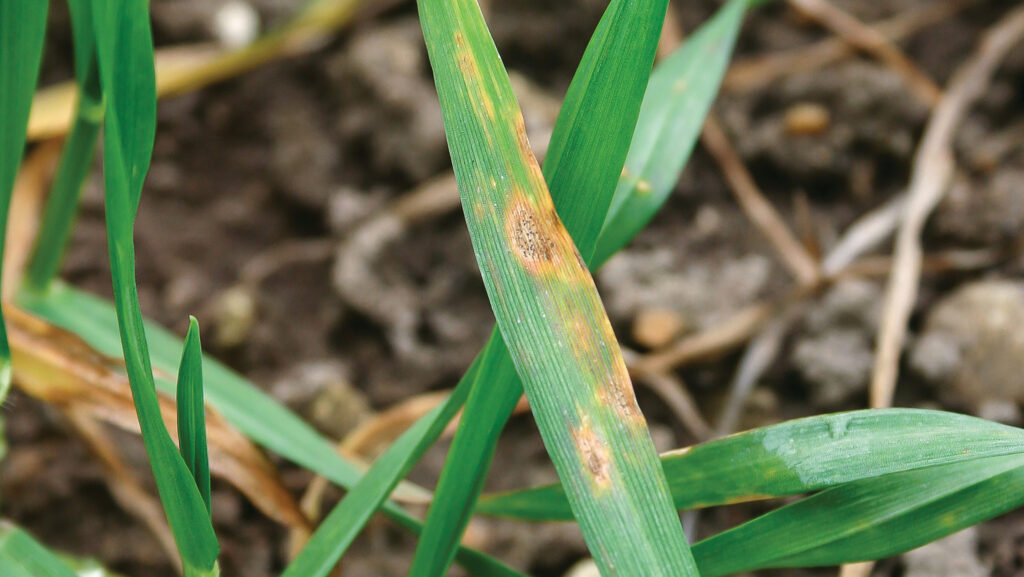 Septoria lesions on wheat © Blackthorn Arable
The latest UK climate report from the Met Office points to warmer, wetter weather, which experts say are the ideal conditions for the number-one disease of wheat.
Patrick Stephenson, Niab regional agronomist for the North, says the recent State of the UK Climate report from the Met Office indicates the UK’s baseline agricultural environment is still heavily oriented towards Septoria tritici.
“Although we are still a maritime country with a temperate climate largely influenced by the Gulf Stream, it’s evident that the UK’s winters are becoming milder and wetter, with summers trending hotter and drier.
See also: Could highest yielding soft wheat be the next market leader?
“UK climate projections also tell us that the frequency of extremely wet months has roughly doubled in recent years.
“With warmer winters and early springs potentially up to 30% wetter [given that a warmer atmosphere holds more moisture], we unfortunately now have a perfect environment for Septoria tritici, the most economically damaging wheat disease, to survive and proliferate in UK wheat crops,” he says.
Variety ratings
He points out that as the current chairman of the Recommended List (RL) committee, when looking at the winter wheat list, most varieties have a current septoria rating of 6.
“While I believe breeders have done a good job in improving the background resistance of their varieties, I still have some concerns.”
First, in a sustained period of warm, wet conditions, the best fungicide programmes, even when applied quickly, will still let some septoria into the crop, he explains.
Second, when assessing RL varieties on their septoria ratings, this is based on a drilling date in early October.
Any farmer drilling earlier than that – for example, in September – needs to understand that the variety’s rating is automatically lowered, so they must factor that in when making their variety decision.
While early drilling can offer benefits, it’s also a way of building up a potential reservoir of disease that can subsequently become a yield robber in the spring and summer months if, and when, the disease gets its optimum weather conditions.
Overall, Patrick says farmers have been lucky to experience historically lower septoria pressure across much of the UK in three of the past five seasons due to extended hot, dry conditions.
And farmers have also generally enjoyed the right conditions to spray quickly when they’ve needed to.
However, he warns that it would be risky to accept this as the “new normal” and forget the septoria risk based on unusually favourable weather.
Rating of 7 or more
Taking all these factors into account, he advises growers to include at least one variety with a septoria score of 7 or more in their winter wheat rotation.
For those in higher rainfall regions, such as the North and West, they should potentially opt for two varieties with robust disease packages offering them the best starting point for reduced risk.
With an annual area of about 750,000ha, equating to 45% of the total winter wheat area, the Group 4 sector is currently the most popular category among UK growers.
Factoring in all the key elements, including overall disease resistance, yield potential and flexibility in terms of drilling dates and first wheat/second wheat positioning, Patrick believes a variety like Sparkler ticks the right boxes.
“With a 7.2 for septoria and a 7 for yellow rust, it offers higher overall resistance against the two key disease challenges that effect most growers.
“Given it’s also the highest yielding Group 4 soft wheat, there’s no trade-off on yield either for growers prioritising septoria or yellow rust control,” he concludes.
Ben Urquhart, technical manager with Sparkler breeder Elsoms Seeds, agrees that the shifting seasonal windows away from the UK’s traditional four-season calendar is a major challenge for arable farmers.
He says the looser, less-defined seasonal weather windows impact significantly on farmers’ decisions around drilling dates.
“For instance, are farmers now drilling earlier to avoid the risk of prolonged wet weather in late autumn?
“Inclement weather also creates an issue linked to the chemistry we use to support our varieties – can it still be applied to the crop in a timely fashion to get the maximum efficacy from the product?”
Ben says with increasingly unpredictable weather and uncertainty over new chemical approvals, one of the few things that farmers still have total control over is the varieties they want to grow.
“Balancing higher resistance scores – particularly on septoria and yellow rust – against potential yield has to be a sensible move for growers right now, and, with the joint second highest septoria score on the RL coupled with a treated yield of 106%, Sparkler has to be in the conversation for any farmer growing winter wheat for the feed or distilling markets.