Yellow rust early warning sensors to be trialled in-field
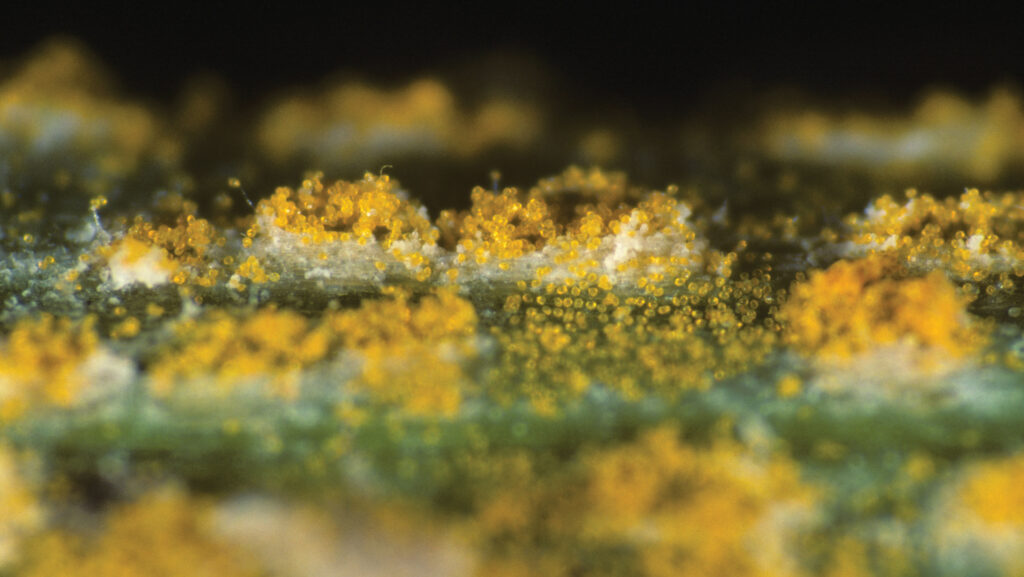 New technology aims to detect yellow rust spores, which are released by pustules on infected plants © Nigel Cattlin
 In-field crop sensors that can detect the presence of active yellow rust spores are being tested on commercial farms this year, after encouraging results in Niab trials.
Developed at the University of Manchester and with the help of £2m funding from Innovate UK, the sensors produced by British start-up SporeSense contain an artificial material that mimics the living leaf and supports airborne pathogens.
By combining artificial intelligence and optical technology in the sensors with the ability to imitate what the pathogen does on a leaf, their use in the field gives an early warning of the arrival of disease threats.
See also: Yellow rust resistance blamed on dominant wheat varieties
That can help to improve disease control and target fungicide use, allowing cereal growers to meet both sustainability and profitability aims, claims the team behind this new technology.
Research partners in the three-year Innovate UK project included Rothamsted Research, G’s Fresh, Niab and the University of Manchester, with the initial results giving SporeSense the confidence to commercialise the system.
Once the sensors are in place in a wirelessly connected network, they ground truth the spread of disease.
The farmer or agronomist receives real-time alerts and can see how disease is spreading across farms and regions.
This together with spore transport models creates an accurate prediction of when a disease will hit – typically several days ahead of that occurring.
This brings the potential for a dual role in improving spray timeliness and reducing fungicide costs, explains researcher Niaz Rayan.
“Having a material that triggers a pathogen makes imaging much easier,” he says.
“It not only tells you that spores are around, it also identifies whether they are active or not.”
The artificial material is contained on a disc cartridge, which is inserted into the sensors and then replaced every month, as the season progresses.
“Now we know what the system is capable of, we are putting sensors onto selected commercial farms this year to collect more data, with the aim of commercialising the system for 2027.”
The current focus is on pathogens with airborne spores, such as yellow rust and mildew, but the eventual ambition is to produce a disease detection platform that can be used for any disease in a whole range of crops.
Encouraging results
At Niab, the sensors have been tested in plots for the past three years.
Senior research scientist Dr Aoife O’Driscoll points out that spray application timing is critical for good yellow rust control.
“The ability for this technology to pick up germinating spores means that we had some very encouraging findings,” she recalls.
In 2023, there was a 0.8t/ha yield uplift from better disease control, due to a delayed spray timing for the T0 and T1 treatments.
“The absence of active spores early in the season meant that the first two sprays were delayed by 19 days and 13 days, respectively, she reports.
In 2025, an additional 0.5t/ha was recorded, along with a £40/ha saving in fungicide costs.
“There was no need for a T0 spray and good yellow rust control was achieved from just one spray, timed to coincide with the late arrival of yellow rust in Cambridgeshire.”