Yellow rust forces rethink of wheat fungicide programmes
 © GNP
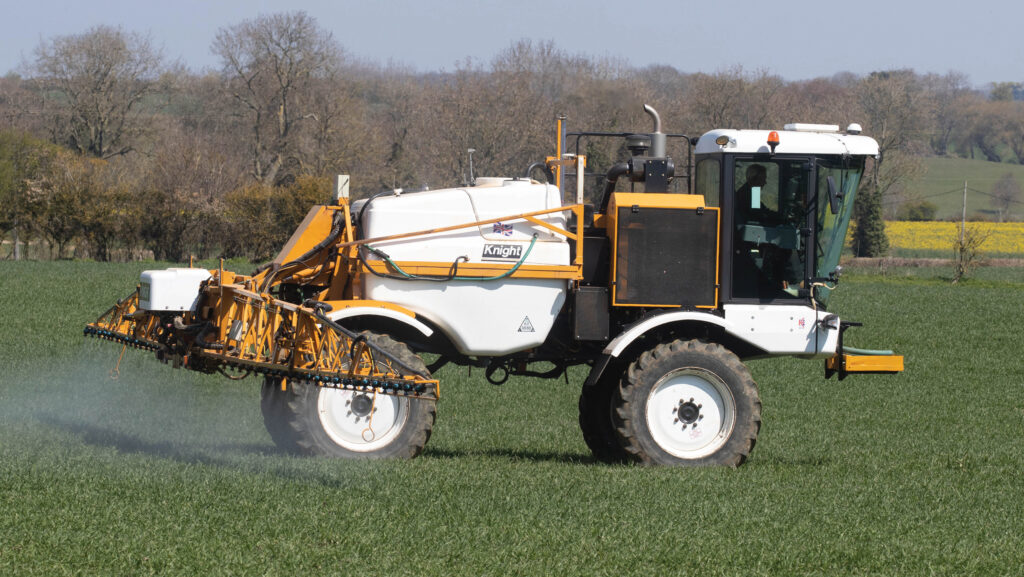
© GNP Wheat growers are urged to re-evaluate fungicide strategies for 2026 now the new race of yellow rust has overcome the YR15 resistance gene widely used in winter wheat varieties.
Jonathan Blake technical director at crop consultant Adas explains the breakdown of the YR15 resistance gene marks a significant shift in yellow rust epidemiology.
With varietal resistance weakened, he says T0 sprays should be considered routine on susceptible varieties.
“T0 is a given. It is one way to reduce that initial inoculum at T1 and make sure we’re in a preventative scenario.”
See also: Two new generation SDHI fungicides at risk of cross-resistance
With yellow rust risk in 2026 depending on variety, early inoculum and weather, he advises that reliance on resistance ratings alone is no longer sufficient.
“I am concerned that varietal susceptibility may have been underestimated. If the YR15 race is ubiquitous, things could be very different,” says Jonathan.
This will mean an early start to disease monitoring, tailoring programmes to yellow rust risk, and ensuring leaf two is protected. Fungicide choice and timing remains paramount.
Rising disease pressure
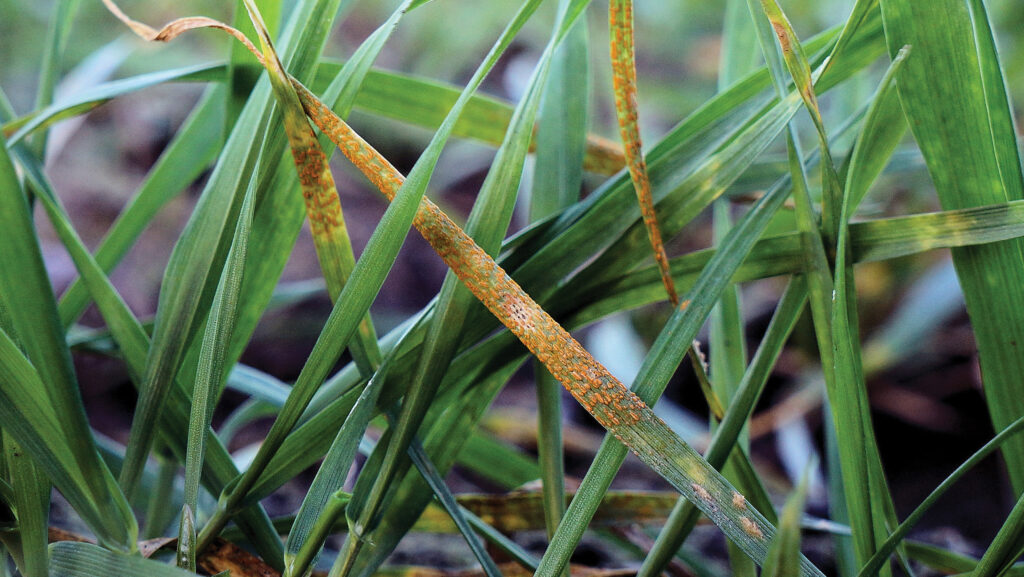
Although recent Defra pest and disease surveys have found yellow rust levels steadily increasing, Jonathan has seen an “almost exponential rise” over the past two to three years.
“The YR15 gene has been widely used in wheat breeding programmes, and ratings and susceptibilities have changed.
“But they’ve changed by varying degrees, depending on the variety, with some more reliant on the YR15 resistance gene than others.
“It makes monitoring of crops more critical than ever this year,” explains Jonathan.
© Blackthorn Arable
While he cautioned against directly extrapolating this trend into 2026, he stresses that 2025 experiences may have underestimated the new scale of the threat.
“Last year was actually not a season that was conducive to yellow rust,” he says, noting widespread frosts, dry conditions and higher temperatures later in the spring.
“Despite this, yellow rust was still observed in crops well into June across some regions.
“My fear is if we have a season that is more conducive to yellow rust, this could be a major problem.”
Septoria vs yellow rust
Jonathan also emphasises the difference in disease biology between yellow rust and septoria, particularly the speed at which yellow rust cycles.
“In May, at average temperatures of about 10C, septoria has a latent period of just over three weeks, but when we look at yellow rust in that same period, it’s closer to 15 days.”
With the typical gap between T1 and T2 sprays being around four weeks, this allows yellow rust to complete at least one infection cycle between applications, leaving final leaf two vulnerable.
Survey data shows that yellow rust severity is often highest on leaf two rather than leaf three – a reversal of the usual septoria pattern.
This is significant because leaf two counts for about 25% percent of light interception during grain filling.
“This explains why trials often show a clean leaf three and flag leaf, but a heavily infected leaf two.
“Our programmes are timed around septoria control, but yellow rust is quite a different beast,” Jonathan says.
Extra spray
Given the shorter latent period, Jonathan suggests growers reconsider the role of a T1.5 spray, particularly on susceptible varieties or where yellow rust is present early.
In one high-pressure trial at Adas Terrington, Norfolk, a five-week gap between T1 and T2 allowed yellow rust to overwhelm crops.
The simple inclusion of an additional T1.5 treatment targeting leaf two completely changed the outcome.
While not every crop will need it, Jonathan advised:
“If you’ve got yellow rust present at T1 and you’re applying a treatment, then walking away and expecting to come back four weeks later and not see any disease, I think that’s optimistic.”
Jonathan Blake was speaking at the recent Association of Independent Crop Consultants (AICC) annual technical conference
Agronomist’s view – David Boulton, Indigro/AICC
Yellow rust is easy to find across the Midlands, particularly in susceptible varieties such as Scope and Extase, warned Indigro’s David Boutlon.
“Much of the focus this season will understandably fall on the breakdown of YR15, but it is important not to overlook the continued need to actively monitor and manage so-called ‘classic’ yellow rust susceptible varieties.
“Early detection and a proactive approach remain critical,” says David.
He added that yellow rust control does not need to be expensive, as there are several low-cost fungicide actives that remain highly effective when used correctly.
“Where active yellow rust is present, I would recommend a minimum of a half label rate of tebuconazole and azoxystrobin at early stem extension (T0 timing), followed by the inclusion of prothioconazole later in the programme.”
Growers should always check product labels carefully, particularly with regard to earliest application timings, as most tebuconazole products are not approved for use before GS30 in winter wheat.
David advised that where possible, he will prioritise the 250g/litre emulsion (oil-in-water) formulation over the 430g per litre suspension concentrate.
“This formulation has delivered more consistent on-farm performance, a trend that has also been reflected in Adas trials,” David says.
Importance of T0 for yellow rust control in the South West
Applying a T0 fungicide could be an essential component of fungicide programmes to keep yellow rust at bay this season.
ProCam agronomist Paul Gruber, based in Oxfordshire, first identified yellow rust in winter wheat in January this year, but last year he identified the disease in late May.
Previously high-resistant varieties with eights and nines have significantly dropped ratings which will need factoring into programmes.
“A lot of perceived high resistance varieties are more susceptible to yellow rust having lost resistance due to the breakdown in the YR15 gene,” says Paul
There are also reports of yellow rust in parts of the South West which normally wouldn’t be affected as much by the disease.
Varieties such as Champion and Typhoon typically grown in this region are more susceptible and growers will need to bare this in mind.
Susceptible varieties
- Group 1: Zyatt, Skyfall, Cheer
- Group 2: Mayflower, Palladium, Grebe, Shergar
- Group 3: Flute, Solitaire, Bamford
- Group 4: Insitor, Gleam, Wolverine, Redwald, Blackstone, Aintree, Fowlmere, Scope, Champion, Beowulf, Dawsum, Typhoon
Control
“Yellow rust is a rapidly moving disease if you get it the wrong timing, you cannot claw yield back, which is why a T0 spray is important,” he says.
Crops are looking forward but Paul recommends not going too early as the disease rapidly changes.
He suggests a T0 should not be applied any earlier than the last week of March, with crops further north a good 10 days later.
ProCam agronomist Nigel Scott recommends an azole spray at T0 which is relatively cost-effective, with the addition of a strobilurin for improved persistency.
“A T1.5 can be beneficial. If there is a gap between traditional fungicide timings, leaf two can be exposed which is why a T1.5 can come in handy. Yes, there is an extra cost, but it can be beneficial,” he says.