Dyson Farming launches UK’s biggest research farm
 @ Adobe Stock
 Learning by doing is the mantra behind the newly opened Dyson Farming Research Centre in Lincolnshire, as it aims to do something genuinely transformational for British agriculture.
Sir James Dyson has given his research team the task of making farming “light years different” in 10 years’ time, so nothing is off limits and the clock is already ticking.
See also: The farming practices helping create a better food system
Productivity and profitability
The dedicated group of researchers, led by Dyson’s Richard Meredith, are looking for new ways of doing things, with a laser focus on productivity and profitability.
A block of land of up to 405ha – some 3% of the company’s land mass – will be used to test, accelerate and scale solutions that could be deployed on farms.
This will often be in combination with existing techniques and other developments, to make a difference in a measurable manner.
15,000ha farming operation
The expectation is that the entire 15,000ha Dyson Farming operation will be benefiting from some of the findings in the next three to five years.
This will be helped by the business’s approach to data and technology stacking.
As Daniel Cross, managing director of Dyson Farming, explains, research projects that aren’t led and co-ordinated by farmers often don’t translate to the real world or deliver the value they promised.
“There are lots of products, ideas and innovations out there, many of which have only been tested on a very small sample size or in a laboratory.
If they’re going to be transformational when they’re deployed, they must be put through their paces in a farm setting,” he says.
Being able to screen multiple ideas for their viability and then test them to get a more thorough understanding of their impact and evaluate the most promising across the farm’s rotation is essential to drive the industry forwards, highlights Daniel.
“Practical is just as important as intellectual,” he stresses.
“As a business, we’re farming 15,000ha and if we don’t have innovation, it’s a problem.
“Farming differently is our model and that needs to have constant improvement at its core,” he says.
“We’re up for it and we want others to come with us. Solving the industry’s problems as a collective will work best.
“The collaboration opportunity is one of the most exciting things about the Dyson Farming Research Centre.”
What does farming differently look like?
Digital transformation is being driven by the need to make better decisions, says Sheener Ooi, chief financial officer at Dyson Farming.
Legacy software systems have been replaced with the Italian X Farm system so that integration with telemetrics and weighbridges can be achieved, which along with financial alignment allows performance to be measured continuously.
“The next stage is Master data, where we create a scheme that allows for the standardised capture and interrogation of data and builds the foundations for AI [artificial intelligence],” she adds.
AI will allow them to do things faster, reveal unexpected outcomes, interrogate findings and identify trends, notes Sheener.
“It will make a real difference to our operating efficiency by the end of the year.”
Edible and specialist oils
Cold pressed rapeseed oil is just one of the products produced by Dyson Farming in a newly commissioned oils plant, using oilseed rape grown in a circular system by the business.
Omega-rich sunflower oil is also an output for use in Dyson-branded hair products, from sunflowers grown on the farm.
The resulting oil has three times the omega content of other sunflower oils, thanks to the combination of suitable variety choice and agronomy regime.
Glasshouse production
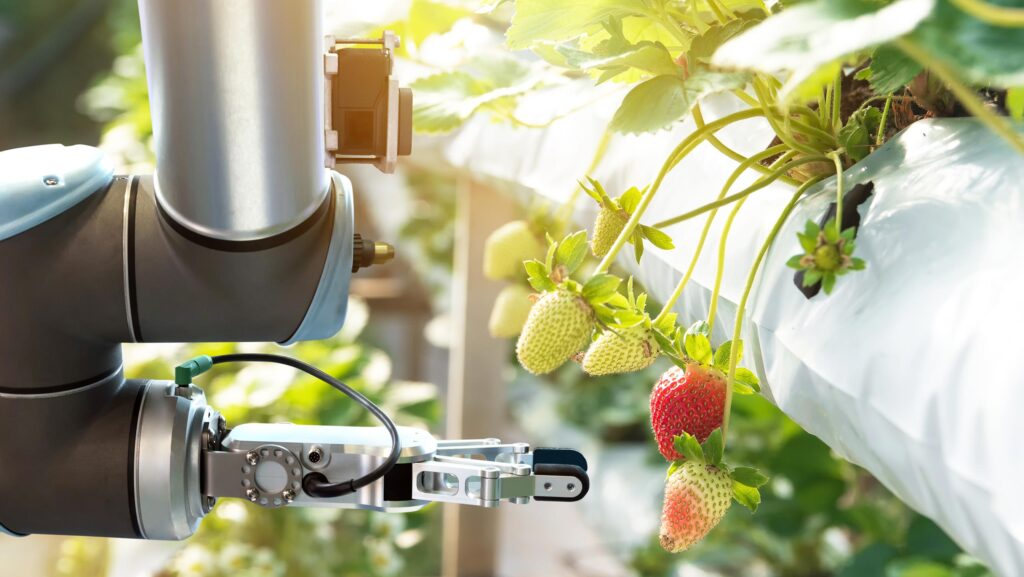
Nowhere is innovation and collaboration more evident than in the glasshouse at Dyson Farming, where strawberries are produced year-round in a novel rotational growing system and picked by robotic harvesters.
R&D work on varieties, sensing technology and engineering developments has revolutionised how the strawberry crop is grown.
Dogtooth robotic harvesters using autonomous navigation along the rows locate and pick ripe fruit, viewing them for imperfections and grading the picked berries as they go.
Seed potatoes
Soil-free seed potato production is another example of doing things differently.
Dyson Farming is working with Airponix to produce eight varieties of seed potatoes in a system using less energy, water and land.
The potatoes are grown vertically on a high-density A-frame structure, using natural light, with a nutrient-rich fog surrounding and penetrating the plant roots, allowing them to absorb what they need.
The aeroponics system reduces water use by 95%, improves yields, replaces the need for other inputs and can be used again, says Airponix chief executive Michael Ruggier, bringing the cost of production down and allowing real-time, detailed feedback.
Farmers Weekly‘s Arable Insights Live event was hosted at Dyson Farming last month, providing industry stakeholders with the latest agronomy advice and technology updates.