

Grower trial aims to unlock food-grade millet production
A crop of millet stood like a green oasis in the middle of the parched Kent landscape in mid-August this year at Nonington Farms, seven miles outside Canterbury.
Grower Emma Loder-Symonds hopes millet might prove to be more than a highly resilient, drought-tolerant, low-input crop.
While the crop is typically grown for wild bird seed end use, Emma’s Defra-funded Adopt project is seeking to pioneer growing it for human consumption in the UK.
See also: When should regenerative growers cultivate?
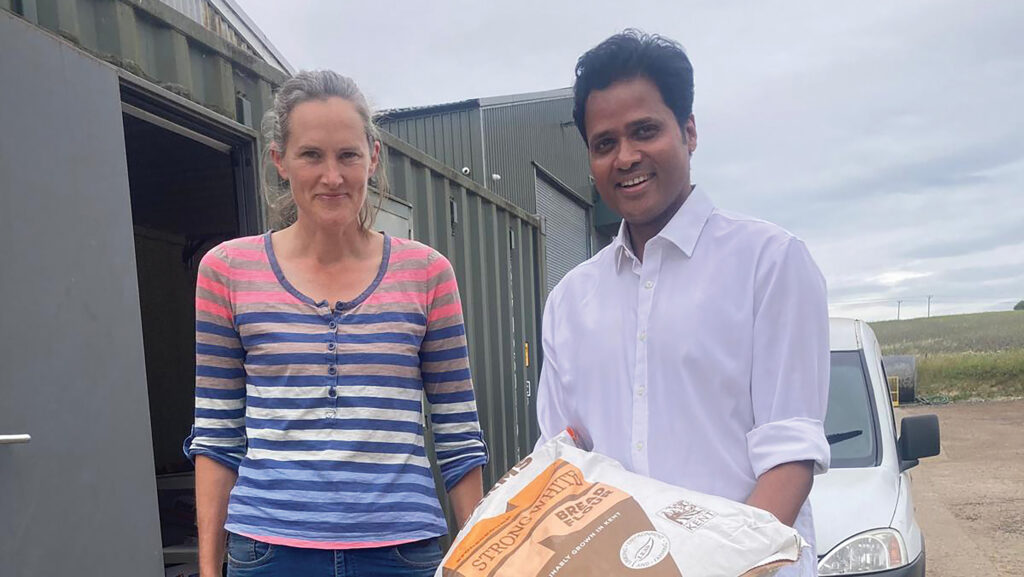
Emma Loder-Symonds and Dev Biswal © Will Harris
The inspiration came from chef Dev Biswal, who runs the cathedral city’s Cook’s Tale restaurant. Emma supplies Dev with heritage wheat flour grown and milled on a recently downscaled, end-market focused 40ha farm.
“Dev approached me because millet has a long culinary history in many parts of the world,” Emma says.
A versatile, gluten-free and high-protein grain, millet has been a staple in Africa and Asia for thousands of years and is popular in Eastern Europe. It can be milled for use in cakes, biscuits and pasta, used as a cooked wholegrain in salads, or brewed into gluten-free beer.
In the UK, while it’s been successfully grown for wild bird seed and in environmental schemes, there’s currently not a market for food use.
Growing for a niche end market fits Emma’s new business model perfectly. Rather than running a large-scale, but stressful, 1,600ha contract farming operation, Emma and her husband James are now concentrating on processing a much smaller area of crops grown on-farm and establishing direct-to-consumer relationships where they can dictate their own prices.
What is Adopt?
The Accelerating Development of Practices and Technologies (Adopt) funding through Defra’s Farming Innovation Programme aims to support farmer-led on-farm trials developing and testing new solutions to farming challenges, with the results shared to help other farmers.
Projects last from six months to two years and are led by a farmer.
Agronomic challenges
Growing millet isn’t without its agronomic challenges, Emma notes.
“First, you would usually cut it in September. Theoretically at least, in the UK, September can be wet, making harvesting more problematic,” Emma says.
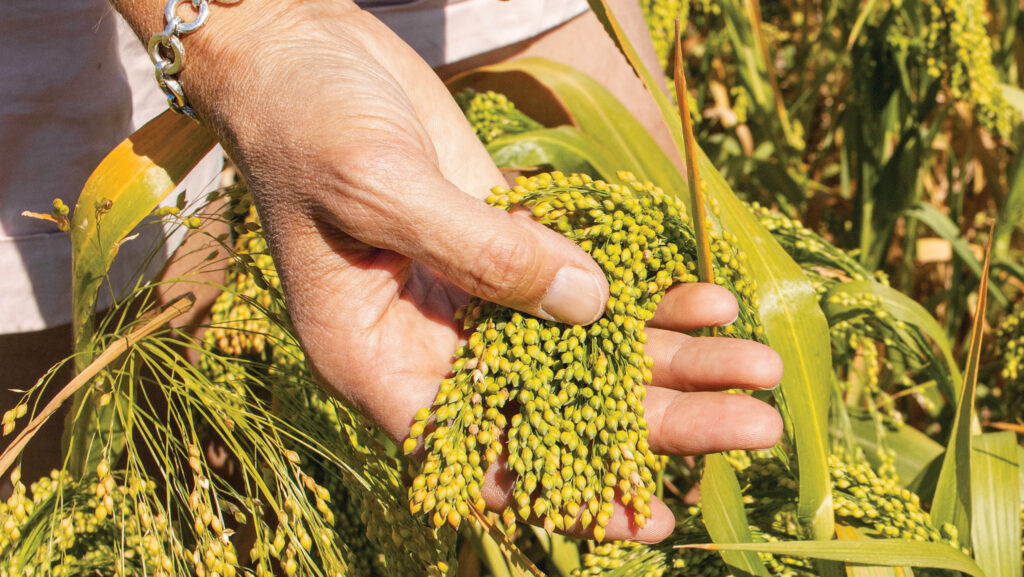
Proso grains © Mike Abram
“But more importantly, when it is cut for bird seed, it is usually desiccated with glyphosate, and the maximum residue limits for millet [for food use] are 10 times more stringent than for wheat.”
That’s led to the key agronomic question the Adopt project is seeking to answer – can millet be swathed? “We do it for other crops, such as buckwheat, so why not?” Emma asks.
And with future approval of pre-harvest glyphosate use in all crops uncertain, the results of the project could have extra utility, she says.
Drilled on 15 May, Emma’s 5.6ha of Proso white millet was intercropped with spring beans to potentially help add a little bit of fixed nitrogen.
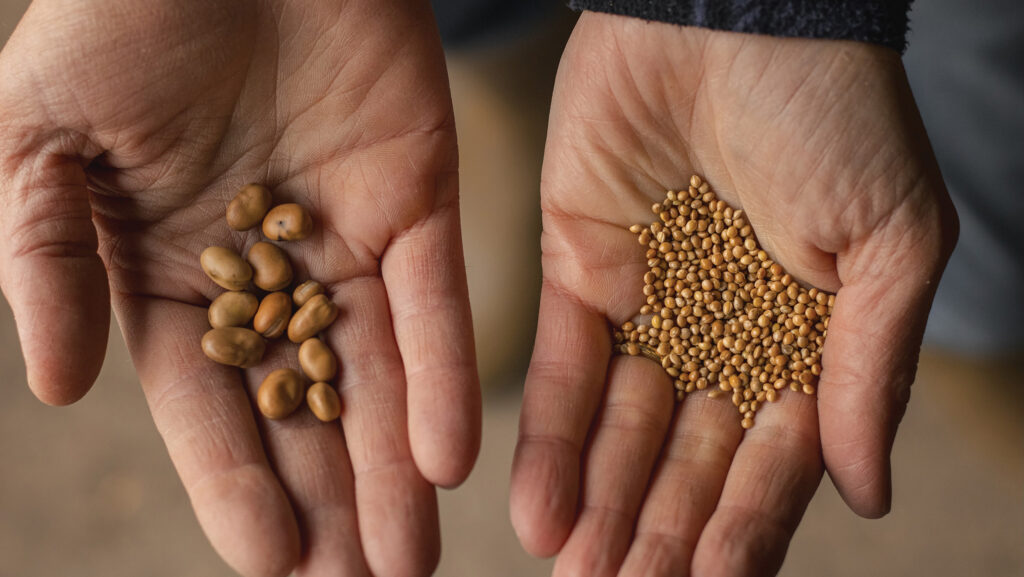
Companion bean and millet grains © Will Harris
The crop followed a multispecies overwintered cover crop that was grazed and then terminated with glyphosate before drilling.
“We timed drilling perfectly as it rained the next day,” Emma recalls. “But it hasn’t rained since June. It’s obviously a very good crop in a drought.”
Agronomy advice came from project partner David McNaughton of Soya UK, a firm with a lot of experience from growing millet for bird seed. Slug pellets and 40kg/ha of nitrogen were applied at drilling.
“David did suggest a top-up of nitrogen after drilling, but we didn’t feel it needed it,” she says.
“We think millet is a bit like oats in that it will scavenge for nutrients, and we back our soil health to be good.”
Swathing trial
For the swathing trial, Emma is planning to split the field into four strips, with one-quarter left to be direct combined.
The other three strips will be swathed on the same day, and then combined after five, 10 and 15 days to test for the optimal harvest window.
Given the dry season, harvest is likely to be early, and direct combining could be successful this season, she suggests.
“In some years, there’s likely to be lots of secondary tillers, and swathing helps reduce the amount of green matter going through the combine.
“But I don’t think that will be a problem this year, so I reckon it might work, not least because the crop doesn’t have lots of green material at the bottom.”
The other key part of the project is how to process the millet for human consumption.
© Mike Abram
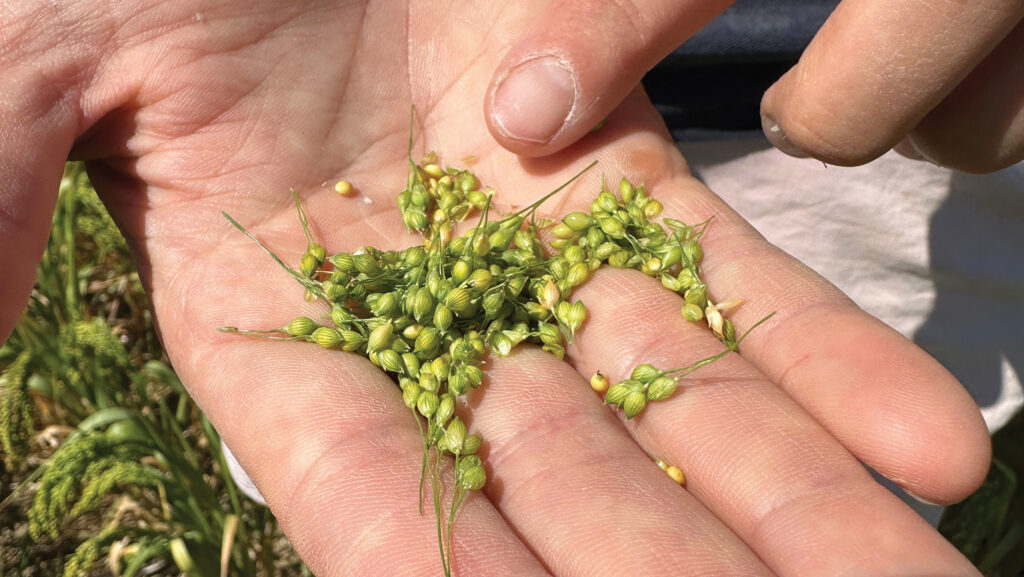
“The husk is unpalatable,” Emma says. “We’re looking at doing that with a bolt-on to the stone mill we use to mill all our heritage and wheat blends. Nobody in the UK, I think, does it, but we have some leads.”
Another challenge is that millet grain, along with every cereal, contains a substance called phytic acid, says Dr Lydia Smith, who is leading the research into processing part of the project for Niab.
“It’s what the plant uses to store material in the seed in a safe form to withstand the break between production of the seed and the seed germinating for the next generation,” Lydia explains.
But humans lack the ability to metabolise phytic acid, while it also strongly binds micronutrients, essentially making them unusable.
Traditionally in countries where millet is used as a food ingredient, it is fermented overnight.
“The grains are ground with water and allowed to ferment,” she says. “That solves the phytic acid problem to some extent, but doesn’t produce something that is lovely to eat.”
Micro-malting
An alternative, which Niab will be testing, is an arrested germination step, not dissimilar to the start of malting.
“If you kid the seed that it’s germinating, it starts to mobilise the phytic acid using its own enzyme capacity. But it is a fine balance, as you don’t want it to go too far and produce a proper root and shoot.”
Niab uses the exactly the same micro-malting process for barley, she says. “So we’re going to test that with the millet.”
Like barley, the micro-malted millet could be used to brew beer, but Lydia also suggests the whole grain could be used as a direct food ingredient.
“That would be my preferred outcome as you’re using the whole grain.”
Once processed, Dev will be picking up the baton, to showcase the many diverse uses of millet.
“He wants to show everyone why they should be eating millet, and these are the recipes,” Emma says.
That’s crucial because if the project is going to be successful, building a new market for food grade millet in the UK is critical.
“That’s always the challenge with new crops,” Lydia stresses. “If farmers grow it, but nobody buys it, it’s a disaster.”
What could be adjusted in year two?
Adjustments in year two of the project could include establishing the bean companion crop earlier than the millet, Emma Loder-Symonds says.
“Growing beans in May is not a great idea, so I’m considering putting the beans in earlier and then offsetting with the millet.”
She might also look at bringing the drilling date of the millet earlier, while experience this year with micronutrient applications showed potential benefits for helping the crop through the multiple heatwaves.
Trials growing different types of millet could also be expanded.
This year, Emma is growing the Proso white millet typically grown in Europe in the main trial, but also trialled hand sowing two different foxtail millets that are more popular in other parts of the world.
Scattered in June, a small population has managed to establish, giving Emma hope that if properly drilled, these alternative varieties could be options to grow.
One key goal of year two is to also assess how a winter wheat performs following millet, she adds. “I think it will be a good entry point, but Niab will be monitoring that closely.”
Emma is also hoping for a wetter year to test millet’s commercial viability in different types of season.
This year has demonstrated just how resilient the crop can be in exceptionally dry conditions.
The next test is how reliably it performs when the weather is less favourable, she says.
“Can millet perform consistently enough to give farmers another viable crop option, while also supplying a new UK market for food-grade grain?
“If it can, millet’s future on UK farms could extend well beyond bird seed.”

Staying sharp shouldn't be a chore
Explore more / Transition
During the series we follow our group of 16 Transition Farmers through the challenges and opportunities as they seek to improve their farm businesses.
Transition is an independent editorial initiative supported by our UK-wide network of partners, who have made it possible to bring you this series.
Visit the Transition content hub to find out more.
