

How climate change is reshaping crop agronomy
 © GNP
© GNP Evidence from long-term trial data and climate modelling shows that warmer summers, wetter winters and more extreme weather events are affecting yield reliability, disease pressure and pest risk.
The key question facing growers and agronomists is no longer whether climate change will affect arable systems, but how quickly management and crop choices must adapt.
Adas senior crop research scientist Christina Baxter presented evidence of climate change impacts on UK arable systems at the recent Association of Independent Crop Consultants (AICC) annual technical conference.
See also: How climate change may increase pest and disease threats
By comparing average on-farm wheat yields with AHDB Recommended List (RL) trial yields from 2002 onwards, a clear trend emerges. Since around 2006, both datasets show large seasonal fluctuations.
“The fact that both datasets show the same pattern of fluctuation tells us that they are dealing with the same limitations coming from the environment and changing weather patterns,” says Christina.
A separate analysis using four-year rolling averages between 2002 and 2025, which removes much of the seasonal noise, shows RL yields increased by about 0.5t/ha over those 13 years.
2.5t/ha yield gap
However, on-farm wheat yields have remained static or even declined slightly, leaving a significant yield gap of about 2.5t/ha.
“Some of this can be attributed to changing weather patterns and the fact we may not be adapting our management,” she adds.
Average temperatures in central England have increased by about 1C, with slightly less warming in Scotland and Northern Ireland.
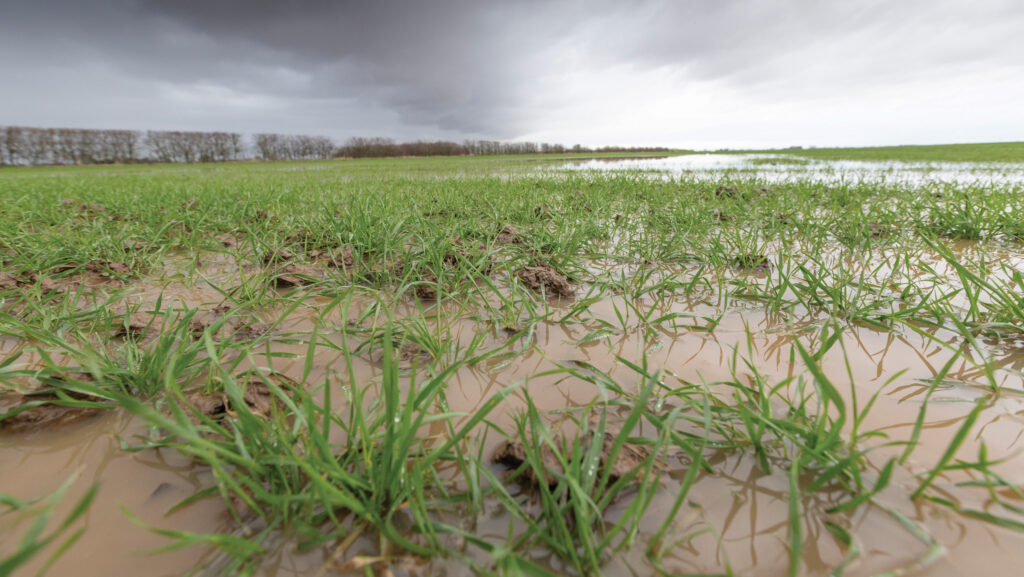
While changes in total annual rainfall are less clear, there is a general trend towards drier summers and wetter winters, which is expected to intensify.
There is also strong evidence of an increase in heavy rainfall events contributing disproportionately to winter precipitation.
Crop response
So how are crops responding to these changes? Analysis of Yield Enhancement Network (YEN) data has helped identify how environmental and agronomic factors relate to yield.
Christina explains that wheat maturity shows a strong association with yield, while anecdotal evidence suggests growers are seeing earlier senescence in crops.
Using the RL score for variety maturity, the YEN data shows that varieties maturing two days earlier than the control yield about 1t/ha more, while those maturing three days later yield about 1t/ha less.
“Maturity is closely linked to flowering time. What we believe is happening is that earlier varieties are flowering and filling their grains earlier in the season, under cooler temperatures when more water is available,” she explains.
“This raises the question of whether we should be considering growing more earlier flowering varieties in the future.”
YEN data also shows climate impacts on other yield-critical factors such as grain size, grain weight and the length of the production phase immediately after flowering.
Mean growing season temperatures in the first decade of YEN data increased by about 0.5C, with the largest rise of 0.8C occurring in June and July.
“The production phase is influenced by degree days. Therefore, temperature increases are resulting in a grain fill period that is around 10 days shorter, which has a negative impact on thousand grain weight,” Christina says.
Earlier varieties
Earlier-maturing varieties could help protect yield by allowing crops to flower and go through grain production during cooler conditions, reducing the risk of grain fill being cut short by heat and drought stress.
However, options are limited. Over the past five years, only one variety, Fowlmere, has entered the RL system with a maturity score of -2.
Nevertheless, management can still play a role in protecting the grain production phase and maintaining grain size.
“Good water capture deep in the soil profile, a robust fungicide programme at flowering, and adequate nutrient concentrations in the canopy that are redistributed to the grain are all critical,” says Christina.
“Key nutrients include nitrogen, phosphorus, sulphur and zinc. Deficiencies in these can accelerate senescence.”
Heat and drought stress also pose a growing threat to yield, and identifying varieties from RL data that perform well in dry seasons or on lighter soils is important.
Nutrient uptake
YEN grain nutrient data, spanning more than a decade, has been analysed to understand how changing weather patterns affect nutrient uptake.
Grain nutrient concentrations fluctuate significantly between seasons, influenced by crop development, yield and nutrient solubility.
In 2025, for example, grain nitrogen concentrations were higher than previous years because nitrogen was taken up earlier and concentrated by lower yields.
By contrast, grain phosphorus concentrations were lower due to the very dry spring and summer. Phosphorus is an immobile nutrient that relies on soil moisture for diffusion to plant roots.
“When rainfall data was compared with grain nutrient concentrations, phosphorus, manganese and sulphur were all strongly influenced by spring rainfall,” Christina explains.
“Greater rainfall from April to June increased phosphorus and manganese uptake. For sulphur, which is highly soluble, higher early spring rainfall reduced concentrations due to increased leaching, particularly when sulphur fertiliser is applied early.”
Establishment matters
Should this change crop nutrition strategies? Not fundamentally, says Christina, but it does reinforce the importance of establishment.
“Good establishment ensures a large root biomass with high root length density, which is essential for nutrient uptake in the topsoil and water uptake from the subsoil later in the season.”
Drilling date has a major influence on root system size. Drilling just two or three days earlier can significantly increase root length, especially in warm soils where roots can grow about 1cm per day.
Early nitrogen can help reduce the risk of slow uptake in dry springs, but later sulphur applications may be justified in some high rainfall seasons. Tissue testing remains a useful tool for identifying sulphur deficiency.
Christina cautions that strategies to improve abiotic stress resilience, such as early drilling, can increase disease and lodging risk, highlighting the need for flexibility in response to seasonal conditions and short-term forecasts.
“Foliar fertilisers may also offer potential for delivering nutrients directly to the crop, particularly micronutrients.”
Scenario modelling
At the UK Centre for Ecology and Hydrology (UKCEH), researchers have developed process-based models that estimate maximum potential yield constrained by climate at a 1km sq resolution across the UK.
Professor Richard Pywell explained that models have been run for +2C and +4C warming scenarios to help farmers understand how climate change may affect their systems.
Currently modelled crops include wheat, oilseed rape and grass. Importantly, potential yield does not account for nutrient limitations, pests or disease.
Under the +2C scenario – broadly equivalent to 2050 on the current trajectory – wheat yield potential is predicted to increase in northern regions, but decline in parts of the south. Oilseed rape remains relatively stable.
Around 2080 in the +4C scenario, wheat becomes much more questionable in southern England, and oilseed rape begins to suffer too.
To make this data accessible, UKCEH has developed a tool allowing farmers to enter a postcode and see how different warming scenarios could affect their yield potential.
Crop suitability
Called Farm Health Check it provides insights into soils, vegetation, habitats and crops, helping farms balance productivity, profitability and sustainability under climate risk.
Farmers enter their Single Business Identifier (SBI) and operational data from platforms such as Gatekeeper or Omnia.
The tool then generates maps and metrics showing farm assets, climate risks and potential adaptation pathways, such as improving soil organic matter to increase water-holding capacity.
“It tracks performance over time so farmers can see how things are changing and improving,” says Richard.
Farm Health Check also highlights future crop suitability. For example, sunflower, currently marginal, could become viable under moderate or high warming scenarios.
For a Wiltshire farm, modelling shows declining suitability of wheat and oats, while durum wheat, chickpeas, lentils and soybean become more viable.
“This could help diversify rotations,” says Richard, “but it is important to trial these crops on farm and understand how to grow them in practice.”
One example is recent rice trials in the Cambridgeshire Fens. “Although very marginal at the moment, we need to start testing these crops and varieties now.”
Pests and diseases
UKCEH yield models do not account for pest and disease pressure, but research at the University of Exeter is examining how climate change could reshape current and future threats.
The University’s new Global Meteorological Simulator, or “weather pod”, allows experiments under controlled climate conditions, making research more field-realistic than traditional laboratory work.
Dr Helen Fones said this enables detailed study of crop-pathogen-climate interactions and warned that pests and pathogens are already on the move or evolving.
“The Colorado potato beetle is one example of a pest expanding northwards. Another is Xylella, which causes Pierce’s disease in grapevines and is limited by cold winters. As winters become milder, it could potentially establish in the UK.”
Existing pathogens are also evolving. Yellow rust populations are adapting to warmer climates, and shifts are being seen in fusarium species composition.
Testing has revealed an increase in multiple fusarium species with differing virulence and fungicide sensitivity, which could alter management strategies. An expansion in maize area could further increase risk, acting as a reservoir for infection.
“Septoria leaf blotch, which is the pathogen I work on, thrives in warm, wet conditions and is, therefore, expected to become more problematic in parts of the UK,” says Helen.
Survival strategies
Helen’s research also covers pathogen survival mechanisms.
Septoria can form biofilms under stress, increasing tolerance to heat, drying and fungicides. Disrupting biofilm formation could offer new disease control targets.
Manipulating plant-associated microbial communities may also provide sustainable protection against pathogens.
“Predicting and mitigating disease risks under climate change requires understanding pathogens as well as plants,” Helen concludes.
“We need to know which pathogens will thrive where, how climate change affects crops, pathogens and ecosystems, and how we can use this knowledge to inform management strategies.”
Agronomist’s perspective: Ben Boothman, AICC
Climate change is already shaping decision-making and the way risk is managed on farm, according to Yorkshire-based independent agronomist Ben Boothman.
Recent seasons have highlighted a clear shift towards wetter, milder winters and drier, warmer summers, with rainfall increasingly arriving in shorter, more intense periods.
Ben says this will start to influence variety choice, with a growing focus on suitable options with earlier maturity.
He adds that while UK growers have historically relied on locally adapted varieties, there is increasing interest in material from northern Europe as agronomists and breeders assess how best to build resilience against climate trends.
Adaptation is not just about crop choice.
Whole-system thinking, including more flexible rotations and cultivation strategies, will be key, and spring cropping decisions are increasingly being shaped by drought risk, soil type and the reliability of agrochemicals under dry conditions.
“Five years ago, drought probably never really entered our heads, but now it’s not just about whether the crop will reach its potential, but whether the herbicides we’re putting on are going to work.”
Looking ahead, Ben believes climate change will bring opportunities as well as threats, from protein crops such as soya to more radical shifts in rotations.
However, he stresses that navigating this uncertainty requires expert, independent advice.
“You can’t just go off a playbook like some have in the past. Everything must be tailored for a specific field or farm.”