How tech approach lifted ‘field of the future’ margins by 26%
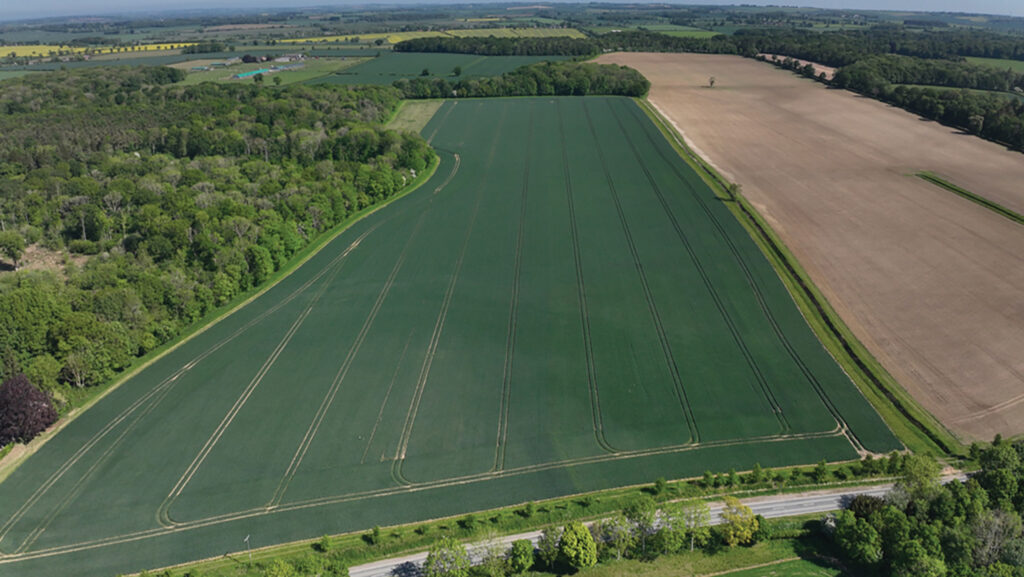 Revesby Estate 19ha field of Redwald wheat used in season two of the trial © Agrii
 A change in approach at Revesby Estate in Lincolnshire saw the “field of the future” deliver a 26% higher gross margin than the farm standard at harvest 2025, in a season that was dominated by soil moisture.
This was in contrast to season one (2023-24) of the Agrii trial, which saw the “field of the future” (also referred to as the Digital Technology Farm [DTF] area) fall 1t/ha short of the farm standard.
As Agrii’s technology trials manager, Jonathan Trotter recalls, opting for the wrong fungicide strategy contributed to the 1t/ha shortfall.
See also: How tech trial is helping Lincs estate improve wheat inputs
In season one, data was mostly guided from technology such as SmartFarm app disease forecasting. However, Jonathan notes this approach did not work.
So last season (season two), Jonathan – along with Agrii UK digital agronomy development manager Lucy Cottingham – adopted a new approach for the digitally farmed area, combining agronomic knowledge and regular field walking with technology.
It seems to have paid off, with £137.63/ha extra gross margin. This was mainly due to the higher yield (more than 0.82t/ha) as total costs were similar.
T1 fungicide
One example of the new approach was the T1 fungicide.
“Based on the Contour disease risk predictions, plus Bioscout spore sensor, data suggested there was no significant disease risks so we went with a reduced fungicide approach,” says Jonathan.
Crucially, when walking the field, they found yellow rust and took action.
“If we had not gone field walking, we would not have picked up the rust risk – which could have significantly impacted yield. We ground-truthed the crop and acted with a T1.5.”
While this increased the fungicide spend, if they had gone with just the data-driven approach, there may have been a yield penalty like the season before.
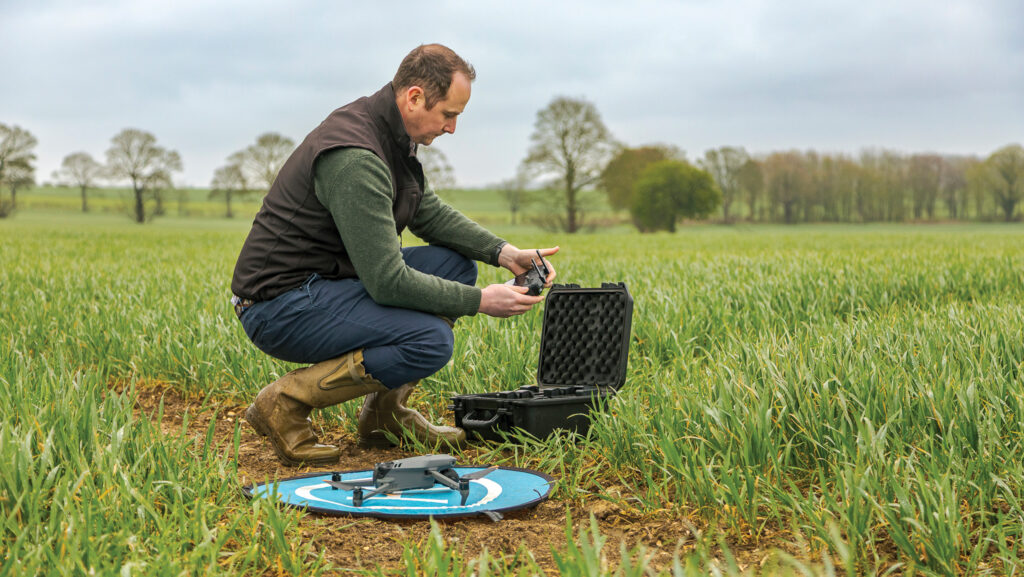
Jonathan Trotter with the Skippy Scout drone © Agrii
Nitrogen use efficiency
Another benefit for the DTF area was a more efficient use of fertiliser, with an average nitrogen use efficiency (NUE) of 60% compared with 56.5% for the farm standard.
On the lighter area at the bottom of the field, the tech side exceeded 70% NUE from 37% less spend on N.
Jonathan puts this down to using variable rate for both applications, while the farm standard area had a flat rate for the first application and variable rate for the second.
One key difference was that the variable rate on the farm standard area was based on just satellite data, while the DTF area also used the higher resolution Skippy Scout drone data to ground-truth the satellite data.
This resulted in variable N rate maps which had greater variability in application rates. “This seems to be bringing an extra benefit.
However, the drone data is not that easily assessable for farmers as it isn’t yet in Contour and it’s something that we are working on to benefit farmers,” says Jonathan.
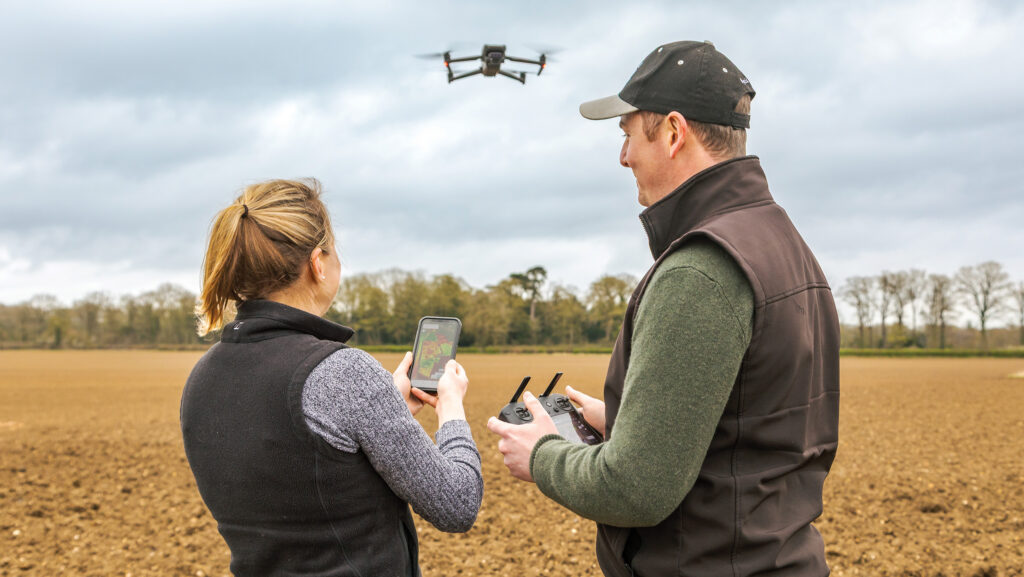
Jonathan Trotter and Lucy Cottingham with drone © Agrii
Second fertiliser
Furthermore, the second fertiliser dose went on seven days earlier for the DTF area which may have been beneficial in a drought year, says Lucy.
Revesby Estate’s farm manager, Peter Cartwright, explains that for the second application, he pushed harder at the top end of the field and pulled back at the bottom, driven by historic knowledge on yield potential.
With hindsight, if he had known it was going to be so dry, he says he would have cut back a bit on the fertiliser.
“It was nicely set up to maximise grain fill and push yields, but the extreme heat resulted in early senescence of the crop.”
Digital Technology Farms
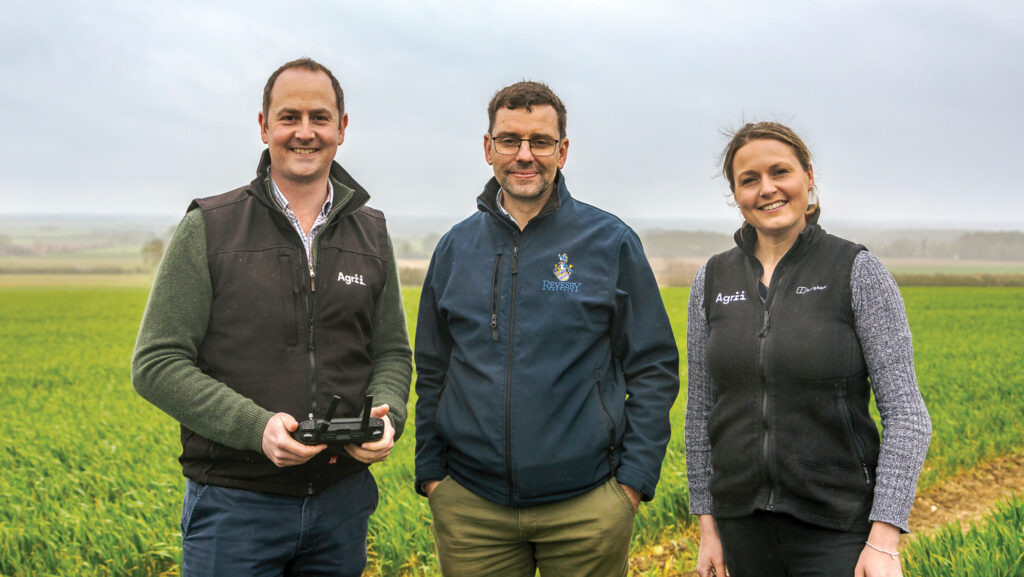
Jonathan Trotter, Peter Cartwright and Lucy Cottingham © Agrii
Revesby Estate is one of the four Digital Technology Farms established by Agrii to assess how new technologies can be combined to best effect and integrate into existing farm practices.
In the second season, half of a 19ha field of direct-drilled Redwald winter wheat was managed by Revesby Estate’s farm manager Peter Cartwright using his standard farm practice for fertiliser and fungicides (field of today).
The other half was managed by Agrii’s Jonathan Trotter, and Lucy Cottingham, based on technology and data sources (field of tomorrow).
They focused on crop nutrition (applications and timing), nitrogen use efficiency, and fungicide application timing and choice.
At the end of the season, Agrii carried out a cost benefit analysis.
Year three

Optigene portable lab © Agrii
This season, the trial is in a field of Bamford wheat which has suffered slug grazing. The technologies being trialled include the Optigene portable lab. This device gives a measure of any latent yellow rust and septoria infection in leaves, says Lucy.
Also new to 2026 are two Paultech devices that measure nitrates in soil at three different depths. “This will, hopefully, indicate if any top-ups are needed,” she says.
The final technology is looking at soil acoustics. A probe in the ground will listen to soils and this can indicate if the soil is healthy or not by listening for biology like worms.
Agrii has also brought the Danish Perplant sensor onto the farm for Peter to trial and feedback on its use.
This is an AI-powered, plug-and-play camera sensor that retrofits onto tractors to provide real-time data.
Lucy points out that its biomass measurements will aid variable rate nitrogen, being midway between satellite and drone use.
Results |
||
|
|
Farm standard |
Digital Technology Farm area |
|
Yield (t/ha) |
7.58 |
8.4 |
|
Total output (£/ha) |
1,232 |
1,365 |
|
Total costs (£/ha) |
702.1 |
697.47 |
|
Gross margin (£/ha) |
529.90 |
667.53 |
|
Figures include: £4.5/ha Rhiza VRA cost, £1/ha Skippy cost and £27/ha VRA Sustainable Farming Income. Source: Agrii |
||
Spend |
||
|
|
Cost (£/ha) |
Difference (£/ha) |
|
Nutrition |
||
|
Farm average |
£232.98 |
– |
|
Farm zone B |
£240.43 |
+£7.4 (+3.1%) |
|
Farm zone D |
£229.03 |
-£3.95 (-1.7%) |
|
Tech average |
£202.84 |
-£30.14 (-15%) |
|
Tech zone C |
£170.24 |
-£62.75 (-36.9%) |
|
Biostimulants |
||
|
Farm standard |
£0 |
– |
|
Digital Tech Farm |
£22 |
– |
|
Fungicide |
||
|
Farm standard |
£117.35 |
– |
|
Digital Tech Farm |
£156.25 |
+£38.90 (+25%) |
|
Source: Agrii |
||
Disease and fertiliser strategies in 2025
Fertiliser
Cottingham explains that they used the Skippy Scout drone mapping and green area index (GAI) tool to inform their nitrogen applications.
They then used the Rhiza NDVI mapping tool to correlate the high-resolution drone GAI data with satellite data to produce a fertiliser application map for each timing.
The calculations were made using a target yield of 10t/ha and 9% protein across medium soils and 8.5t/ha with 9% protein in light soils, along with soil mineral nitrogen estimates based on February soil samples.
Tissue testing was also carried regularly through the season to check crop N status.
The first liquid urea application was made on 4 March at two rates, 85kg/ha and 132kg (see panel).
Lucy says they also applied Nientris on 20 March, which is an endophyte that fixes atmospheric nitrogen to see if they can cut back fertiliser and maintain yields.
On the farm side, Peter Cartwright adopted a flat rate of 110kg/ha for his first split, in line with the rest of the Estate.
The second fertiliser application saw a variable rate approach taken on both halves.
Disease strategy
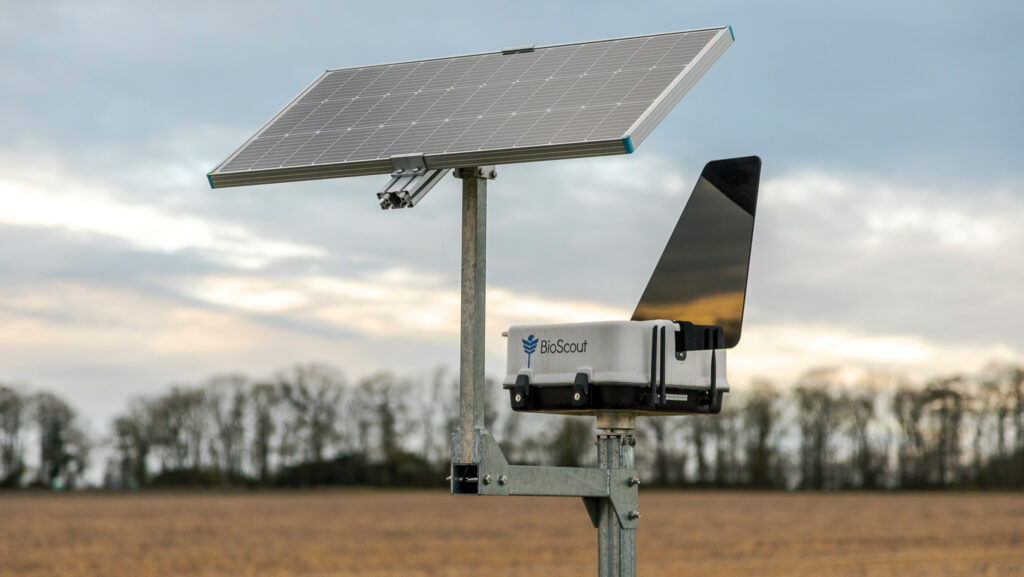
Technology being trialled includes the Bioscout spore sensor © Agrii
Moving to disease, Lucy says they used Contour disease risk predictions coupled with an agronomic input to formulate strategy.
This brought in knowledge and understanding of variety, disease ratings – from AHDB and Agrii’s variety susceptibility ratings (VRA) data – and product efficacy.
Later in the year, Lucy started to use the Australian BioScout spore tester to monitor the airborne disease risk (from 24 April after T0 and T1).
At the T0, a low-disease risk forecast meant the tech side went with a biostimulant-only approach.
“There was little visual disease present in field in early spring, mainly septoria contained to lower leaves in March and early April.”
Peter says the farm strategy was to apply a strobilurin plus tebuconazole. “The strobilurin was to help promote root growth after the wet winter and build biomass.”
At the T1, the tech side went earlier as they had not used a fungicide and they again went with a biostimulant, as disease risk was still low.
However, Lucy recalls that just after spraying the crop, she did see yellow rust and this prompted a T1.5 with Comet to tackle this rust.
On the farm side, Peter went with a rust-focused T1 of (benzovindiflupyr) plus 0.8 litres/ha Soratel (prothioconazole).
At the T2 timing, Peter used his earwash programme and his planned T2 at the T3, as he had already used an SDHI 10 days prior.
The very rapid crop development had resulted in a short T1 to T2 interval.
“We went with a strobilurin again to fight stress and there was no septoria risk. We wanted to save the big guns [SDHI fungicides] for later if it turned wet.”
Yellow rust
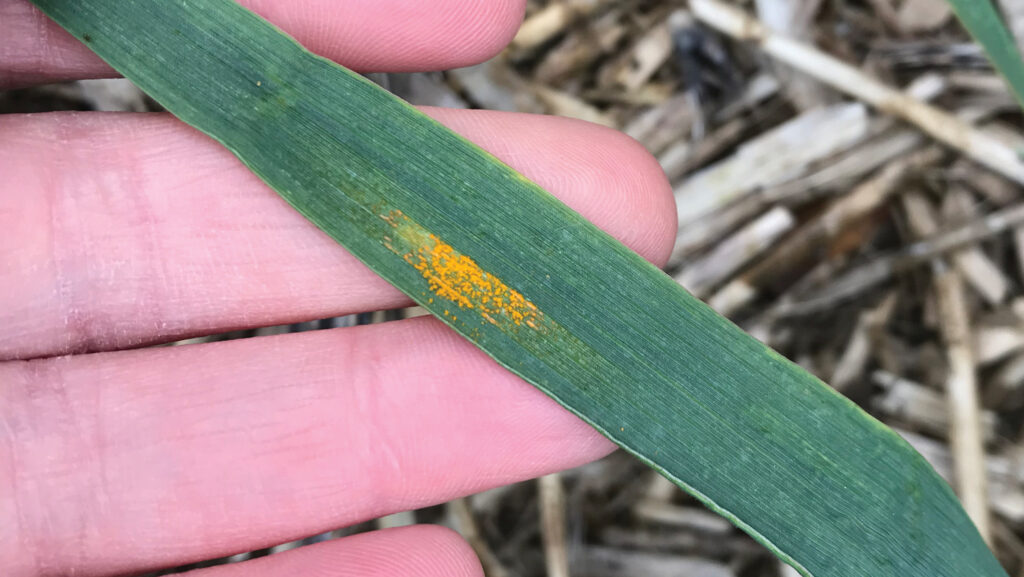
Yellow rust © Agrii
At this stage, yellow rust while present had become inactive following treatment had become inactive in the dry conditions, so Lucy also used the Bayer disease check service to give another layer of decision by looking at latent septoria and yellow rust.
“We decided for the tech side that T2 being flag-leaf timing and the leaf for yield, we didn’t want to compromise on our input for this timing hence our approach using conventional chemistry.” So she opted for Vimoy plus Torch Duo.
Finally, at T3, low levels of rust were being picked up by BioScout, so Lucy used an azole mix.
A similar strategy was used on the farm side, along with fluxapyroxad, as extra insurance in case the weather changed.
Fertiliser and disease inputs used in the trial |
||
|
|
Farm standard |
Digital Technology Farm area |
|
Nitrogen fertiliser (Nitrasol N28%) + Liqui Safe |
||
|
First split (4 March) |
Flat rate: 110kg/ha |
Variable rate: Light soils/higher biomass 85kg/ha Medium soils/higher biomass 132kg/ha |
|
Second split |
7 April Variable rate: 95-119kg/ha |
31 March Variable rate: Light soils/higher biomass 52-77kg/ha Medium soils/higher biomass 79kg/ha |
|
Crop total N |
204-229kg/ha |
162-211kg/ha |
|
Fungicides |
||
|
T0 |
27 March 0.75 litres/ha Azoxystar (azoxystrobin) + 0.5 litres/ha Tubosan (tebuconazole) + 2.5 litres/ha Manzi (manganese, magnesium, zinc and nitrogen) |
20 March 375g/ha Innocul8 (biostimulant for plant defence) + 2 litres/ha Manzi (manganese, magnesium, zinc and nitrogen) |
|
T1 |
6 May 0.6 litres/ha Ceratavo Plus (benzovindiflupyr) + 0.8 litres/ha Soratel (prothioconazole) |
17 April 1 litre/ha Physiocrop (mixed minerals for abiotic stress/ plant growth) + 1.5 litres/ha Human Z50 (manganese, zinc and sulphur) + 1 litre/ha Phyte-P Plus (highly available potassium phosphite) |
|
T1.5 |
– |
2 May 375g/ha Innocul8 (biostimulant for plant defence) + 0.59 litres/ha Comet (pyraclostrobin) |
|
T2 |
15 May 0.85 litres/ha Affix (azoxystrobin) + 2 litres/ha Lono Multi (nitrogen, potassium, copper, magnesium, iron and zinc) |
14 May 1 litres/ha Vimoy (isoflucypram) + 1 litres/ha Torch Duo (prothioconazole + spiroamine) |
|
T3 |
23 May 2 litres/ha Opte-Mag (magnesium + nitrogen) + 1 litre/ha Pioli (fluxapyroxad) + 0.6 litres/ha Helsinki (prothioconazole) + 0.4 litres/ha Zonor (tebuconazole) |
2 June 2 litres/ha Opte-Mag (magnesium + nitrogen) + 0.6 litres/ha Helsinki (prothioconazole) + 0.4 litres/ha Zonor (tebuconazole) + Kantor (Adjuvant) |
|
Source: Agrii |
||