Cornish farmer puts variable-rate nitrogen tech to the test
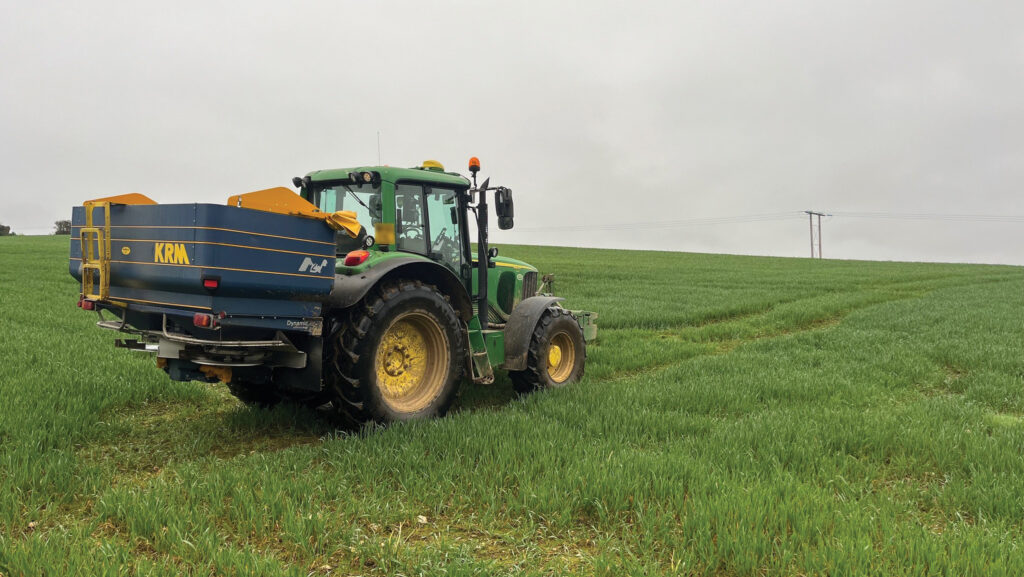 Fertiliser spreading at Cornhill Farm © Pete Olds
 Expenditure on nitrogen will be a key focus for arable farmers this season, with many looking to make marginal savings on application rates to make inputs go further.
For those not currently using variable-rate nitrogen systems, this may well be the season to make the investment.
Cornish AHDB Monitor Farm host Pete Olds is trialling two variable-rate systems across his farm to identify the best tool for the job.
See also: 4 new nitrogen management technologies and how they work
He currently uses Omnia’s NDVI satellite imagery to create yield maps and determine N rates, but frequently finds cloud cover to be a limiting factor.
Being put to the test this season, will be the cab-mounted Yara N-Sensor, and next-generation satellite tool Messium, which will be compared against the farm standard.
Pete Olds © MAG/Emma Gillbard
The aim is to target nitrogen to level up crop uniformity, yield and margin.
“We integrate a lot of poultry manure in our rotation from our laying hen enterprise. We’re hoping to even up crops and tailor N use, accounting for any potential overlaps and variation in manure content,” says Pete.
Yara N-Sensor
Pete is particularly keen to use the Yara N-Sensor, which scans crops in real-time and does not rely on satellite function.
Cloud cover is a frequent occurrence at the farm’s coastal location – just 10 miles from St Ives – which compromises data capture.
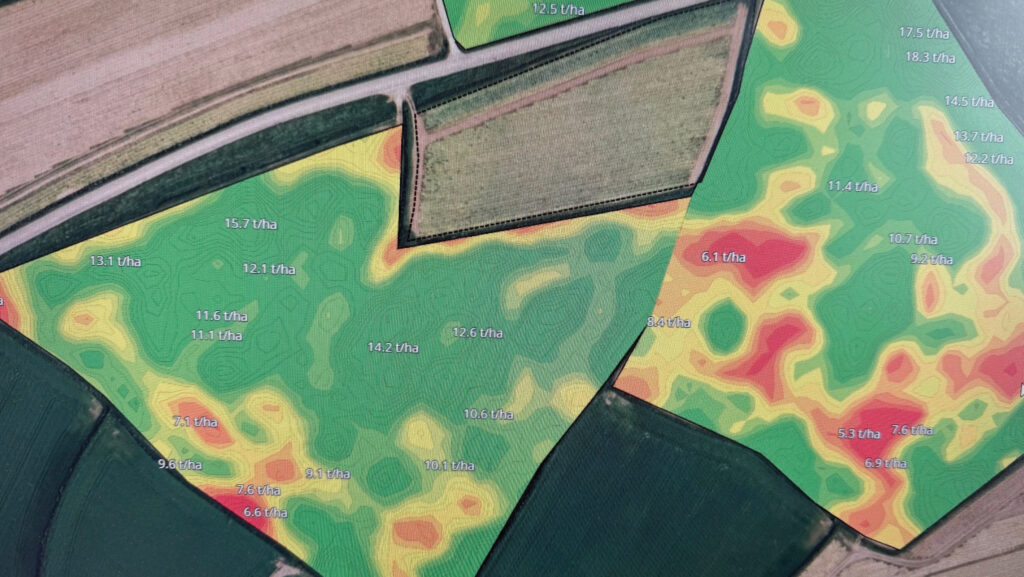
Farm standard yield map at Cornhill Farm © Pete Olds
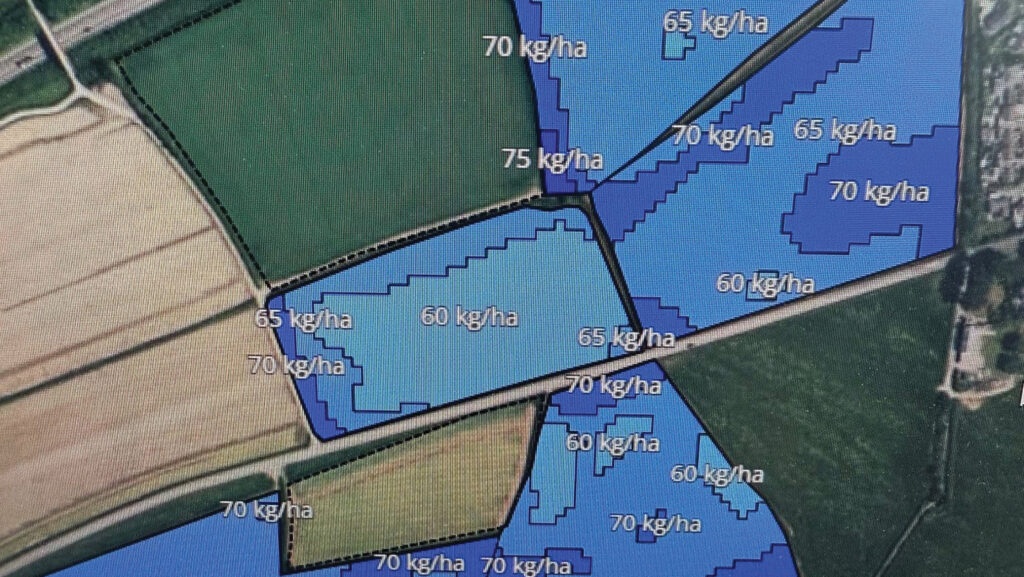
Variable rate fertiliser plan at Cornhill Farm © Pete Olds
“Too much cloud means we cannot gather accurate satellite imagery. We often use yield maps which are three to four weeks out of date to determine variable-rate plans, which is not accurate enough,” says Pete.
Instead, the N-Sensor uses a combination of visible, infrared and near-infrared light to assess the plant’s chlorophyll content and determine N use.
“To get accurate N applications, the most recent data is essential. As long as we can travel in the field, we can use the cab-mounted sensor and get up-to-date information,” he says.
Freely available N tester
A handheld leaf nitrogen measurement tool that is quick and easy to use is freely available to Yara customers.
The Yara N-Tester BT establishes a crop’s nitrogen status by measuring the chlorophyll content of the leaf.
It is calibrated for use on UK winter cereals, from which a field-specific nitrogen recommendation can be calculated, acting as a foundation to tailor N use accordingly.
Cornhill Farm
Pete and his wife Jenny grow 160ha of cereals at Cornhill farm near Cambourne, destined for a home-made mill and mix for their 17,000 laying hens.
Winter wheat receives about 200kg N/ha in three splits of granular fertiliser, aiming for a yield of 10t/ha. “We currently vary applications by up to 50kg N/ha.”
“With the N sensor we hope to use the absolute setting to automate variable N application.”
The farm also grows winter barley, oats and lupins, all destined for home-grown chicken feed.
Frequently asked questions
Simon Robbins, sales manager at agritech specialist Taylored Agri, highlights four frequently asked questions relating to the N-sensor.
Q: How many hectares will justify using the N-Sensor?
A: 150ha and above of cereals and oilseed rape provides a good payback.
Q: Is the N-Sensor affected by weather conditions?
A: The ALS sensors can be used in any light conditions, even in the dark, and the ALS2 can be used on a dew-covered crop. The first-generation passive sensor requires daylight to be used.
Q: Will the N-Sensor provide crop biomass maps?
A: Yes, these are available throughout the N-Cloud platform and existing mapping platforms.
Q: Can the N-Sensor be used for anything other than nitrogen application?
A: Yes, the sensor can be used for variable-rate protein dressings and growth regulators
Simon predicts growers to experience up to a 4% increase in crop yield and up to a 14% saving on nitrogen through using the device.
“We find the bigger the range, the better the outcome and potential savings,” says Simon. “We have growers varying between 0 and 150kg in some cases, but we suggest a 30 to 40kg N/ha difference as a minimum upper and lower limit.”
It takes 1.5 seconds to scan the crop and apply the fertiliser, which can match speed to application rate.
However, the nitrogen sensor cannot see what is in the soil – it only responds to what is in the plant. There is a soil mineralisation potential setting which can be set at high, medium or low.
“If the Yara N sensor performs well we will certainly be investing in the kit as our farm fits within the 150ha return on investment figure,” says Pete.
Messium
Next-generation satellite tool Messium, which provides “real-time” data on crop nitrogen and biomass status will be trialled, offering actionable insights on crop total N content.
The satellite uses hyperspectral maps, encompassing 450 wavelengths, rather than the standard three wavelengths of red, green and blue.
Using advanced crop growth models and weather forecast data, the tool provides precise fertiliser dose rates and timings.
Pete is interested to find out whether the novel satellite technology will improve image capture during cloudy weather conditions. He will be carefully comparing any differences against the NDVI satellite farm standard.
Andy Finnemore, the farm’s Hutchinsons agronomist, notes that the Messium platform takes into account the weather forecast when modelling nitrogen recommendations.
“With this technology cloud cover can still present a challenge, but with more high-tech satellites monitoring the UK, the greater the likelihood of obtaining cloud-free images,” he says.
Hutchinsons has been trialling the next generation satellite across a number of farms over the past season.
The project remains under development and the optimal use of data from the technology is yet to be fully understood.
Check with your local water company to see if any technology grants are available to help financially with integrating variable-rate technology on-farm.

Staying sharp shouldn't be a chore