Foliar urea fails to deliver in AHDB trials
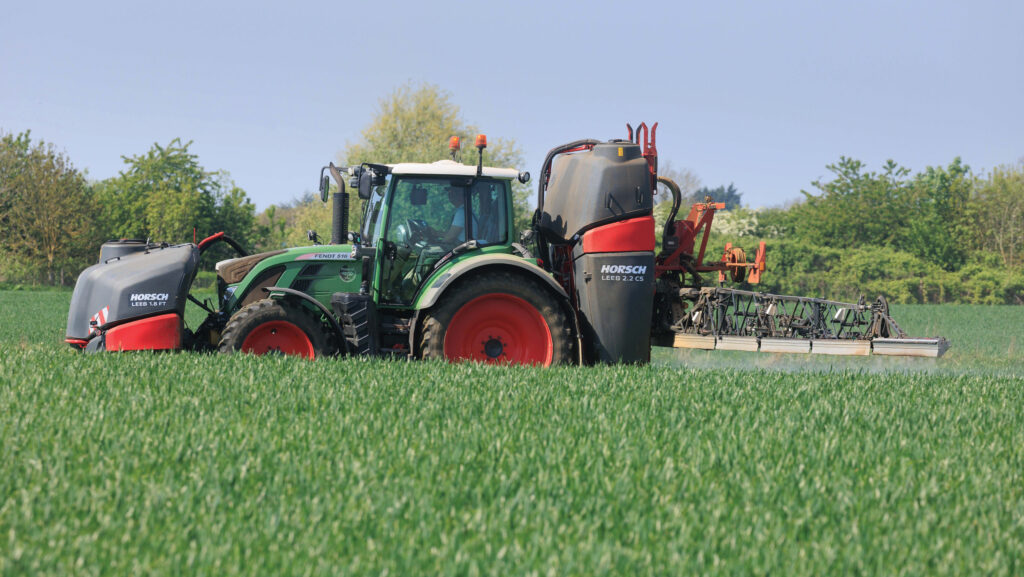 © Tim Scrivener
 A foliar-applied urea nitrogen application failed to provide either a wheat yield response or grain protein increase across two different years in trials at AHDB Strategic Farm East at Morley Farms in Norfolk.
The trials were part of two separate projects looking at nitrogen use on the farm, with the other trial investigating whether quantifying and measuring spatial variation in nitrogen use efficiency mattered.
In other words, should growers bother with variable rate applications.
See also: Intercropping trials show boosted protein levels with low N
The rationale
Foliar-applied polymer urea products have gained in popularity in recent seasons through a combination of economics, desire to improve nitrogen use efficiency, and climatic reasons.
Niab soils and farming systems specialist David Clarke explains the rationale behind these products:
“Soil moisture tends to be enough for soil applied nitrogen to go into solution and end up in the crop at the first two nitrogen timings in March and April. However, by the time we apply the third split in May, soil moisture levels are quite low, while evapo-transpiration is high.
“So soil applied nitrogen isn’t going to be as efficient. By applying a product direct to foliage, we can bypass those limitations and go direct to the plant.”
Morley Farms had been using a foliar nitrogen product, MZ28, for the past couple of seasons since the spike in nitrogen fertiliser prices.
Applied at 28 litres/ha, the product is advertised to have 85% nitrogen use efficiency, so at that rate it should be equivalent to 40kgN/ha of soil-applied nitrogen.
However, harvest grain protein measurements were lower at 9.5-10% compared with the historical 11-11.5%, since it started to be used.
“Potentially, we were underdoing nitrogen across the farm and wondered if inefficiency from this product might be causing that.”
The trial
To test that theory, David set up two simple on-farm tramline trials, albeit with careful site selection to make sure the areas chosen were as uniform in nitrogen uptake as possible.
“We made the trials as small as possible, with half tramlines widths of 12x100m in length.”
Yara’s AtFarm maps were used to identify areas with the most uniform N use from the first two N applications, up to the beginning of May.
The trials include two controls – one where no additional nitrogen was applied on top of the 160kgN/ha applied in the first two applications, and a second of 40kg/ha of soil applied nitrogen.
This was compared with 28 litres/ha of MZ28, with both treatments applied in the first week of May in both years of the trial.
The two seasons were very contrasting, with 2024’s wet spring theoretically favouring soil-applied nitrogen, as soil moisture levels didn’t drop in line with multi-year averages, while the very dry spring of 2025 was the opposite.
Grain cut from individual plots was weighed, with samples sent for grain protein analysis.
The results
The results showed an average 0.4t/ha yield response from the soil applied nitrogen, but no response from the foliar-applied product, David says.
In the drier year, while the MZ28 showed a 0.3t/ha response over the untreated, it was still only half that of the soil-applied treatment, and perhaps crucially caused no uplift to grain protein compared with untreated plots. In contrast, the soil applied nitrogen increased grain protein by 0.5%.
For the soil applied nitrogen, David calculates that about 15kg of the 40kgN/ha has been converted into used nitrogen in grain.
“That’s not fantastic efficiency at 38%. There will be proportions in the straw and roots, but typically not more than 20-30% of the total N, so we’re still under 50% efficiency from that final timing.
“But it does pay for itself, with the 40kgN/ha giving a return of around £22/ha, while the MZ28 reduced margins by £42/ha,” David says.
For host farmer David Jones, the trial has produced enough evidence to switch back to soil-applied nitrogen.
“This is one farm, one system – and it may work better in other crops or systems.
“But I would encourage growers to do this sort of experiment on-farm when bringing in new products or alternative sources to check whether they are delivering responses,” he says.
Is it worth variably managing soil N?
Analysis from trials at AHDB Strategic Farm East suggests it is worth trying to manage nitrogen variably within fields, but tools to do so still need some work.
Data from seven replicated nitrogen response trials across two fields at Morley in two seasons showed that optimal nitrogen rates could vary by as much as 80kg/ha, says Niab’s David Jones.
That included parts of field with variations in organic matter, even at levels below 4.5%.
“RB209 suggests that anything under 4.5% should be ignored, but we have data that shows organic matter differences under 4%, and even between 2.5% and 3.5% have a considerable impact on optimal nitrogen rates,” he says.
But while the data showed managing fields for variable nitrogen was worthwhile, the next step was investigating whether current tools are able to accurately allow farmers to make decisions in the field when nitrogen was applied.
N-Sensor
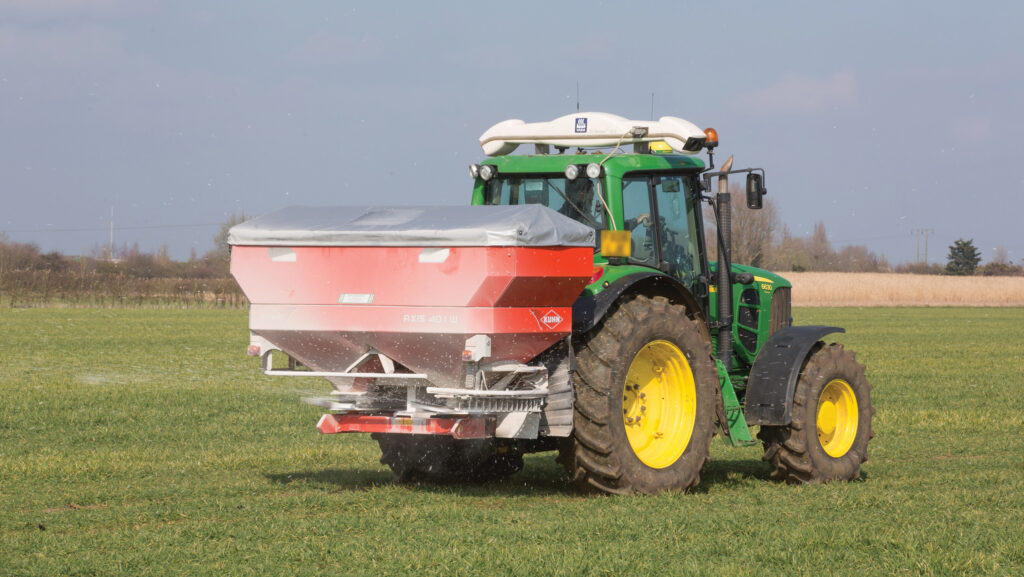
© Tim Scrivener
One of the most popular current ways to variably apply nitrogen is through Yara’s N-Sensor, which Morley Farms had been using for the past two years.
The technology provides an estimate of nitrogen uptake in crops using light reflectance to assess the crop’s chlorophyll content and biomass.
The system can be used in two ways – either by applying more nitrogen to poor areas of the field compared with good areas, or vice versa, give good areas more nitrogen because the poor areas are yield-limited by some other factor, such as available water, and won’t respond to extra nitrogen even if applied.
David’s analysis of the N Sensor maps at each of the nitrogen application timings with the optimum nitrogen doses in the nitrogen-response trials showed no correlation between the amount of nitrogen in the crop at the application timing and the overall optimal dose at the end of the season.
“My next step was to look at the change in nitrogen uptake,” he says.
“We didn’t see any correlation between the difference in nitrogen uptake between the first and second applications, but when we look at the difference in uptake at the third timing to the second timing, there is some correlation.”
That correlation suggests if nitrogen uptake has been high, then it could be possible to reduce nitrogen doses at the final timing, he says.
“This is a very limited dataset, just seven trials, but it does appear a useful way to use nitrogen uptake maps.
“If you have a N-Sensor, it would be worth looking at how nitrogen uptake is changing across the three nitrogen splits.
“Is it consistently going up by the amount you apply, or are those uptake maps changing across time?”
The latter would suggest something else is limited, not nitrogen, and potentially the differences in uptake could be used at the third timing to variably apply nitrogen.
“It’s something that warrants more investigation,” David says.
Potentially, nitrogen response trials funded by AHDB for the LearN project in 2013 and 2017 could be used for further analysis, as well as more fields on Morley Farms, he notes.
“If these patterns continue, we could use these nitrogen uptake maps in a more targeted way other than just blanket applications based on biomass.”
Soil sensors
David also looked at the potential of sensors that detect nitrate levels in soil, and whether they could be used as a tool to vary nitrogen rates.
In theory, users should see a peak of nitrate in the soil after applications, which slowly declines until the next application.
“Unfortunately, in our trials we haven’t seen any obvious peaks from applying up to 100kgN/ha, so that’s not giving us usable information to make management decisions.”

Staying sharp shouldn't be a chore