How funding is helping farmers with foliar nutrition efficacy
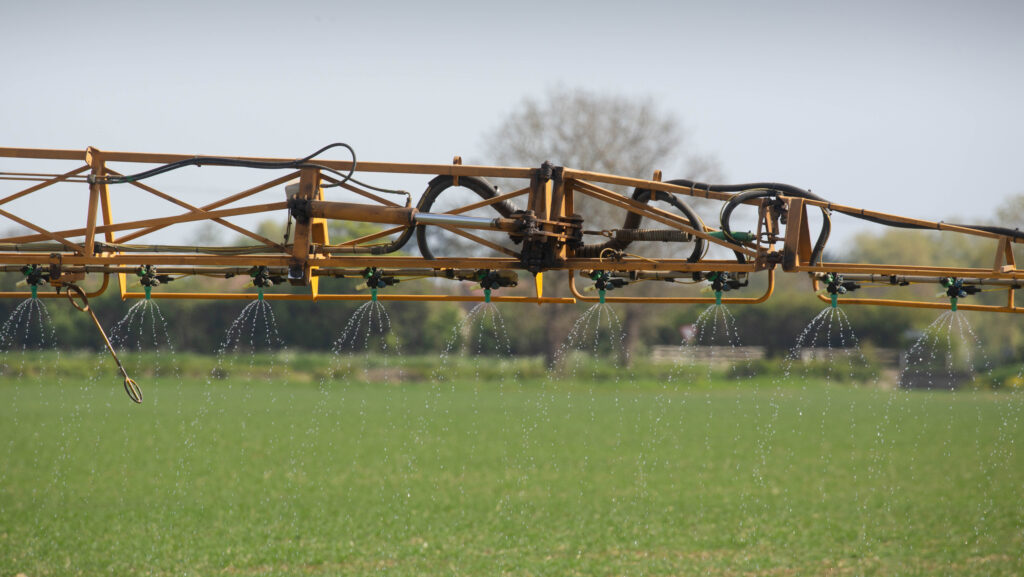 © Tim Scrivener
 Prolonged conflict in the Middle East is having serious repercussions on fertiliser prices around the world, making Cambridgeshire farmer Tom Pearson’s foliar fertiliser project even more timely.
Using home-produced foliar nitrogen, he and his team – Shona Russell and Rhys Jones – aim to increase nitrogen use efficiency at a fraction of the cost of ready-made products without economically damaging yields or grain protein quality.
See also: Septoria fungicide gives grower good returns in high-risk year
If successful, nitrogen use could be reduced by up to 70% compared with a conventional conservative RB209 recommendation.
Some growers, including Tom, have already experimented with foliar nitrogen, particularly after the last spike in fertiliser prices following the Russia/Ukraine war.
But the cost of ready-made foliar nitrogen, the hassle factor of melting urea and the potential need for more passes have been barriers to wider adoption, Tom says.
Tom’s Adopt project – “Foliar optimisation for low-input innovative agricultural resilience” – hopes to delve into this further.
Melting urea
“What we are proposing is that you melt urea on farm – which costs about a fifth of buying it in – making much more economic sense,” he says.
“If you can improve nitrogen use efficiency to closer to 70%, instead of the typical 45-50%, and the product you’re using is much cheaper, then you’re on to a winner.”
Melting urea on farm creates extra work and requires some knowhow, which is why as part of the project, the farm will produce video content about how to do it effectively.
“It’s an endothermic reaction, which means the liquid cools as you melt the urea, so you have to keep stirring,” Tom says.
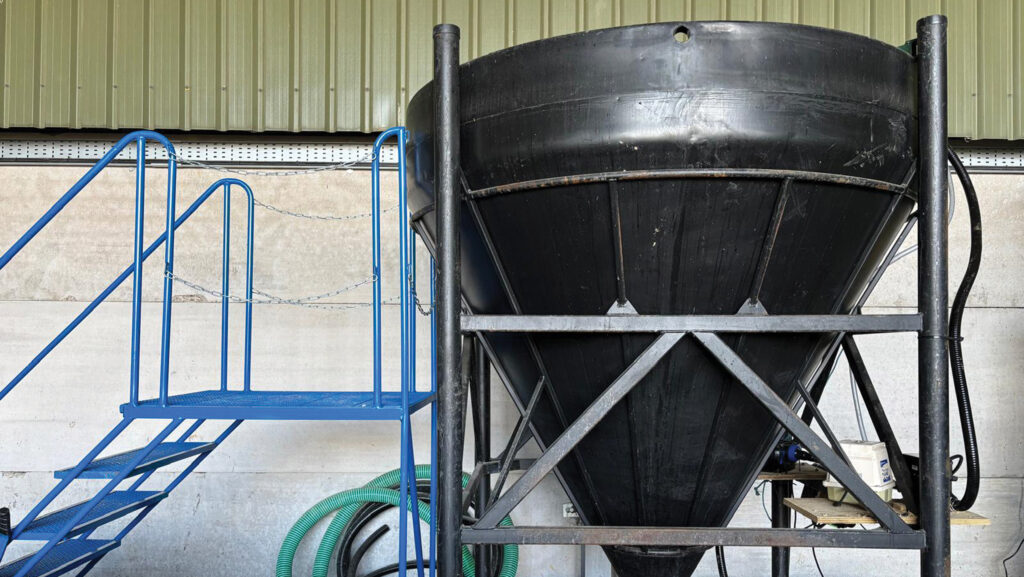
Urea is melted in a 2,000-litre conical flask © Shona Russell/Pearson Gape Farming Partnership
The farm uses a 2,000-litre conical flask bought from Enduramaxx to melt 800kg of urea in 1,000 litres of rainwater, with an air compressor blowing air into the tank to keep it moving.
Carbon sources and trace elements will be added, following the advice received at an Integrated Soils foliar nitrogen training course with independent expert Joel Williams.
While there is added “faff” for the farm, the potential benefits extend beyond lower costs and reduced fertiliser inputs. “We want to tie this in with what we call ‘reactive agronomy’.”
Reactive agronomy is made possible by regular sap and tissue testing, which is interpreted by regenerative farming research and data lead Shona Russell.
The resulting understanding of the movement and supply of nutrients within the plant will allow her to not only adjust supply of nitrogen, but all other nutrients during the season within the foliar treatments.
“Foliar nutrition is a much more efficient way of getting nitrogen into the plant. Using the little-and-often approach will give more chances to amend other nutrients that can improve plant health and efficiency.”
The aim is to keep the plant healthy, enabling reduced fungicide costs, while helping to justify extra nutrition passes.
“When we tried this last year – admittedly in a very dry year – the majority didn’t need any fungicides at all,” Tom says.
What is Adopt?
Six rounds of Accelerating Development of Practices and Technologies (Adopt) funding through Defra’s £5m Farming Innovation Programme have so far been available for farmers to access, with the latest round closing on 8 April.
The grants support farmer-led on-farm trials developing and testing new solutions to farming challenges, with the results shared to help other farmers.
Projects must have the potential to improve productivity, resilience or sustainability, and progression towards net-zero farming, and have total costs of between £50,000 and £100,000. Projects last from six months to two years and are led by a farmer.
A £2,500 facilitator fund helps farmers engage an external project facilitator to support Adopt grant applications.
The trial
To test the approach in the Adopt project, fields of Palladium Group 2 and Vibe Group 1 milling wheat will be split into nine blocks of about 1ha, Shona explains.
In each field there will be three replicates of the three treatments:
- The standard, conventional approach following a conservative RB209 recommendation
- The foliar approach, where two initial soil applied applications are followed by five to six foliar applications
- A combined approach of three soil applied doses, followed by two foliar applications (see table).
“That’s about 90-100kg N/ha in the foliar treatment compared with 230kg N/ha for RB209 treatment and 160kg N/ha in the combined approach,” Shona says.
Foliar trial treatments |
|||
|
Treatment |
Total N applied |
Soil applied |
Foliar applied |
|
RB209 conservative recommendation (Control) |
230-250kg N/ha |
Three splits: 70kgN/ha, followed by 120kgN/ha, and then 40kgN/ha (+10kgN/ha at T2 and T3 for milling wheat) |
None |
|
Foliar approach |
90-100kg N/ha |
40kg N/ha |
Up to six applications of foliar urea (10kg N/ha) based on growth demand |
|
Combined approach |
160kg N/ha |
Three splits: 60kg N/ha,followed by 40kg N/ha, followed by 40kg N/ha |
Two x foliar applications (10kg N/ha) |
|
Source: Tom Pearson |
|||
The middle ground could be important, Tom says.
Not only is it more realistic for farmers to adopt with less risk – particularly on farms relatively early on in trying to improve soil health – but also for potential supply chain benefits.
“It’s where we believe the supply chain is interested in reaching with wheat production. My gut feel is it is trying to support farmers who can reduce their nitrogen, while keeping yields up and reaching protein specs.”
While that kind of supply chain support is only starting to emerge in pilot programmes for the low-protein wheat market, the inclusion of the Vibe field is because Tom believes it is possible with Group 1 milling wheat.
“There is a big push for carbon insetting, and the easiest thing to monitor is nitrogen use.”
As well as Tom’s farm, two other farmers are involved in the project – Charles Paynter and Ed Reynolds – who will be repeating the trial on fields of Palladium.
Adas Agronomics is helping with trial design and location, as well as analytics. Mary Dimambro, managing director at environmental consultancy firm Cambridge Eco, was instrumental in getting the project approved.
Various soil and leaf tests will be used to create growth curves. Grain nutrient analysis will be assessed, as well as yield, protein, and the economics of each treatment.
In addition, shona plans to use four methods to determine nitrogen use efficiency and make greenhouse gas emission calculations, with results presented at a meeting in November.
Advice for applying for an Adopt project
- Leverage professional support – take advantage of the facilitator fund and expertise to test your ideas.
- Have clear objectives about what you are trying to find out, and ideas for solutions.
- Speak to other farmers who have been through Adopt process.
- Start early and be realistic about time commitment – it does take time and effort to apply, even with the simpler Adopt process compared with other government research projects.
- Don’t wait – apply while you can. You never know how long these opportunities will last.
- Decide your involvement level early – some projects use an Adopt facilitator to manage parts of the project. Data-focused projects are perhaps easier. for facilitators to manage, while others benefit from more farmer involvement.
- Use it as a skills development opportunity for you or your staff.
- Be detailed about time and costs in your budget, and ready for admin when submitting claims.
- Use it as a chance to collaborate. These trials could also provide valuable opportunities for industry to obtain data from high-standard, on-farm trials.
Source: Tom Pearson and Shona Russell

Staying sharp shouldn't be a chore