N-fixing bacteria cuts cost and lifts yield for Cambs growers
 Jon (left) and Stephen Eayrs © ProCam
 Cambridgeshire farmers Stephen and Jon Eayrs added a nitrogen-fixing bacterial endophyte to their winter wheat fertiliser programme last season, with promising results to show for it.
The father-and-son team wanted to assess ways of reducing their reliance on granular nitrogen – a move that has proved beneficial given current concerns over fertiliser price and availability due to war in the Middle East.
See also: Yellow rust alert: Disease reported in winter wheat across UK
Farming just over 400ha of arable land between Huntingdon and St Neots, Stephen and Jon have a crop nutrition strategy based on granular urea or ammonium nitrate, split across three applications.
This is followed up with either liquid or granular micronutrient sprays, tailored to crop requirements.
The pair decided to add the bacterial endophyte treatment, Encera, to the T1 fungicide pass, replacing 30kg N/ha of bagged nitrogen.
Although the bacterial product is designed to be applied alongside a full dose of granular nitrogen, Stephen and Jon trialled a reduced rate to keep costs similar.
Stephen notes that farming heavy clay soils presents various challenges.
“Crops can sometimes struggle to get going. Part of the thinking was for the Encera to work alongside the granular nitrogen to give hungry crops a boost in the spring, to increase tiller numbers and plant health,” he says.
What is the endophyte?
The farm’s ProCam agronomist, Ian Jackson, explains that the product is a naturally occurring nitrogen-fixing bacteria that forms symbiotic relationships with plants, providing nitrogen direct to the cells of the leaves and roots.
After application the bacteria move through the plant and colonise new growth.
This helps to maintain nitrogen supply throughout the season.
“Early N applications can leave hunger gaps later in the season,” says Ian.
“Encera enables systemic nitrogen fixation, allowing plant cells to fix their own nitrogen.”
© ProCam
Trial findings
The product was applied to a 70ha block of winter wheat, made up of the varieties Bamford or Dawsum.
Comparisons were made with two neighbouring fields of the same varieties which were not treated with the endophyte.
The Encera area received a 30kg/ha reduction in granular N, with a total of 190kg/ha applied compared with the farm standard of 220kg/ha.
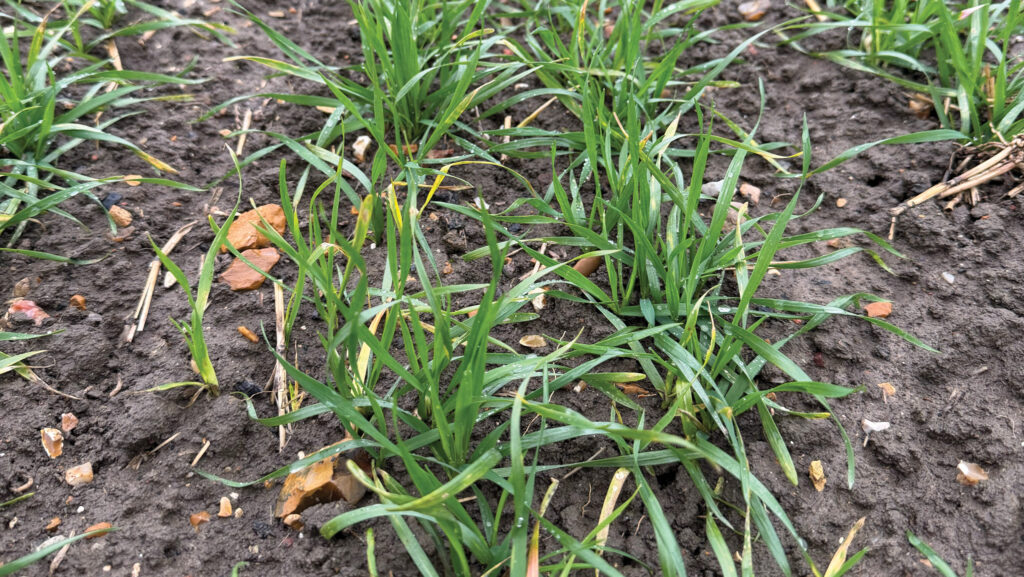
The early spring visual assessment of the two areas revealed obvious differences, with greener, healthier crops on the Encera area.
Importantly, there was a slight yield increase, with a 0.25t/ha benefit.
“This showed we supplemented the reduced granular input with a product that can supply nitrogen in a different form and achieved a better yield, improving the return on investment,” says Stephen.
Full-dose trial
This year, the plan is to apply the product with a full 220kg/ha dose of granular nitrogen to evaluate if crops can be pushed further and the additional cost can still provide a return on the investment.
The plan is to split a field in half and apply the usual rate of granular nitrogen in three applications, with the endophyte treatment going on half the field to monitor the difference.
“Yes, we will be spending more on nutrition in this area, but I am interested to see if the returns in yield or quality can justify the expenditure,” says Jon.
“This data will allow us to tailor our inputs in future years and avoid becoming solely reliant on a single form of nitrogen fertiliser.”
Stephen and Jon agree that there is no silver bullet for crop nutrition, but having additional tools in the armoury is a huge benefit, particularly as input prices continue to rise.
“No one knows what the future of the fertiliser market will be, so we need to explore options that offer us greater resilience, particularly if spreading restrictions are imposed,” says Stephen.
“Arable farming works best when we can produce the highest quality and greatest amount of produce, as cost-effectively as possible,” he says.
Application of Encera
The nitrogen-fixing bacterial endophyte treatment is supplied in sachets and added to the spray tank mix at 12.5g/ha with the T1 fungicide application. The product is compatible with fungicide and herbicide tank mixes.

Staying sharp shouldn't be a chore