New UK fertiliser tailored to soil and crop requirements
 © GNP
© GNP Farmers can now order bespoke fertiliser formulations, tailored to precise crop and soil requirements thanks to a new UK-based fertiliser manufacturing machine.
The Triplex machine works by inputting soil or sap analysis data from individual farms to create bespoke liquid and foliar fertilisers tailored to field conditions.
Micronutrients such as zinc, boron and manganese can be added, as well as molasses and humates, meaning growers no longer need to rely on blanket recommendations.
See also: Fertiliser buying advice as Iran conflict squeezes supplies
Improved nutrient use efficiency
The science behind the machine means it can build larger, more complex nutrient compounds, which are less prone to leaching.
“Creating larger particles improves nutrient use efficiency and reduces losses as these more layered compounds remain in the soil for longer,” explains Andrew Sincock, managing director of Agro-Vital, who helped develop the technology.
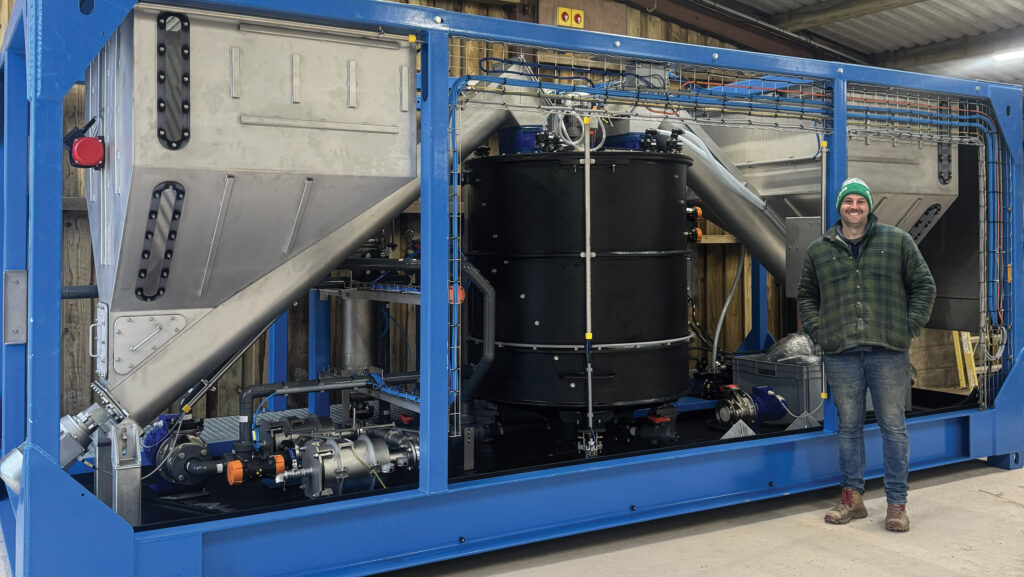
Andrew Sincock with the Triplex machine © Triplex
On the other hand, single soluble nutrients move more quickly through the soil and are more easily lost.
“The way these formulations are structured means nutrients are readily available to the crop,” says Andrew.
At current fertiliser prices, for every £1 spent on fertiliser, the predicted spend on Triplex fertiliser would range between 80p and £1.20, so is comparable for price.
Multiple crop types
Once farm-specific data is analysed, the system can create a tailored fertiliser programme in as little as 48 hours, allowing farmers to act quickly and efficiently.
The finished fertiliser products are delivered on farm in IBC containers, ready to be applied.
This can be applied through a standard spray nozzle, and comes with a 12-month shelf life.
The technique has been used in the Netherlands for the past three years.
UK customers can adopt the concept this year. The products can be used across multiple crops, including vegetables, cereals and potatoes.
Currently, there is one Triplex machine in the UK, based in Chepstow.
As the business grows, Andrew envisages more machines located across the country, acting as regional nutrient hubs.
He sees it being most suited for regenerative farms.
In future, Andrew sees potential for large contracting businesses or estates to invest in their own fertiliser manufacturing units, enabling them to create tailored fertiliser formulations directly on-site.
How the new fertiliser technology works
The Triplex system was developed in the Netherlands through extensive research and collaboration between Agro-Vital’s team of agronomists, engineers and data scientists.
Carl Gibbard, Agro-Vital technical sales manager and agronomist, explains how the fertiliser manufacturing works.
“Hot water is pumped into a large vessel to dissolve urea.
“Sulphuric acid is then added to maintain an optimum temperature of around 20C.
A range of bespoke nutrients are then introduced at different stages to maintain this balance and create the formulation,” he says.
Typically, dissolved urea delivers about 18% nitrogen.
But through this process, nitrogen levels can be raised to as much as 24%, due to the acidification and warming process that optimises nitrogen capture.
The system is a highly advanced mixing process.
Molasses can be included to help chelate trace elements, and formulations do not have to be urea-based.
Almost all inputs begin in solid form before being dissolved to create a liquid formulation.
The special Triplex mix acts as a gluing agent, effectively holding the formulation together.
Farmer thoughts
Herefordshire farmer John Joseph is on board with the bespoke fertiliser concept, particularly at a time when margins are slim and agronomy inputs must be maximised.
“We need to be more efficient, so a fertiliser that is tailored to crop requirements and soil analysis has to be heading in the right direction,” he says.
John plans to trial the Triplex liquid fertiliser on his Wildfarmed wheat this year to help meet protein requirements.
He also plans to apply a pass to his herbage seed crop after a cut of hay.
John’s ultimate aim is to grow healthy nutritionally balanced plants, and sees tailored fertiliser fitting well with this regenerative approach.

Staying sharp shouldn't be a chore