How odour, sound and vibrations can control crop pests
 © Blackthorn Arable
 Could weaponising odour, sound or microbes found naturally on crop leaves be the solution to some of the toughest pest challenges growers face?
From scent-based repellents that disguise crops from aphids, to microbes that subtly alter insect behaviour, and sensors that eavesdrop on pests through plant vibrations, a new wave of science is transforming how farmers fight against insect pests.
These are just some of the ideas emerging from research that a new generation of agri-tech firms are trying to develop into commercial propositions.
See also: Maize for anaerobic digestion – how do the numbers stack up?
Weaponising odours
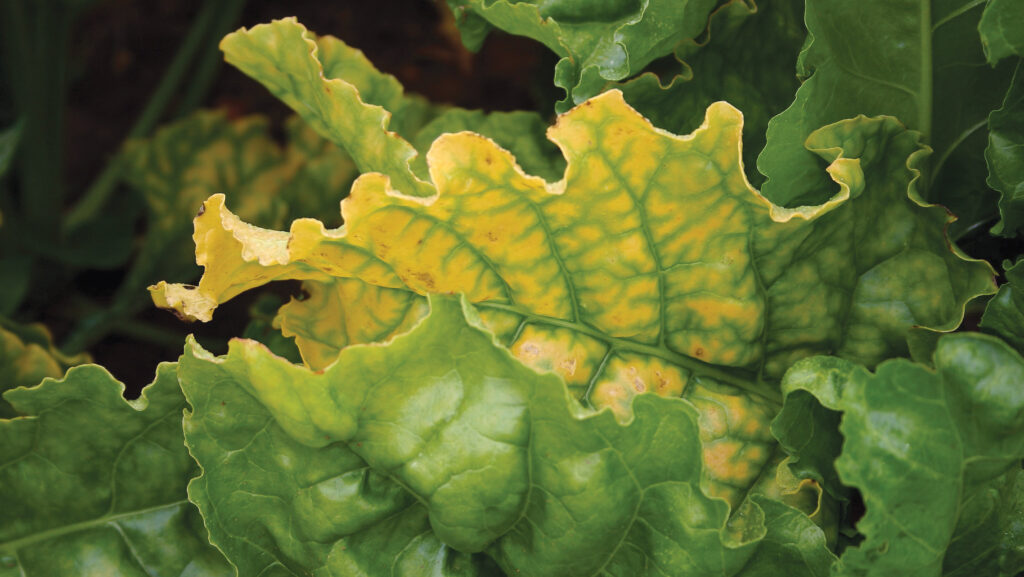
French firm Agriodor, spun out of research at French institute INRAe, is exploiting odours to help protect crops against aphids transmitting virus yellows in sugar beet and cabbage stem flea beetles in oilseed rape.
Of the two, the most advanced is a repellent granule for use against Myzus persicae in sugar beet, says Vincent Jacquot, Agriodor, chief executive officer.
“The granule is impregnated with a blend of odours and coated with a natural material to have a slow-release effect to manage aphids for a minimum of 21 days.
“It has three modes of action. First, it repels the winged aphids, responsible for field colonisation.
“Its smell disturbs their feeding behaviour, so they feed less, limiting the risk of virus transmission, and finally, missing energy, they reproduce less,” he explains.
The granules are spread using a slug pellet applicator at a rate of 4kg/ha.
Trials in France have reduced infestations by half and lowered levels of virus yellows, with the product also part of trials in the UK with the British Beet Research Organisation.
“At the end of the season there is a yield effect. Last year, with very low pressure from aphids, it was 3t/ha in France.
“This year, with more aphids, we expect larger increases.”
The technology is active on all stages of the life cycle, which differentiates it from pheromones, which tend to target disrupting mating behaviours of male adults, he says.
Products have also been developed for weevils in field beans, and a project is ongoing in oilseed rape for cabbage stem flea beetle.
Scents were originally identified from a library of existing odours known to influence insects.
“With our technology we could identify which of the 15-20 molecules in an odour are most effective, allowing us to blend and formulate our products.”
Reverse chemical ecology is improving the speed and efficiency the company can identify potential molecules.
This uses machine learning to predict which molecules are likely to bind to olfactory receptors in the insect’s antennae, which can then be tested in the lab to see if they trigger the desired behaviour.
Mosquitoes and virus yellows control
Research into why mosquitoes bite people provided the inspiration for another potential solution to virus yellows from BugBiome.
Dr Alicia Showering spent five years at the London School of Hygiene and Tropical Medicine studying microbes that live naturally on skin, the odours they produce, and whether that influences attractiveness to mosquitoes.
She’s pivoted that idea into crop protection after her co-founder, Chris Mosedale, pointed out similar issues exist in agriculture.
“We’re discovering insecticides from microbes,” Alicia explains.
“We capture microbial diversity from crop leaves and then screen these microbes to find new actives to protect from pests and the viruses they transmit.”
After sampling a diverse group of microbes from the leaves, the firm then uses metabolic fingerprinting to isolate targets before screening for whether they cause changes in insect behaviour.
When a target is identified, the firm delves into the specific natural products it produces to see whether there is a more traditional insecticidal mode of action when it is concentrated, she adds.
BugBiome’s first target is aphids, particularly Myzus persicae and virus yellows in sugar beet, with another programme also looking for candidates to control cabbage stem flea beetle.
“We’re running trials in sugar beet with Niab,” she says.
“Our trials have shown that we reduce the number of aphids, but there’s further work needed to understand the impact on virus yellows,” she says.
Plant vibrations used to detect pests
It’s not just smell that could be used in the fight against insect pests.
Prof Emily Bick’s lab at the University of Wisconsin-Madison in the US has been researching the idea that plant vibrations can be used to detect, identify and quantify insect pests.
“We’re listening for insects,” she says.
“As insects feed on leaves, bore into the stalk, feed in the root zone, they cause the plant to vibrate.”
That information is not new – entomologists have been using piezoelectric microphones, laser barometers and accelerometers to listen to plant vibrations for years.
“The big difference is we can process all this data en masse.
“My lab has recorded 17 different cropping systems and 27 crop pests, mostly insects as this doesn’t really work for nematodes, to figure out what is detectable.”
After initially starting with readily observable pests, such as tobacco hornworms and Colorado beetles, which were relatively easy to match them visually eating plants with the vibrations collected by a sensor, they moved to non-observable pests, such as corn rootworms.
“We injected soil with 2,000 corn rootworm eggs and when we dug up the plants, we could see plants that were fed on had more sounds in a replicated fashion than control plants that were not fed on,” says Emily.
With the concept proven, Emily set up a startup, BugBug with co-founder Laurence Still, in the UK to develop a sensor, known as the Insect Eavesdropper, that attaches to plants to record vibrations.
“The magic is pairing that device with our algorithms to analyse sounds in ways that have never been done before,” she says.
That information could be used to help with control of a number of different insect pests, including cabbage stem flea beetle larvae.
Understanding when cabbage stem flea beetle larvae are exiting the plant could help time interventions either with insecticides or parasitoids.
All experts were interviewed by Farmers Weekly at the World AgriTech Innovation Summit in London or at Agri-TechE’s Reap conference in Peterborough

Staying sharp shouldn't be a chore