How research project is set to help farmers slash slug pellet use
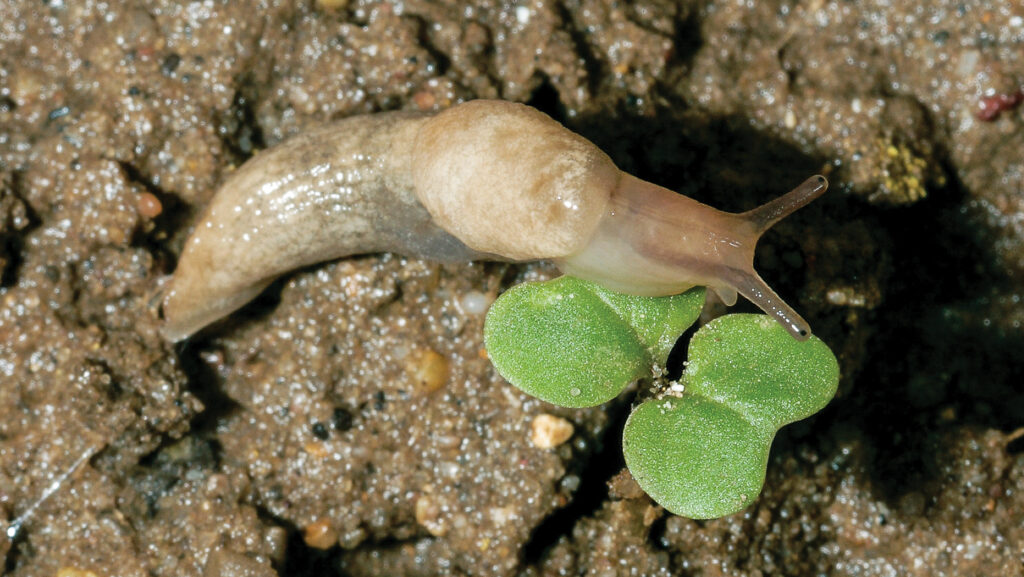 © Blackthorn Arable
 A precision slug risk model developed through a £2.6m research project has successfully passed its first on-farm test, despite being deployed during one of the lowest slug pressure seasons in recent memory.
Researchers say the results provide strong evidence that the new system can accurately identify slug hotspots within fields, bringing precision pellet application a significant step closer to commercial reality.
See also: Tips to get ahead of the autumn slug threat
Dry conditions
The three-year Strategies Leading to Improved Management and Enhanced Resilience against Slugs (Slimers) project, led by the British On-Farm Innovation Network (Bofin), finished this year.
It has brought together researchers, technology companies and growers to understand why slugs congregate in patches and how that knowledge can help with on-farm decision making.
Slimers’ final year focused on validating a digital risk mapping system developed by Harper Adams University, using commercial farm data collected by growers across the country.
Keith Walters, professor of invertebrate biology and pest management at the university, says the project has now moved beyond simply understanding slug biology.
“We’ve reached the point where we can predict, with a high degree of confidence, where slugs are most likely to occur within individual fields,” he explains.
“That is a very different proposition from simply knowing that slugs like heavy soils or wetter conditions.
We’ve identified the combination of factors that drive patch formation and built those into a practical prediction model.”
Previous work during the project showed that slug populations remain remarkably stable within fields, with patches forming where soil texture, moisture, organic matter and pH combine to create favourable conditions.
Slugs also congregate in local areas based on them meeting each other and changing their behaviour to go round in circles, reinforcing these hotspots over time.
The challenge for the final season was proving this understanding could be converted into a tool capable of guiding management decisions on commercial farms.
Instead of establishing large grids of refuge traps as in previous years, participating growers used GPS-guided transects across predicted high- and low-risk areas.
Weekly slug counts were then compared with the model’s predictions.
Despite many farms recording very low slug populations throughout the autumn, the highest counts consistently occurred within the areas identified as highest risk.
Keith says this was particularly encouraging because low slug populations make it much harder to distinguish genuine biological patterns from random variation.
“In some respects, it was the ideal season to validate the model,” says Keith.
Accessible data
The model combines information from soil electrical conductivity (EC) maps, topography and other environmental factors that many growers already collect for precision farming purposes.
Within seconds it can produce a colour-coded map highlighting areas of high and low slug risk across an individual field.
Growers can then select their own treatment threshold depending on previous cropping, expected pressure and appetite for risk, creating the potential for patch treatment rather than blanket applications.
Ultimately, the aim is for these maps to integrate directly with GPS-controlled applicators, automatically varying pellet application rates as machinery moves across the field.
Keith believes that represents a significant step forward for integrated slug management.
“Ferric phosphate remains an extremely valuable tool, but we shouldn’t be applying it where there is little or no risk.
“If we can target treatments much more precisely, we improve stewardship, reduce costs and make the whole system more sustainable.”
Validation on farm
Among the “slug sleuths” helping test the system was Richard Cross, farm manager at Oxton Estate in Nottinghamshire, where heavy clay soils mean slugs remain a significant challenge, particularly following oilseed rape.
Having been involved with Bofin from its early days, Richard was keen to help develop practical solutions rather than simply accept blanket pellet applications as the norm.
“Blanket applying slug pellets has never really sat comfortably with me.
“We do it because we can’t afford to lose crops, but if we can become much more targeted then that’s got to be the right direction.”
Testing involved comparing the model’s predicted risk maps with actual slug populations recorded in the field.
For Richard, many of the results confirmed what experience had already suggested.
“The maps matched many of the areas where I’d expect slugs to be active, particularly the heavier, wetter parts of the field.
“But they also highlighted some areas that I wouldn’t necessarily have considered high risk.
“That’s where the science becomes really useful because it removes some of the guesswork.”
Although slug pressure remained relatively low throughout the season, Richard says the absence of crop damage in untreated low-risk areas has increased his confidence in the system.
“If we’d had a really high-pressure year, we’d have pushed it even harder, but what we’ve seen certainly gives me confidence that we’re heading in the right direction.
He says he would like to see another couple of seasons of validation, in different conditions, but adds the model looks spot on.
Potential savings
The greatest attraction for growers is likely to be the opportunity to reduce pellet use without compromising crop establishment.
Based on the fields tested this season, Richard estimates pellet use could potentially be cut by about 50%.
“On our farm that could easily mean saving around a tonne of slug pellets each year,” he says.
“There’s an obvious financial benefit, but it’s also about demonstrating that we’re using them responsibly.”
He believes that stewardship will become increasingly important if ferric phosphate is to remain available in the long term.
“If we can show we’re only applying pellets where they’re genuinely needed, hopefully we avoid the sort of restrictions we’ve seen with other products.”
The technology itself is also largely in place, with the only missing link being connecting the treatment map to equipment already capable of variable-rate application.
Current trials rely on operators switching applications on and off using digital treatment maps, but Richard says linking the model directly to existing isobus-controlled applicators should be relatively straightforward.
“We already use variable-rate technology for fertiliser and lots of other operations. This is really just another layer of precision farming.”
Important step
Certis Belchim, which markets Sluxx HP ferric phosphate slug pellets in the UK, believes developments like this represent an important step towards more sustainable slug management.
The firm’s portfolio manager, Maisie Bruce, says precision decision-support tools have the potential to help growers optimise pellet use while protecting both crop establishment and the long-term future of ferric phosphate.
“It remains a highly effective and important tool for slug control, but like any active, it’s vital that it’s used responsibly.
“Being able to accurately identify where slug pressure is will lead to more informed decisions and better overall slug management.”
Maisie stresses that the technology is not about replacing slug pellets, but about ensuring they are used as part of a broader integrated pest management (IPM) strategy.
“When used alongside good crop establishment, careful rotation planning, regular monitoring and threshold-based decisions, precision application can help reduce inputs without compromising your crop.”
She believes this approach delivers both economic and environmental benefits.
“Applying pellets only where needed reduces input costs, while also demonstrating good stewardship of an important active substance.
“That’s good for farm businesses and good for the wider environment.”
Further work
Researchers hope to secure further funding to validate the model across additional seasons before moving towards wider commercial adoption.
Keith says more data will increase confidence across a wider range of weather conditions and cropping situations, but he believes the project has already demonstrated that precision slug management is achievable.
“We’ve gone from understanding why slug patches form to producing a model that growers can actually use,” he says.
“There’s still work to do before it’s ready for widespread commercial use, but we’ve shown that the concept works.”
Key points
- Final year of the £2.6m Slimers project successfully validated a precision slug risk mapping model
- Risk maps accurately identified higher-risk slug hotspots using existing soil and environmental data
- The system could enable targeted pellet applications through GPS-controlled applicators instead of blanket treatments
- Nottinghamshire grower Richard Cross believes pellet use could potentially be reduced by about 50% while maintaining crop protection
- Researchers are seeking further funding to validate the model across more seasons before commercial rollout