Natural aphid control gets boost from biological spray
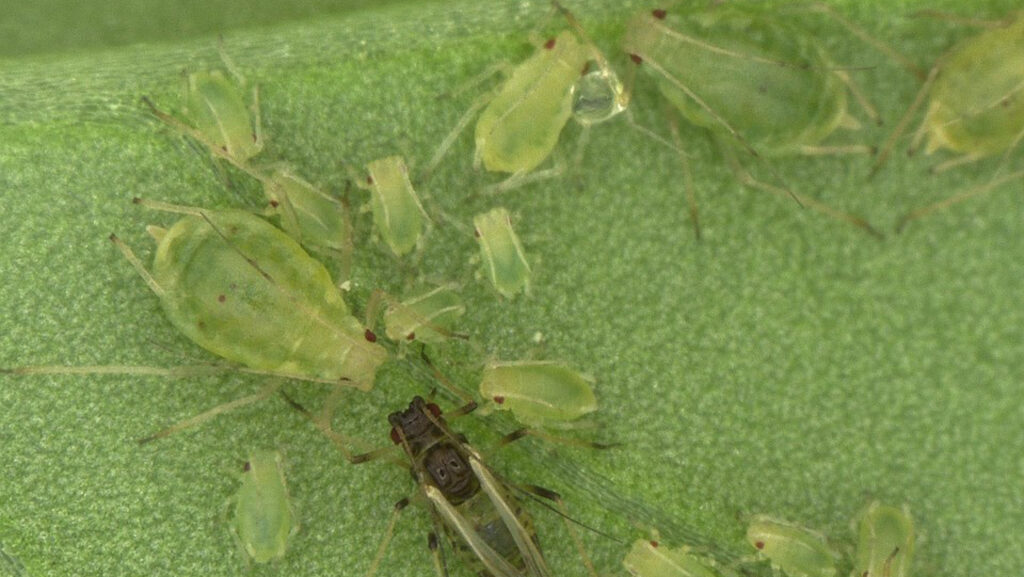 Peach potato aphid and lacewing © BASF
 A new biological product that attracts beneficial insects to crops to improve aphid control is available to growers.
Developed by BASF, the product, known as Apthena, contains the natural pheromone (E)-B-farnesene that aphids release as an alarm signal.
Natural enemies such as ladybirds and lacewings have learned to use this scent to locate their prey.
By utilising this knowledge of insect behaviour, Apthena aims to attract beneficial insects into crops earlier to reduce aphid pressure and therefore disease transmission.
See also: Study suggests silicon spray reduces cereal slug damage
“The new development is a really exciting tool; it is an enabler and fits alongside other tactics that draw beneficial insects into crops,” notes Tom Pope, professor of applied entomology at Harper Adams University.
Beneficial insects
- Hoverfly larvae
- Lacewing
- Ladybirds
- Predatory midges
“For me, the future of crop protection is the intelligent selection of IPM [integrated pest management] tools, understanding interactions between them and harnessing synergistic effects,” he says.
Active ingredient
The active ingredient (E)-B-farnesene was first identified in the 1970s, but its application has been revolutionised by advanced encapsulation technology.
“While (E)-B-farnesene is the principal component of aphid alarm pheromone, it is volatile and degrades rapidly,” explains Rob Storer, business development manager for BASF Biologicals.
“What makes Apthena unique is its proprietary formulation. The active ingredient is encapsulated to control its release over an extended period of 20-30 days.”
The microcapsules are formulated using natural and inert ingredients and are free of microplastics.
Field trial results
Field assessments carried out by BASF highlight promising results.
- In peas, the product increased the number of plants containing beneficial insects by 18%,
- In sugar beet, the presence of aphids was significantly reduced from an average of 2% to 0.5%.
- In standardised Y-tube choice tests, ladybirds exhibited a significant preference for vessels emitting air with Apthena, opting to travel down the pheromone gradient far more frequently than controls.
Application
It is recommended for application rate of 0.3-0.5litres/ha with water rates of 100-300 litres/ha.
The product can be repeat applied at 14-day intervals. There is no maximum number of applications.
Rob notes that to get the best results, beneficial insects need to be active for it to work.
“The spray could be applied in the autumn to reduce aphid build-up, but temperatures are often low at this time of the year so beneficial insect numbers aren’t that high.
“Follow-up applications in the spring are the most effective when natural predators are more effective.
“Apthena can help bring beneficial insect populations into crops earlier to keep aphid populations low,” he explains.
The spray is rainfast within 24 hours, and requires no buffer zone so offers flexibility for growers.
Although its aim is to keep pest populations below an economic threshold, where needed, the biological product is compatible with other approved crop protection products, including with IPM compatible insecticides.
It is permitted for use in all crops and situations and there is no CRD registration requirements for beneficial attractants.
Rob notes the product will be competitively priced within the biological input market.
Importance of IPM
“Aphids pose a massive threat to global crops, causing billions in damage annually through direct nutrient extraction and virus transmission,” warns Tom Pope, professor of Applied Entomology at Harper Adams University.
However, the number of insecticides growers can use is shrinking.
With fewer products available, the selection pressure from remaining conventional products is rising, further increasing the risk of resistance.
This is why Tom says integrated pest management is essential.