Novel electric weeder works without chemicals or moving soil
 © MAG/Richard Allison
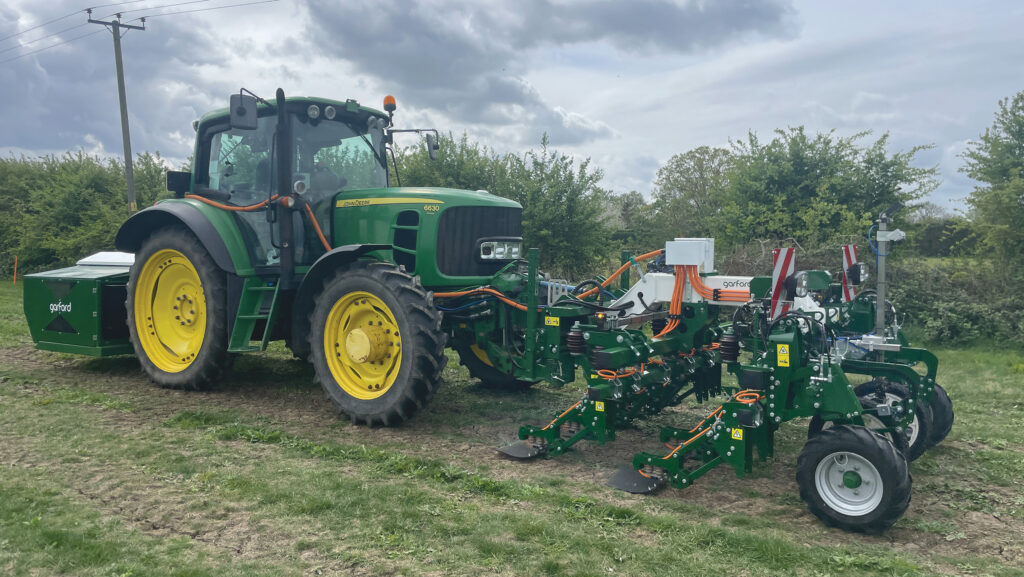
 A non-chemical systemic approach to weed control is now commercially available to UK farmers, following the launch of Garford’s electric weeder.
The novel system is the result of a collaboration between UK start-up Rootwave with its electric weeding technology expertise and mechanical weeding expert Garford.
Last season, saw the weeder successfully prove itself on two commercial farms and this spring it was launched to the wider market.
It is the only non-chemical approach that offers systemic (whole plant) control of weeds.
See also: How tech approach lifted ‘field of the future’ margins by 26%
How it works
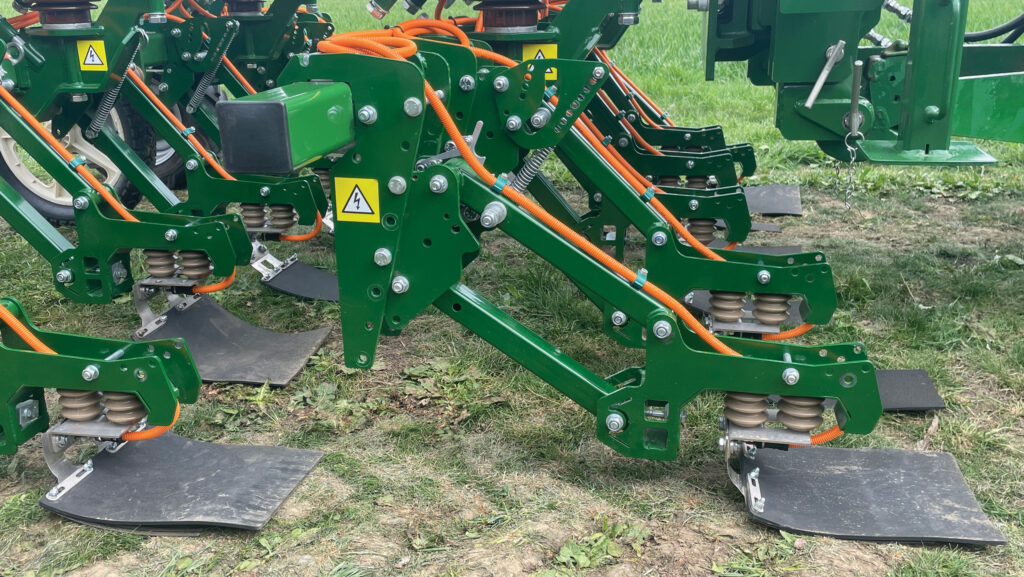
Electrodes work in pairs to zap weeds © MAG/Richard Allison
Speaking at a press demo near Deeping St James, Lincolnshire, Garford managing director Jonathan Henry says the technology used is the contact transfer system.
This is where there are two electrodes on the ground, and the current is pushed through the plant and roots using soil as the return back to the second electrode.
It is not to be confused with the less effective spark discharge system – as used in some other systems around the world – where the electrodes are suspended above ground.
What makes the technique especially valuable is that it is systemic, killing roots as well as what is above ground, says Jonathan.
The current flows through the whole plant, which heats the fluid in the plant cells, vaporises them and that damages the cell membranes. This results in plant cells very rapidly desiccating and dying. “You can physically see the results within minutes of treatment.”
High frequency
The system uses high-frequency (18,000Hz) AC current, which gives better efficacy and is orders of magnitude safer than DC systems.
Soil is a conductor and there is quite a lot of variation in its impedance due to differences in moisture. By using higher frequency current, it is less affected by these soil moisture variations, he says.
For it to work, impedance of the plant needs to be lower than the soil, so it won’t work in saturated soil, explains Jonathan.
However, by the time the weeds are actively growing in spring, there is likely to be air in the soil which means its impedance will be at a level for the weeder to effectively work.
The weeds being treated also need to be dry. If there is surface moisture, there is a risk that the electricity will flow across the plant surface rather than through it.
“So in conclusion, you need enough air in soil (not waterlogged) and dry weeds for effective operation.”
If it is dry enough to apply chemical herbicides, Jonathan says it will be dry enough for the weeder to do its work.
“But unlike spraying, it is not wind sensitive. This means farmers can have a wider window for weeding.”
Given its effectiveness on plants, some farmers may question its impact on soil biology.
Jonathan points out that independent tests have demonstrated that soil biology is preserved, as the electricity does not damage soil macro fauna, nematodes, bacteria or fungi.
This is because it works using concentrated current flow though the weeds and it takes multiple paths back through soil as the return conductor.
Efficacy on weeds
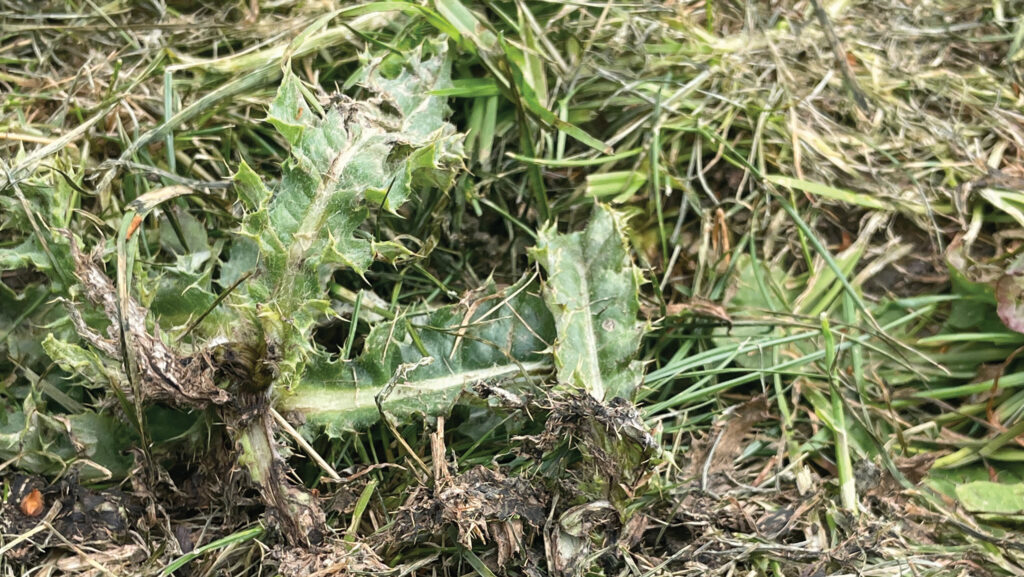
Trials have shown almost 100% weed kill efficacy © MAG/Richard Allison
Trials have shown almost 100% efficacy in different situations. “I would expect to achieve this with the right forward speed,” he says.
However, the system is not suitable for all situations. For example, high biomass cover crops.
“You need power and energy, so if you want to kill lots of biomass like a cover crop, you would need to go very slow and burn lots of diesel, which is not a good use of the system,” he says.
It’s more suited for crop establishment systems with weeds at a similar growth stage and while they are still small.
Jonathan sees the weeder having a role in vegetables and high-value row crops that require precision weed control, organic and low-input farming systems, as well as conventional farms looking to reduce chemical inputs.
It has already found favour in organic systems with two Scottish producers using it to grow organic carrots.
Andy Baggott, UK sales manager at Garford, explains that the carrot beds are formed and plastic film is placed on top to warm the soil and encourage weeds to grow.
The plastic is then removed and the weeds are burned off using gas burners prior to planting.
The farmers see the electric system replacing the burners, which will pay for itself within two years. “They can spend up to £80,000 a season in gas,” says Jonathan.
The next step will be in sugar beet and maize crops before considering broadacre crops. “We don’t know yet if it will compete with chemicals in broadacre crops.”
System setup
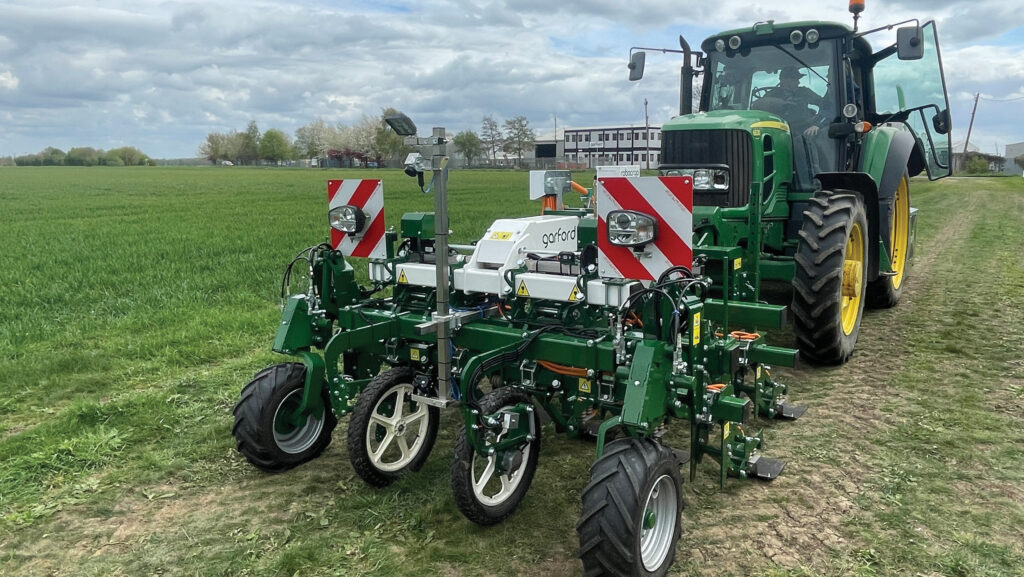
The electric weeder is now commercially available in the UK © MAG/Richard Allison
Each machine consists of a power pack on the three-point linkage – a generator powered by the pto – and cables run to the front of the tractor where the pairs of electrodes are mounted on two standard Garford toolbars.
Double insulators ensure there is no risk of electricity passing into the tractor frame.
There are six pairs of electrodes and the controller manages them in pairs so the system can cope with uneven weed density.
Otherwise, you can end up with untreated areas as all the power is pushed into the weed patches or wheelings, where there is a different impedance.
That’s because compacted areas have a lower impedance.
The electrodes can be adjusted into two modes. The broadcast setting – where the electrodes are staggered to cover the whole width – can be be used on stale seed-beds before the crop has been drilled, for example.
Alternatively, they can be moved into inter-row mode with each pair of electrodes running in succession along the row space.
If farmers are using the system later in the season, there are crop shields that can be attached which keep the electrodes off the crop. Jonathan adds that it can be configured for both raised beds and flat fields.
Current model
The current system has two 3m toolbars (one bed width) to which the electrodes are mounted, and a pto-driven generator producing 400V at 60kW.
Priced at £180,000, it also comes with Garford’s camera guidance system and artificial intelligence to identify weeds within the crop.
For power, the machine needs a 130hp tractor – on the demo, it was mounted on a John Deere 6630 tractor.
There are plans to double the system to 120kW to enable 6m passes (twice the width), which Jonathan says will be a game changer.
Experiences from the 2025 season
The optimum window for electric weeding is when weeds are small and with a forward speed of 4kph, says Garford managing director Jonathan Henry.
Because its non-chemical and does not disturb the soil, it is compatible with both organic and regenerative farming systems. It is also Soil Association approved.
Last season, there were two machines being used on commercial farms in Scotland.
One was growing organic carrots in a raised bed and it worked well on shoulders of the beds. “It’s sandy soil, so tricky to do [weed] mechanically.”
The electric weeder was used in tandem with the Robocrop in-row weeder, and it was found that one single pass was sufficient with the electric weeder, as the weeds didn’t grow back.”
The electric weeder targeted the wheelings and between rows.
On the other farm, the soil is more stoney and they were still able to use it – the stones had been windrowed into rows and the machine adapted to wheel (tyre) steer instead of the default disc steer.
Even a bad couch grass problem in a rented field was sufficiently managed, says Jonathan.
There are six machines currently in the UK. Looking to the future, they are hoping to combine it with hoe technology to offer a single pass system.