

Hazelnuts offer new high-value crop opportunity
 © Tom McVeigh
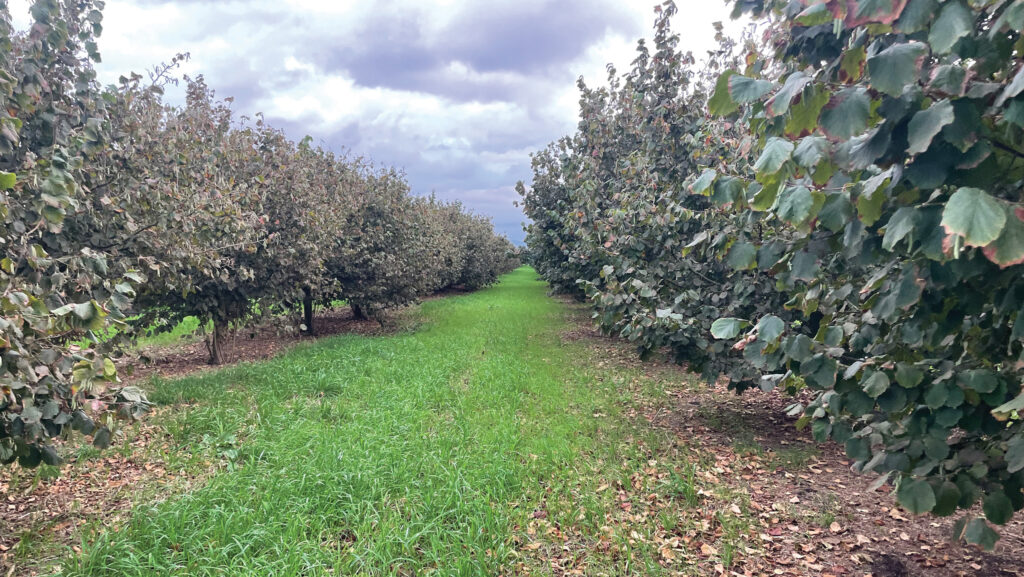
 Arable farmers looking for a new, high-value crop suited to the changing climate should consider producing hazelnuts, says Suffolk farmer and Nuffield scholar Tom McVeigh.
Grown in an agroforestry-type orchard system, hazelnut production provides growers with a market-based solution that doesn’t rely on government support.
Tom says it has the potential to generate £10,000/ha a year in gross margin terms.
See also: How new income streams are protecting Shropshire farm business
“Cereal prices aren’t sustaining our businesses at the moment,” says Tom. “With environmental expectations only increasing and further challenges imminent, farms like this one are at a crossroads.
“We have a choice between waiting for government support and an uplift in grain markets or taking control of our own destinies.”
Global market
Hazelnuts are a non-perishable and highly mechanised crop option with the specification of a cereal crop but the value of top fruit, he says. There is also a global market and increasing demand for the product.
Specification is a key point. At least 70% of the global market is for an 11-13mm nut, which is why the traditional cobnuts at 18-19mmm aren’t suitable. It’s a small difference, but it has a massive impact, notes Tom.
“That’s why American hazelnut varieties are required for new UK orchards. They have performed better, produce the right size and shape of nut and can attract a premium.”
Having undertaken a great deal of research and travelled the world to learn more about hazelnuts, Tom believes there is a huge opportunity for UK growers.
But as it is a commodity crop, it needs to be done at scale and requires grower numbers for the necessary infrastructure.
Global hazelnut production
Most of the hazelnuts consumed in the UK come from Turkey, with Spain, Italy, France, the US and Chile also producing the crop.
Turkey is the largest and cheapest producer, says Tom McVeigh, although yields are very low at 0.8t/ha and the operation is still all done by hand – whereas in other parts of the world, it is highly mechanised.
Climate change is causing production issues across Europe, with warmer temperatures affecting the number of chill hours, as well as the biology of the plant and its ability to pollinate, reducing yields.
In France, the Eurasian stink bug has reduced yields by 20%.
“Hazel trees pollinate over the winter, so late frosts can be an issue. That was a particular problem for Turkey last year.”
Pest problems show the importance of planning future orchards with integrated pest management as part of the layout, says Tom.
Infrastructure
A cleaning plant and a cracking plant will have to be built – which Tom is keen to progress with.
While the grower receives an in-shell price for nuts leaving the farm in a lorry, they have to be cleaned to deal with debris and cracked to remove the shells for more cost-effective transport into the supply chain.
He needs a commitment of 400ha of hazelnut orchards to justify a cleaning plant and 1,000ha for a cracking plant.
Currently, he has about 250ha pledged from the farming community and stresses that market access depends on scale and continuity of supply.
“I’ve calculated that 20ha of hazelnuts is one man’s work,” says Tom. “There’s winter pruning, removing suckers in the spring and harvesting in September.”
There are upfront costs and Tom estimates an eight- to nine-year payback time.
At about £10,000/ha for the establishment of an orchard, there are ongoing costs of £3,500/ha a year for the necessary pruning and maintenance of the trees.
One-off establishment costs |
||
|
Item |
£/ha |
Notes |
|
Trees |
3,150 |
Includes delivery |
|
Guards |
500 |
Spirals/mesh and stakes |
|
Labour |
1,500-2,000 |
Planting, training and pruning |
|
Irrigation |
3,000-3,500 |
Drip lines, pumping and installation |
|
Fencing |
1,500-2,000 |
Perimeter protection |
|
Site preparation |
500-1,000 |
Ground and soil amends |
|
Total |
10,000 |
Typical all-in cost |
Net profit (£/ha) at maturity |
||||
|
In-shell price (£/t) |
||||
|
Yield (t/ha) |
2,800 |
3,000 |
3,200 |
3,500 |
|
4 |
7,000 |
7,800 |
8,600 |
9,800 |
|
3.5 |
5,650 |
6,350 |
7,050 |
8,100 |
|
3 |
4,300 |
4,900 |
5,500 |
6,400 |
|
2.5 |
2,950 |
3,450 |
3,950 |
4,700 |
Timescales
It takes five years until the first harvest. As output doubles each year after that, in-shell yields of 3-5t/ha are achievable in the UK, and there are no geographical constraints to where hazels can be grown.
“Remember that this is a tree that has been in the UK since Roman times – we are just looking at growing it in an efficient and modern way. Even so, it remains a low-input, low-labour crop.”
Today, hazelnuts attract an in-shell price of £4,500/t. However, Tom has based his calculations on £2,800-£3,500/t to avoid any unrealistic expectations or disappointments.
A fertigation system is required to provide the water and nutrients that the trees require as they grow and produce.
A maximum of 80kg of nitrogen/ha is used on hazelnuts and a different mindset is recommended – Tom suggests not considering them as an arable crop and likens them to apples.
Planning an orchard
Harvesting is carried out in September, after the nuts have fallen to the ground. They are then swept and vacuumed up – or combed up – with a range of harvesting techniques used according to the site and conditions.
“This is why you need to think hard about what else you do around the trees. A ‘crop’ of chickens seems to be one of the best options.”
As with all tree enterprises, deer and squirrel damage are potential problems, with fencing and control measures required.
“You do get a dilution of any damage where you have lots of trees, compared to a very small planting,” says Tom.
Looking ahead, carbon payments could become an additional income stream, as could biodiversity net gain (BNG). He is also investigating the potential of truffle production in orchards.
Sustainable Farming Incentive (SFI) payments for high-density planting may be relevant, although Tom stresses that there is an optimum planting density for hazelnuts and the availability of government support should not be the reason for going ahead.
Kenton Hall Estate
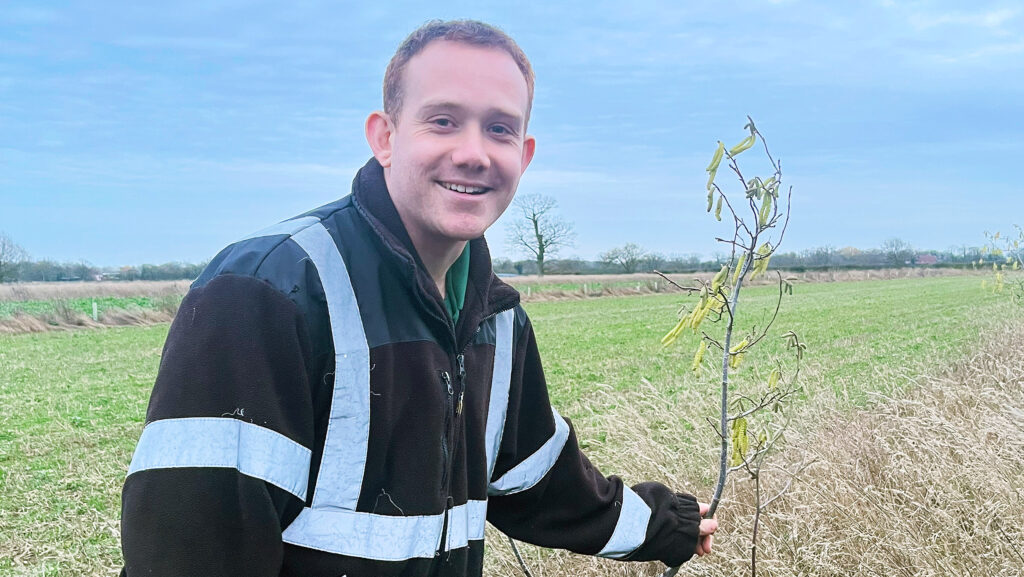
Tony McVeigh © Louise Impey
Introducing as many things as possible is how Tom McVeigh is future-proofing Kenton Hall Estate in Suffolk, as he balances productivity with resilience.
The 200ha mixed farm, with combinable crops and beef cattle, also hosts a cookery school, glamping site and wedding venue – all of which are run by other family members.
A trial field has enabled Tom to try out a new farming system, learn from the findings and understand if the heavy clay soils are suited to a changed rotation with no-till at its heart.
On the farm, planning permission has just been received for two free-range poultry sheds. All being well, building will start in the spring.
Agroforestry
The area of agroforestry will increase to 24ha as hazelnut orchards go in, providing food, biodiversity and carbon.
In time, he hopes that the chickens will work well with the hazelnut orchards.
He is also investigating biodiversity net gain for a strategically located small site and exploring renewable energy opportunities.
“We’re looking again at the concept of a mixed farm, given that the BPS [Basic Payment Scheme] has gone and we need to take control of our own destiny.
It’s clear that we can’t continue to farm in the way that we used to.”
For more information on the hazelnut opportunity, email Tom McVeigh at mcveightom@googlemail.com

Staying sharp shouldn't be a chore
Explore more / Transition
During the series we follow our group of 16 Transition Farmers through the challenges and opportunities as they seek to improve their farm businesses.
Transition is an independent editorial initiative supported by our UK-wide network of partners, who have made it possible to bring you this series.
Visit the Transition content hub to find out more.
