How high-protein spring barley can unlock bigger premium
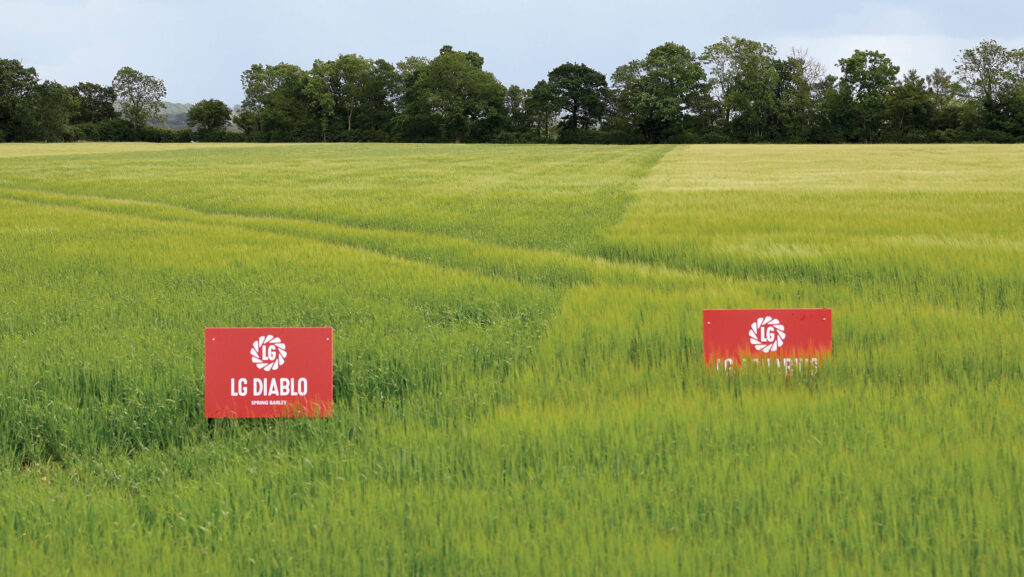 Spring barley Diablo v Aquarius © Beanstalk Global Max MacGillivray
 Premiums for spring barley remain weak on the back of low demand from maltsters as consumers, especially younger generations, reduce alcohol consumption.
But there could be an emerging market, if still small, for high-diastatic power (DP) malts, where premiums of up to £40/t over malting might be available.
These malts are used for grain distilling, where typical mashes contain about 10% malt, with the remainder unmalted cereals such as wheat, maize or rye. By comparison, in malt distilling or brewing, most of the mash is malted barley.
See also: New barley set to be key dual-purpose variety across UK
That means the malted barley needs to contain more enzyme activity or diastatic power to convert the starch in the unmalted grains into alcohol, explains Gary Mills, seed manager for Scotgrain, which oversees malt barley procurement for Bairds Malt both in Scotland and for Bairds’ Witham Maltings in Essex.
Typically, varieties containing high levels of DP have come from Scandinavia, but with a significant yield penalty of about 10% compared with control varieties such as Laureate or Diablo.

Ryan McCormack © Beanstalk Global Max MacGillivray
“Even with a big premium, it has been difficult to get a farmer to commit and to grow in sufficient quantity,” Gary says.
That could change with a variety from Limagrain – Aquarius, which has a UK yield of 103% of the controls on AHDB’s Recommended List, making it competitive on yield with current market favourites.
“It’s quite a unique variety,” says Limagrain arable technical manager Ron Granger. “Two years ago, the industry wasn’t talking much about this market, but now they are.”
The variety, added to the Recommended List in 2024, hasn’t attracted much interest, although those who were growing it as a feed variety had found it to be high-yielding, with good disease resistance, stiff straw and a good specific weight.
“I think that it has been grown successfully on farm already, which shows that with this new specific use, farm uptake shouldn’t be a problem,” Ron suggests.
Limagrain demo farms evaluate variety performance at field scales
Dennington Hall Farms is one of two farms hosting a newly established Limagrain demonstration farm.
The initiative is designed to complement AHDB Recommended List trials by evaluating variety performance at larger scales with varying soil types, cultivation choices and input strategies.
As well as the spring barley comparisons, trials include comparing 13 Limagrain wheat varieties across three establishment systems – direct drilled into a summer catch crop, minimal tillage and a plough-based system.
Other trials on the farm compare tramline-width strips of various oilseed rape and winter barley varieties, while the Accelerating Development of Practices and Technologies (Adopt) project is looking at cover cropping ahead of winter wheat, as well as spring barley.
A second Limagrain demo farm is located on Rob Atkin’s farm in Staffordshire.
Higher nitrogen spec
But the key to achieving premiums within this market is growing it to much higher nitrogen specification than usual for malting barley. “We’re looking for anything over 1.75% grain nitrogen, up to 2.1%,” says Gary. “It’s the higher nitrogen that gives better enzyme content.”
Surprisingly, perhaps, high grain nitrogen content can be difficult to achieve, with a balance between applying enough to reach the desired grain content, but not too much to cause lodging or other agronomic problems.
“There are ways to enhance grain nitrogen content,” Ron says.
Limagrain trials that include an additional 30kg/ha of nitrogen applied at tillering, on top of the traditional 120kg in the seedbed, can both enhance yield and, in naturally high-DP varieties, increase grain proteins.
“It’s a little bit like milling wheat in that later applications can enhance both yield and grain nitrogen content.”
The opportunity for growing high-DP varieties for grain distilling isn’t just with Scottish growers, Gary says.
East Anglia
While Aquarius looks like a Scottish variety characteristically, getting out of the blocks quickly and growing low to ground, Gary thinks East Anglia might be the best region for hitting the spec consistently.
“In Scotland, the longer days and cooler weather tend to mean bigger, bolder grains with much lower nitrogen. That’s great for alcohol extract, but not so much for enzyme production.
“We are finding in Scotland that it is harder to meet spec, and even with healthy premiums of up to £50/t, farmers were choosing to grow a conventional malting barley.
“In East Anglia, the shorter days and more intense heat will help reach the grain nitrogen content.”
Aquarius is one of seven varieties being grown in tramline-width strip trials as part of Limagrain’s demonstration farm (see panel) at Dennington Hall Farm in Suffolk.
The field is also part of a Defra-funded Accelerating Development of Practices and Technologies (Adopt) trial looking at the effect of cover cropping on nitrogen use in the following crop.
A multi-species overwintered cover crop was established in the second week of August, before being mob-grazed with 1,400 lambs brought down from Yorkshire.
Each variety was then either direct drilled or followed by minimal cultivation two days before drilling with the farm’s Horsch Avatar, with the latter looking much better in this spring’s dry conditions.
The trials help farm manager Ryan McCormack understand how varieties work in different establishment systems.
“Aquarius looks like one of the best varieties in either system,” Ryan says. He’s also growing 50ha of the variety commercially for seed production this season, after growing it the previous season for malting.
“It performs really well, comes out of the blocks early and we hit the nitrogen level without needing to do anything differently with nitrogen applications in a dry season.”
In other years, with better growing conditions and the risk of dilution, you might need to feed it a bit more, he concludes.
Limited seed will push growers back to Yr15 varieties
Due to limited seed of wheat varieties with strong yellow rust resistance after the Yr15 gene breakdown, many growers will still need to plant part of their area with “dirtier” varieties next season, suggests Ron Granger of Limagrain.
Subtle differences have emerged this season in the timing of rust infections in varieties affected by the Yr15 breakdown.
“In some varieties, the yellow rust came in and kept going, while in others, infections were seven to 10 days later. That’s a big window and if you know that about a variety, you could treat it differently.
“It’s the kind of information AHDB should be looking for in Recommended List trials.”
Resistance
The same is true for adult plant resistance, which typically kicks in from about GS37 – knowing which varieties “hold” rust versus those that continue to decline is essential for assessing which are at highest risk, he says.
“If you have an untreated variety where rust keeps going until the plant is dead, that’s a category you need to know is high risk.”
The wheat variety trials at Dennington Hall Farm highlight that yellow rust can be controlled relatively cheaply, particularly while tebuconazole remains available.
But it needs treating early, Ron stresses. “What you can’t afford is to be chasing the ‘warrior’ races because it is very difficult to control once it is established.
“Eradicant fungicides, like tebuconazole, are very effective when used at T0, but if we lose it we still have good chemistry available, although costs will likely increase.”
Content for this article was collected at the recent Limagrain Dennington Hall Farms demonstration day in Suffolk