Crop Watch: Bean drilling and unexpected slug damage
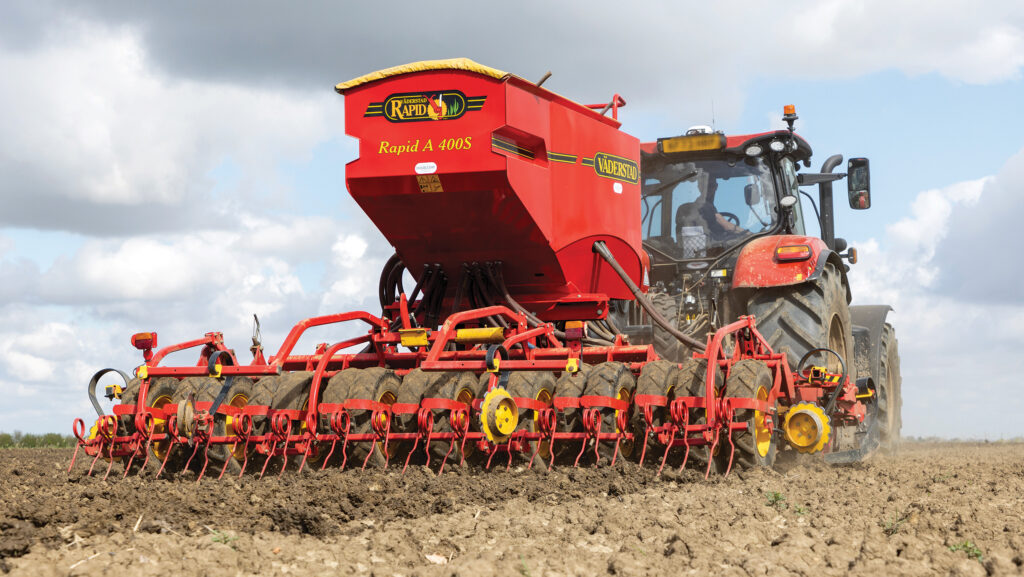 Drilling spring beans © GNP
As enter the second half of October, the promised deluge still has not arrived. Cereal drilling is well advanced and wheat emergence in some areas has been protracted and patchy.
Winter beans are starting to be drilled with the focus on weed control and how best to tackle the threat with very limited post-emergence options and the dry soils limiting the efficacy of pre-emergence herbicides.
See also: How bicropping helps with weed control in pulses
East
Alice Whitehead, Agrovista (Kent/Essex/Suffolk)
There has been no meaningful rain in the East and we are still waiting for the much-publicised autumn deluge to start.
Most wheat drilling has been completed, with only the very worst grassweed fields left to drill.
The light showers might have been enough to flush a few weeds to allow a pre-drill glyphosate, but there have not been many opportunities to try to clean up before drilling.
Herb and salad growers are still irrigating crops into October, which is unheard of normally.
Usually by now, irrigation equipment has been put away and pipelines have been taken up. Not this year.
The mild temperatures are causing concern about aphid populations building in cereals and how quickly some residual herbicide chemistry might be breaking down in warm, dry soils.
I have avoided using cinmethylin too early this season to keep it for post-emergence applications when, hopefully, there will be some moisture and more normal temperatures.
Propyzamide
On this note, propyzamide applications in oilseed rape will surely be well into November when soils have cooled sufficiently.
Those fields of OSR that have survived the combination of drought, flea beetle and slugs are actually looking pretty good, considering all they have been through.
My flea beetle monitoring in veg crops from the spring and summer had shown total numbers of the various species of flea beetle to be up to the high populations of 2021, which was probably the last difficult year of OSR establishment.
Slugs have caught a few people out, with many assuming low populations as it had been such a dry summer. Highest slug pressure has come with cloddy seed-beds or lots of straw residue.
Winter beans have been drilled over the past couple of weeks.
Be careful not to get caught out with crops emerging quickly and missing the vital pre-emergence window for herbicides. I have been recommending a mix of aclonifen, clomazone and propyzamide.
With the lack of post-emergence options, I think it is still worth applying this in the dry conditions – we may end up with a bit of a challenge to clean weeds up otherwise.
Of course, the other option is to delay drilling until a suitable window allows later in the autumn. Seed rates should be increased accordingly.
West
Jamie Armstrong, AICC/Wessex Agronomy (Wilts, Gloucs and Hants)
Rainfall has been the talking point across the South West, with some areas receiving as little as 5mm between mid-June and the rain that finally arrived a few weeks ago.
Totals have varied considerably even within small localities, with some farms reporting 45mm or more while others are still around 25mm.
This has caused real problems for oilseed rape establishment, with a number of crops effectively written off due to a lack of moisture and pressure from cabbage stem flea beetle (CSFB).
Where rainfall has been higher, particularly around the Cotswolds, OSR got off to a much better start and is looking well.
Grassweed control is now complete, along with any broad-leaved weed control required.
The contrast between crops across the region is striking, highlighting just how much establishment depends on catching timely rainfall.
Winter barley went into good conditions, with around 20mm of rain following drilling.
The earliest crops are now approaching the three-leaf stage, but aphids and gout fly eggs are already relatively easy to find when looking closely within crops.
Many fields have reached their T-sum threshold, and insecticide applications are under way where appropriate to reduce the risk of barley yellow dwarf virus (BYDV).
With aphids still active, it is important to keep checking emerged crops and make treatment decisions according to risk.
Around 90% of the winter wheat area I look after has now emerged, with second wheats drilled and beginning to come through.
Wheat varieties
Variety choice has been an important talking point, particularly following the hot, dry finish to the season.
Some varieties handled the conditions better than expected in our region, with Bamford and Scope both performing well.
These varieties may carry a greater yellow rust risk, but where fungicide programmes are timely, the balance between disease risk and yield potential may be worthwhile if we see more dry springs in future.
As ever, variety choice needs to reflect the farm’s disease risks and the level of management it can realistically deliver.
Winter beans are now starting to be drilled. A comprehensive pre-emergence herbicide stack remains important, particularly where grassweed pressure is high.
Much of the season’s broad-leaved weed control will also rely on good residual activity, so getting the pre-emergence programme right from the outset is key.
Winter cereals have been drilled into good conditions, with most crops now emerging well. Some fields are showing slight variation in emergence, but on the whole crops are off to a good start.
North
Conor Campbell, Hutchinsons (Northumberland)
What I believed last year to be dry conditions for September/October have been blown out of the water by the past six weeks.
A combination of warm weather, wind and a complete lack of rain meant that I witnessed what I would class as a medium soil, blowing away one day.
Drilling conditions have been fairly good, but seed-beds have certainly been a challenge on heavier land.
The cloddy conditions and lack of moisture preservation has been very telling, resulting in seed that didn’t chit for up to a month until the recent showers.
It’s been a while since oilseed rape establishment has been as tough and lengthy.
Crops sown the first week of August got off to a great start, as we had adequate moisture and rain that week.
Anything sown after that has been hard work, as soils dried out at record pace.
Early slug pressure followed by CSFB arriving meant these crops really struggled to put on any biomass as they were being held back so much.
I certainly feel as though insecticides, applied late into the evening, did help take the heat off and allow these vulnerable crops to grow.
I’m amazed at how much crop we have managed to keep and this now has a fighting chance with some moisture back in the soil and mild weather on the forecast.
Cereal emergence
Cereals have been very slow and emergence has been patchy.
Soil types and old tramlines have really been highlighted by the dry soil conditions. Thankfully, seed hasn’t gone mouldy and so is now germinating.
Residual herbicide timing has been tricky and many conversations took place around whether it was worth the application or not in such conditions.
It’s amazing how understanding the strengths and weaknesses of the different actives available to us can help with building a programme.
One reason to delay has been to include an insecticide due to the high level of aphid pressure as they enjoy the warmth.
We saw large amounts of BYDV late into the spring last year and these infections no doubt took place late into 2025.
Unlike this time last year, aphids are readily found in field and suction trap numbers high.
It would, therefore, be prudent to cover cereals against infection. It’s also a good opportunity for some foliar nutrition, which will certainly help with establishment.
South
Justin Smith, Procam (East Sussex)
Cereal drilling is continuing at pace in the South, with crops being drilled into fine, well-consolidated seed-beds.
Successful establishment has, however, been very dependent on soil moisture at the time of drilling.
The few showers that have fallen have had little impact on the hangover from the summer’s drought, with much of the moisture these showers have delivered struggling to penetrate the rooting zone.
As a result, establishment has been protracted and uneven in a lot of cases.
The continuing mild conditions have also allowed aphids to multiply at will, and they can be found with relative ease on those crops that have reached the 1-2 leaf stage.
This autumn I have opted to switch to Gocha (esfenvalerate) in preference of alternative pyrethroids as it is more tolerant of the season’s warm temperatures and offers improved persistency thanks to its superior tolerance to UV degradation.
I appreciate this strategy comes with slightly higher cost implications, but I feel the positives outweigh the negatives when trying to safeguard crops from a significant BYDV risk.
In most scenarios, it is too soon to be contemplating the use of residual top-ups, so an insecticide application once the appropriate T-Sum has been reached is the order of the day.
Because seed-beds were so dry when cereal drilling commenced, my initial strategy for ryegrass and blackgrass control in wheat has revolved around Proclus (aclonifen) mixed with a flufenacet-based product.
I have kept Agardia (cinmethylin + picolinafen) in reserve for residual top-up applications, which will be made when enough moisture appears to help germinate the target grassweeds.
It will be essential to apply this later treatment at the optimum timing to get the best results from these key actives.
Meanwhile, my barley pre-emergence herbicide plans have revolved around the use of Cadou Met (flufenacet + diflufenican + metribuzin), which I’ve selected to tackle mixed weed populations including groundsel.
Alternatively, I’ll use Fundatis (beflubutamid + bixlozone) alongside a flufenacet-based partner to target more challenging grassweed populations.
With a very limited choice of post-emergence active ingredients available for the control of brome, ryegrass and blackgrass, a residual top-up at the appropriate timing will also be key.
As we all know, winter oilseed rape can be a frustrating crop at the best of times.
However, when the stars align it is, for many, the most profitable break crop and has many other agronomic benefits.
I always ensure winter OSR goes into the cold months exhibiting resilience to rough weather and pest attack, with an adequate supply of nutrients, especially boron and molybdenum, helping in this endeavour.
I am continually humbled by the faith growers put in us to get the expenditure and financial balances right, and this year will be as important as ever.
Often the results don’t just come from a chemical can, but from an integrated approach and a relationship built on strong communication and trust.