Crop Watch: Hopes for drier weather and wheat T0 strategies
 © Tim Scrivener
 Farmer and agronomists are hoping for a more settled spell of weather, as the continuing damp conditions are hampering fieldwork.
Septoria and yellow rust are being found in wheat crops as thoughts turn to T0 fungicide strategies, as kick off in the coming two weeks.
See also: How grain maize earns more profit than wheat for two growers
North
Stephen Bell – Fane Valley (Northern Ireland)
After a prolonged dull and wet winter with record rainfall across parts of the country, breaks in the rain and glimpses of sunshine now offer a welcome hint of spring.
We’re hopeful for better weather ahead, as thoughts gradually turn back to fieldwork when conditions allow.
Winter cereals have generally come through the winter better than expected, with earlier drilled crops benefiting from establishing roots before soils became saturated.
Where crops are more backward, they will need attention as soon as ground conditions allow, with a focus on nutrition alongside foliar phosphite and phosphate, plus early plant growth regulation to encourage rooting and maintain tiller numbers.
This is particularly important in winter barley, where some of the more forward crops are already approaching growth stage 30.
Hybrid rye and barley are also moving rapidly and will require nitrogen and growth regulation as soon as possible.
The mild, wet winter combined with early drilling has produced some strong winter wheat, particularly on more fertile land, with most crops currently around the mid-tillering stage.
Grassweed control will be a priority in the coming weeks, especially in later drilled fields where pre-emergence herbicides were missed in the autumn.
Disease pressure is already evident, with septoria easy to find in crops. Learning from last season, a T0 fungicide will be important this spring, particularly where yellow rust ratings have slipped following the Yr15 breakdown.
With considerable variation between crops, decisions will be guided by the level of disease in the crop and the predicted yellow rust risk, tailoring programmes to individual varieties.
A strobilurin-azole mix should provide persistence and yellow rust knockdown, while including a multisite will help protect leaf four and slow septoria movement up the canopy from the outset.
Oilseed rape
Oilseed rape crops are full of potential, with green area indices (GAI) typically between 2 and 3.5.
Most have grown away from earlier slug and pigeon damage and are now well into stem extension, with grassweeds dying back following earlier propyzamide applications.
Spring nitrogen is being tailored to canopy size, ensuring forward crops don’t get too bulky.
More advanced crops will receive a plant growth regulator (PGR) at green bud to manage lodging risk, while later developing crops will be treated at yellow bud to promote branching and improve canopy structure.
Crops are generally clean at present, but a prothioconazole-based fungicide will be included with the PGR and foliar nutrition to provide protection and minimise disease risk.
Spring beans will be drilled once soil conditions improve, targeting a plant population of about 30/sq m.
A pre-emergence herbicide of imazamox and pendimethalin will follow immediately after drilling to control grass and broad-leaved weeds, giving the crop a clean, competitive start.
South
Anna Dunford, Hampshire Arable Systems/AICC (Hampshire, Surrey and Isle of Wight)
Spring sprung for all of about four days, giving growers a brief window to catch up with overdue fertiliser applications. Those on lighter, free-draining soils also managed to start spring drilling.
On heavier land, many are still waiting for conditions to improve before getting on the fields.
Winter wheat crops are at varying stages. The majority fall into the “leggy” category, largely due to early drilling and a mostly mild winter, while later-drilled crops remain flat to the ground.
Nodal development is racing ahead of leaf emergence in many fields, with crops displaying a false growth stage 30 – a node at 1cm while leaf four has yet to emerge.
In most situations, however, there is no need to rush in with early PGRs or fungicides.
As crops move from a vegetative to a reproductive phase – the onset of stem extension – day length will begin to have a greater influence on development.
Although the season currently feels early, timings are unlikely to be dramatically different from normal and should move closer to typical as the season progresses.
Septoria
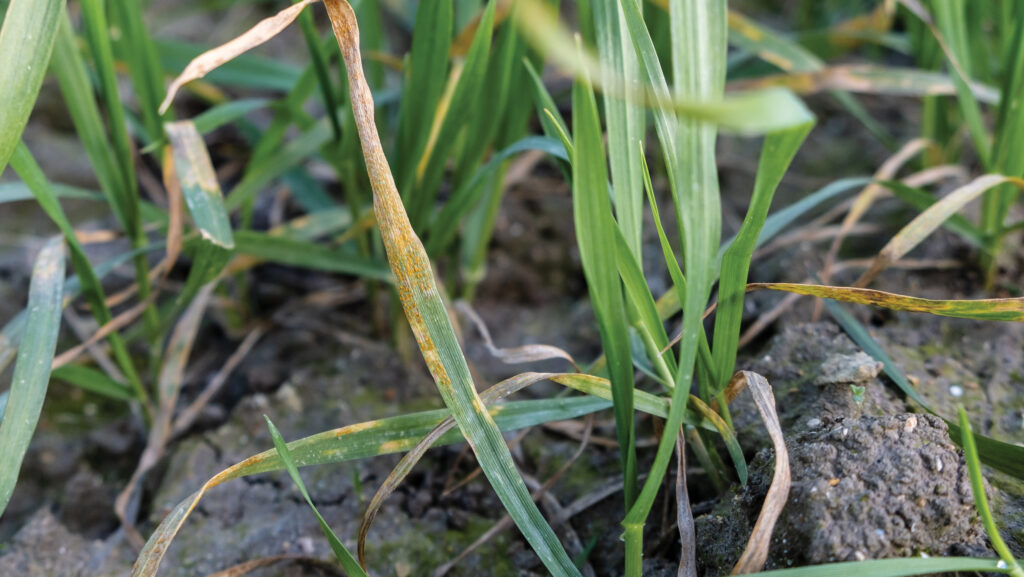
We are beginning to see septoria creeping up plants, particularly on the lower leaves. Yellow rust, driven by the Yr15 mutation, is showing in patches, while brown rust is found in Crusoe and Vibe.
Autumn residual herbicides generally worked well, and final grassweed tidy-up sprays are now under way.
Soil temperatures are now warm enough for optimum activity from products containing pyroxsulam, such as Broadway Star (florasulam + pyroxsulam), although the large diurnal swings – cold nights followed by warmer days – are not ideal for performance.
Weeds such as groundsel, bur chervil and wild carrot are best targeted early for effective control.
Chocolate spot in winter beans has been grabbing attention. With limited early fungicide options available, deciding how best to respond has been tricky.
Later drilled crops have got away with it, and we are seeing only low levels of pea and bean weevil notching on leaves so far, which is somewhat surprising given the relatively warm conditions.
Graminicides are being applied to tidy up cereal volunteers and brome.
Oilseed rape is moving quickly through growth stages, with earlier drilled crops already beginning to flower.
Particularly thick crops are receiving Caryx (mepiquat + metconazole), while those that do not quite justify a standalone PGR will receive tebuconazole at a higher rate at the yellow bud timing.
Pollen beetles are easy to find, but with plenty of buds present, crops should be able to compensate.
West
Ben Allard – Pearce Seeds (Dorset, Wilts and Somerset)
Two weeks into March, and while we have had brief glimpses of spring between the showers, fields on the heavier soils remain largely untravelable. Only the lighter chalk and brash soils are currently fit to travel on.
Winter cereals have, for the most part, come through the winter looking fantastic.
For the first time in several years crops on the headlands have not been washed or rotted out, and many fields have strong establishment right across them.
However, on the heavier land in the south, the persistent rainfall over the past two months is beginning to undo some of the excellent progress made in the autumn.
Disease pressure is building and crops are beginning to look hungry where first nitrogen applications have yet to be applied.
At this time of year, I am often looking for septoria and mildew as the main threats for my T0 programme in winter wheat.
In this region yellow rust is never normally a major threat, especially where in previous years Group 4 hard feed wheats would have good yellow rust ratings, reducing both the risk and presence of the disease.
However, due to the breakdown in the Yr15 gene, this year yellow rust is present and thriving in some varieties.
The T0 programmes are due to be applied over the next 10-14 days, which will include a good dose of tebuconazole to help keep on top of yellow rust.
My advice would be to watch and monitor crops closely, check the updated yellow rust ratings for your varieties, and act if rust is present. If you let it get a foothold, it will become an uphill battle.
While yellow rust is currently the headline risk, septoria is certainly present as well. The inclusion of laminarin at T0 will provide a useful foundation for septoria protection as we move through the season.
Standout crop
Oilseed rape crops are well established with excellent biomass across most fields, and at present it looks like OSR could be the standout crop this season.
The first nitrogen applications went on in February, alongside polysulphate at about 70-100kg sulphur/ha to meet the high demand of the crop.
With crops looking strong and forward, I have used more PGR this year compared with previous years to help manage the canopy and keep the crop nice and uniform across the field.
This has come in the form of Caryx PGR, with the inclusion of prothioconazole for stem extension disease control.
The final dose of nitrogen will be lined up to be applied over the coming week as crops are fast approaching flowering, earlier than in previous years.
Keep a close eye on OSR, as the crop is starting to run away and race into spring.
I wish I could report great progress on the spring drilling front and share optimism about spring cereals, but sadly this is not the case.
Poor market prices and lack of demand for spring cereals, particularly barley, have resulted in a massively reduced area this year.
In addition, the weather continues to delay drilling, with limited windows to get land worked and crops drilled.
It is already starting to be a challenging season for spring cereals, and it has only just begun.
© Blackthorn Arable
East
Harriet Bateman, Prime Agriculture/AICC (West Norfolk, Cambs, south Lincs)
Crops have generally come through the winter in good condition and are entering the spring with strong potential.
Autumn-sown cereals established well from favourable drilling conditions, and timely pre-emergence herbicide applications have largely done their job.
The current focus is on monitoring for any fresh flushes of grassweeds, particularly brome, blackgrass and wild oats, so that they can be tackled promptly where necessary.
Where using spring grassweed ALS chemistry, be mindful of date, growth stage and following crop restrictions.
Most winter cereals have now received their first applications of nitrogen and sulphur to help stimulate early spring growth.
However, the continued spell of damp, overcast weather has slowed field operations for the time being.
Waterlogged patches are beginning to show some yellowing where crops have been under stress, and many fields still need time to dry before cultivations and further spring work can begin.
A large proportion of spring cereals are yet to be drilled and sugar beet drilling will require patience as we wait for good conditions.
A short period of drier weather will quickly allow progress to pick up and it will all change.
Disease pressure
Disease levels are also starting to increase.
Yellow rust is currently the most noticeable problem in winter wheat and is being detected readily in varieties carrying the Yr15 resistance gene, particularly in later-drilled crops that remain at a more vulnerable growth stage.
Septoria is present at high levels across many crops and mildew can be found where canopies are thicker.
While many wheat varieties rely on adult plant resistance for yellow rust, this protection typically only becomes effective from early stem extension onwards, so crops will need to be watched carefully in the coming weeks.
Oilseed rape crops generally look promising where plant populations are strong, although growth has been relatively steady under the dull weather, but crops are now moving at pace.
Forward cereals and OSR are being managed carefully through nitrogen and plant growth regulator strategies to keep crops balanced and prevent excessive early growth.
Although spring fieldwork has been slow to start, overall crop prospects remain positive.
Once soils dry and conditions allow machinery back onto the land, attention will quickly turn to completing spring drilling.