

How grain maize earns more profit than wheat for two growers
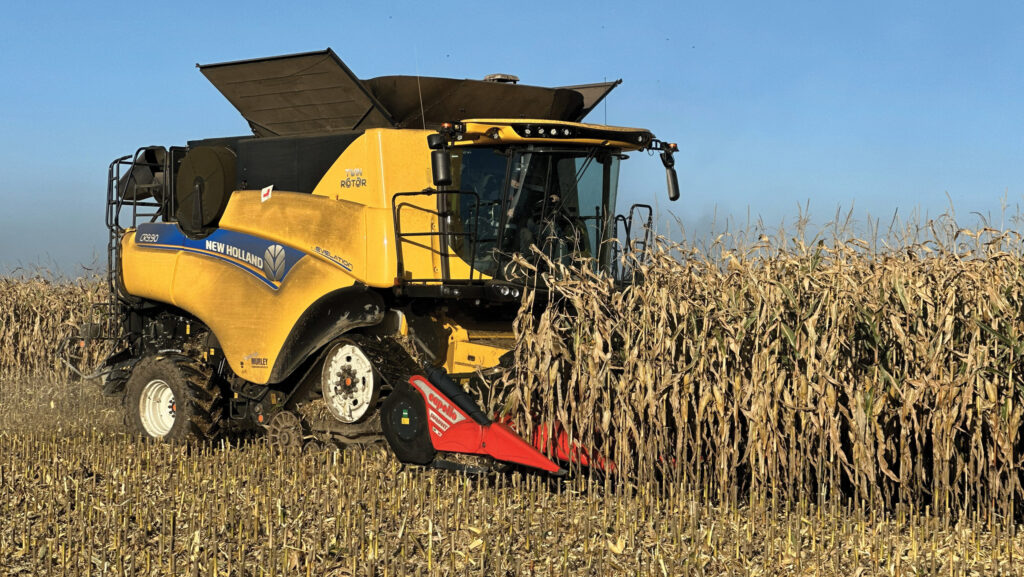
 A specialist header and sieves are needed when harvesting grain maize © GNP
 With yields approaching 10t/ha and gross margins currently exceeding those of wheat, grain maize can be a profitable break crop.
However, the crop does have its challenges and requires good drying capacity and a specialist combine header.
Here we look at two farmers who are seeing success with the crop.
See also: Why grain maize is key break crop in arable farmer’s rotation
Will Oliver, Leicestershire
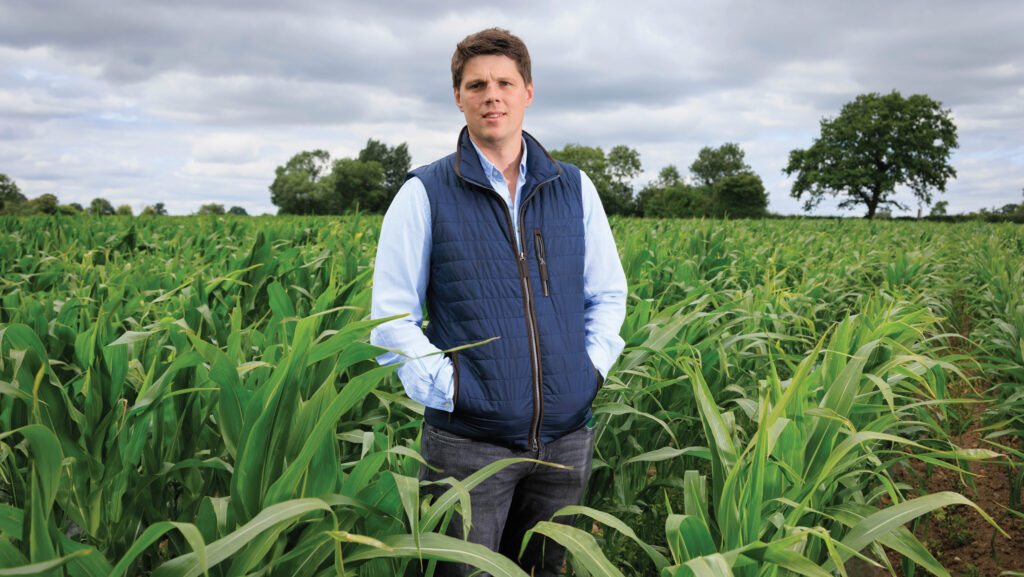
Will Oliver © Tim Scrivener
A replacement for oilseed rape, grain maize is proving to be a profitable option for Leicestershire farmer Will Oliver.
Maize is also helping Will make the most of his poultry manures and enables valuable spring cover crop grazing for his neighbour to fatten ram lambs.
It is now a key part of Will’s break crop area, which accounts for half of the 800ha total cropping, with the other half being first wheat.
Along with the grain maize, this season he is growing OSR for the first time in seven years and has dropped beans.
How it started
In 2012, Will returned home to the family business from Harper Adams and like many other farms in the area, the family were running a wheat, oilseed rape, wheat rotation.
However, the farm was facing challenges which included a worsening blackgrass problem and a need to improve soil health.
Problems with cabbage stem flea beetle saw oilseed rape dropped from the rotation in 2019. At the same time, the family invested in a 200,000-bird broiler unit, producing 1,900t a year of valuable poultry litter.
The question was “how do we make best use of the litter?”. And this is where grain maize comes in, he says.
“I believe the best time to apply manures to get the most out of them is in the spring. The litter is applied and incorporated with a TopDown prior to maize drilling.”
Will started growing grain maize in 2019.
“We had installed field drainage in one field and was too late to drill a winter crop, so we decided to put some grain maize in.
“That year, the OSR performed very poorly due to flea beetle, while the grain maize with a gross margin of £1,365/ha outperformed it.”
The following year, OSR was dropped and grain maize was the most profitable break crop. In 2023, the maize even outperformed first wheat with a gross margin of £1,382.66 versus £1,226.63.
In 2024, grain maize was again the best-performing crop.
Last year, there were no maize contracts available, but he still had enough confidence to grow it, as it delivers grain yields comparable with a good wheat crop at 9-10t/ha.
It proved a challenging year and the drought meant forage prices spiked, so he decided to cut early and sell it as forage.
This delivered a valuable income in a season where the wheat struggled with below average yields of 7t/ha.
Cutting maize early also meant he was able to drill this season’s wheat earlier in near perfect conditions, thereby setting the crop up well for harvest 2026.
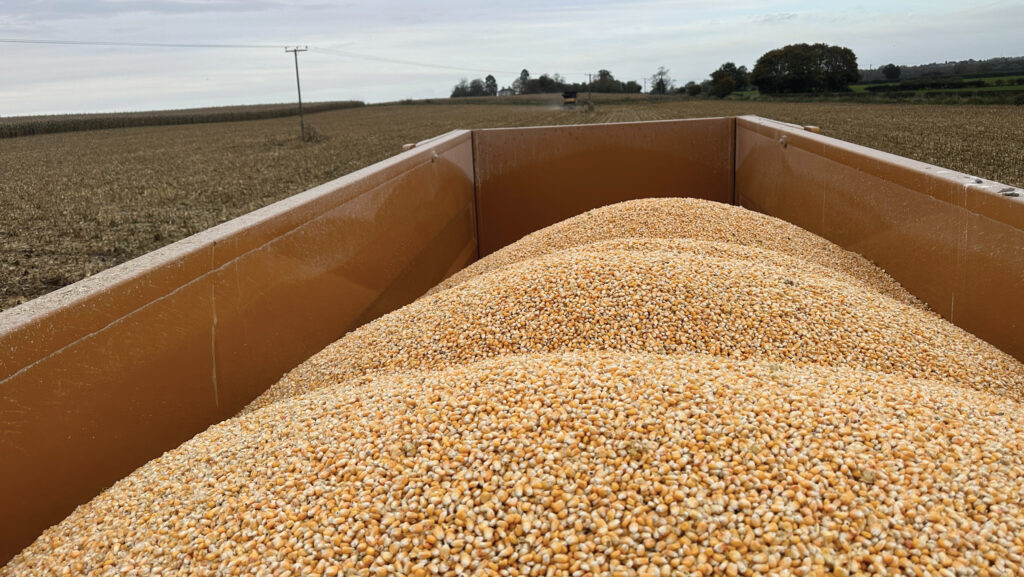
Grain maize has a higher gross margin than the first wheat © MGA
Challenges
One compromise when growing first wheat after grain maize is that it does hit wheat yields a little, being drilled in more challenging autumn conditions.
However, Will says he is prepared to take a bit of a hit with wheat if it means he has a profitable break crop.
While the overall farm average wheat yield hasn’t changed (since growing after maize), they are no longer growing second wheats.
Through the AHDB Strategic Farm trials, Will hopes to push wheat yields closer to 10t/ha, which he used to see with his first wheats.
The other two challenges are the need for good drying facilities and investing in a specialised header and sieves for the combine.
Will already had a continuous flow grain dryer capable of handling maize drying 8t/hr.
Drying is a significant cost at £18-£20/t, as the crop is harvested at about 30% moisture and needs to be dried to 15%.
However, Will points out that while drying can be a big cost, it’s similar to what a fungicide programme might end up costing on wheat.
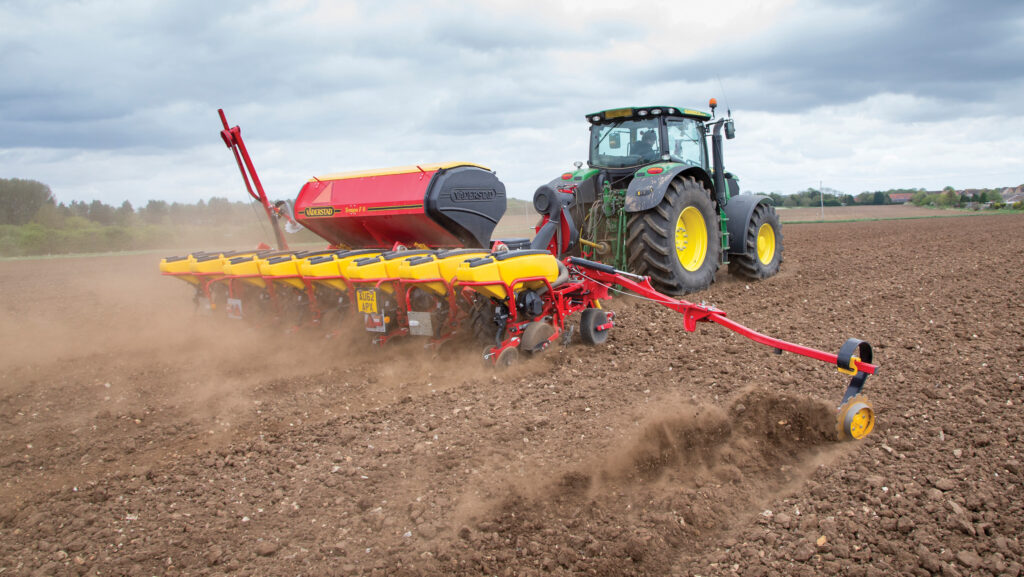
Drilling accuracy is one key part of growing a successful high yielding crop of grain maize © MGA
Benefits
Another benefit of growing grain maize is that it provides cover crop grazing in the valuable late February-March period.
Will’s neighbour Matt Harding runs a beef and sheep farm and breeds rams (Bentley Suffolks) as his main enterprise.
Grazing Will’s rye and vetch crop helps him to rest pasture at the home farm, before the rams return in late March.
“Late February and March is the critical period when we need grazing. You get good growth rates and is a key part to growing the rams,” says Matt.
Growing maize with its later drilling date makes this possible.
Wheat establishment after maize trials
Will Oliver is looking to improve wheat yields following maize, as part of being the AHDB’s newest Strategic Farm, with trials looking at establishment.
Niab research agronomist Dr Joseph Martlew points out that there can be challenges when drilling first wheat after maize.
It’s not only the later drilling, there is also extra trash and the fusarium risk.
One trial which started last autumn is looking at whether pre-drilling cultivations can help break down crop residue in a no-till system.
Two biostimulants are also being tested to see if they help with wheat establishment in the more challenging conditions after maize.
The four treatments are:
- Farm standard – direct drill with the Horizon (no-till)
- Mulch – cultivations to help break down residue consisting of a TopDown, cultivating to 15-20cm depth
- Biostimulant – QLF Boost
- Biostimulant – Sea2 soil.
Niab will be monitoring the impact on maize residue breakdown, wheat crop performance and fusarium levels.
Peter Snell, Dorset

Peter Snell © Andrew Faulkner
Grain maize is part of the diverse rotation at North Farm, where Peter Snell has gained extensive knowledge of the crop in the seven years he has grown it.
Currently, with yields of 7-9t/ha and a price of £180-£200/t, the gross margin is ahead of wheat and he believes there is so much more potential.
He points to US grower David Hula’s achievement on his farm in Virginia, where in 2023 he grew a crop with a world-record yield of 41.95t/ha, while UK wheat yields are plateauing.
“With the aid of new maize varieties and improved agronomy, can we consistently achieve one-quarter or more of this yield?”
Maize is part of his niche cropping mix along with herbage seed, thatching straw and sunflowers. All these are grown alongside his conventional combinable crops to maximise overall arable profitability.
How he started maize
In 2003 after coming back home from Seal-Hayne College, the farm was primarily a 200-cow Holstein cow dairy business.
Two years later, the family sold the cows and focused on arable, which now covers 1,500ha – a mix of owned, rented and contract farming agreements.
So how did he get into grain maize? Historically, they grew forage maize for the dairy herd, and in 2017, they took on some land where there was an obligation to supply feedstocks for anaerobic digestion (AD).
Maize was added to the rotation, but the AD plants didn’t materialise.
However, he saw the value of the crop being a good fit for his rotation and soil types. It also utilises equipment and storage.
In 2019, Peter borrowed a header and harvested, crimped and ensiled 84ha. But the costs of ensiling saw him move to grain maize.
Convinced of its potential, he invested in a combine maize header and batch dryer for drying, which he says proved to be a good move.
The crop is drilled with a Vaderstad Tempo drill and one key part of growing a successful crop is drilling accuracy – he aims for 97%. He has tried strip-till but not seen the consistency
Harvest
Harvest fits in after wheat drilling in September, and Peter uses his New Holland rotary with a Geringhoff 16-row header that has a chopping system for residue.
This has 15 discs that macerate the plants and help mulch residue.
Grain is cut at 30% moisture and dried using a Mecmar S55 drier.
Peter agrees with Will Oliver that drying costs are significant and says it depends on the season.
Last year was a drier year and 17 litres of kerosene was used per tonne of wet grain compared to the previous year at 26 litres/t.
Following crop
Typically, Peter looks to establish wheat after grain maize. He says the seed-bed is there for the following crop, but it’s the damage done at harvest that can create the issues.
His approach to wheat establishment after maize has evolved over the years and he admits it is still not perfected. Flexibility is the key and he opts for home-saved seed, varieties with good vigour and high seed rates.
In more difficult autumns, Peter has ploughed and power-harrowed, but this is slow and expensive.
He feels there is some mileage in broadcasting and has looked at establishing Redwald with a fert spreader. But ultimately, plan B is another crop of grain maize.
Nitrogen
Another area Peter is looking to tweak is nitrogen fertiliser. Sap testing has shown low N levels in the growing plant, which suggests he is not applying it at the right time.
About 70% of its nitrogen requirement is from tasselling onwards, he explains, “yet we apply most of it in the seed-bed or early emergence”.
This year, he is looking to use a high-clearance Agrifac sprayer to run through the maize with some later N, and believes he will see some benefits.
Grain maize agronomy at North Farm
- Similar to forage maize, but specific varieties
- Seed-beds typically min-tilled, but worked at depth to ensure good tilth with no compaction
- Use whatever manures can source
- Mix of five varieties
- Drilled with Vaderstad Tempo on 75cm rows at 85,000-90,000 seeds/ha.
- Receive diammonium phosphate and Uno Start
- Prem-emergence spray of pendimethalin
- Total 150kg/ha of N in seed-bed or early emergence
- P&K applied according to Soyl recommendations
- Post-emergence nicosulfuron + mesotrione
- Trace elements according to sap testing
- Fungicide for eyespot
Will Oliver, Peter Snell and Dr Joseph Martlew were speaking at the recent Maize Growers Association conference in Warwickshire
Nitrogen trials
The Maize Growers Association (MGA) is carrying out trials looking at nitrogen rates and timing in maize.
Speaking at the recent MGA Conference, Grainseed technical director Neil Groom explained that maize needs 60-70% of its total nitrogen requirement from the ninth leaf onwards, with significant demand at the silking and tasselling stages.
But most fertiliser nitrogen is applied in the seed-bed or early post-emergence, about two and half months before this critical period. This creates a risk of leaching.
“So if we can feed it when it needs it, can we increase the nitrogen use efficiency?”
MGA technical lead Jon Myhill presented the independently run crop trial results showing that pulling back nitrogen to 125-150kg N/ha maintains optimum yields, with foliar nitrogen increasing nutrient use efficiency by 20-30%.
However, he adds that there is still one more year to go in the trial before the MGA can make any recommendations to growers.
